Home » Component data » Transistor data » this page
DXTN78060 Transistor Data
Key transistor data for the DXTN78060 transistor including key electrical parameters, pinout, package type and many other key transistor datasheet details.
The DXTN78060DFG is one of a series of modern very low on resistance bipolar transistors from Diodes Inc. which are intended for high performance automotive circuits, although there are many other uses.
The DXTN78060DFG is similar to the DXTN78030DFG but it has a higher voltage capability opening its use out to more applications.
However the current capability is lower and the saturation voltage is slightly higher, although still very low for a transistor.
Key details and performance parameters for the DXTN78060 transistor.
| DXTN78060 transistor datasheet parameters & data |
|
|---|---|
| Parameters | Details |
| Transistor type | NPN |
| Package type | PowerDI 3333-8 |
| VCBO max (V) | 100V |
| VCEO max (V) | 60V |
| VEBOmax (V) | 8V |
| VCEsat (V) | 55mV typ at IC = 100mA and IB = 1mA 65mV typ 100mV max at IC = 1A and IB = 20mA 30mV typ 45mV max at IC = 1A and IB = 100mA 110mV typ 145mV max at IC = 2A and IB = 40mA 850mV typ 125mV max at IC = 3A and IB = 150mA 135mV typ 1705mV max at IC = 6A and IB = 600mA |
| IC max | 3A with device mounted with collector tab on FR4PCB in still air 6A with device mounted with collector tab on 15mm x 15mm 2oz copper |
| TJ °C | -55 - +175°C |
| PTOT mW | 900mW, 2.4W when mounted on 25 x 25mm 2oz copper |
| fT min (MHz) | 150 MHz min, 250MHz typ |
| COB | 18pF |
| hfe | 250 min, 370 typ for Ic = 10mA & VCE = 2V 300 min, 370 typ, 550max for Ic = 100mA & VCE = 2V 240 min, 340 typ for Ic = 1A & VCE = 2V 180 min, 290 typ for Ic = 2A & VCE = 2V 100 min, 170 typ for Ic = 3A & VCE = 2V 25 min, 55 typ for Ic = 6A & VCE = 2V |
| Primary manufacturer | Diodes Inc |
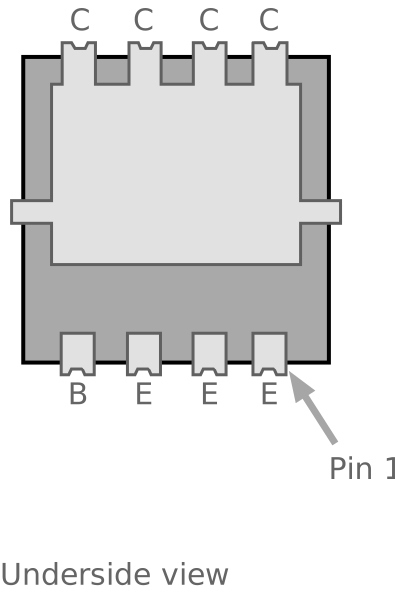
Outline & pinout:
Explanation of transistor parameters
| Parameter | Explanation |
|---|---|
| VCBO Max | Maximum collector-base voltage with emitter open circuit . |
| VCEO Max | Maximum collector-emitter voltage with base open circuit. |
| VEBO Max | Maximum emitter-base voltage with collector open circuit. |
| VCEsat (included where applicable) | The voltage drop across the collector-emitter when the transistor is fully saturated (acting as a closed switch). |
| IC Max | Maximum collector current. |
| Parameter | Explanation |
|---|---|
| TJ | Maximum junction temperature. |
| PTOT Max | Maximum device dissipation normally in free air at 25°C unless other conditions indicated. |
| fT Min | Minimum cutoff frequency at which the current gain in a common emitter circuit falls to unity. |
| COB Max | Maximum collector capacitane, normally measured with emitter open circuit. |
| hFE | DC current gain for HFE at IC. [Note hfe is the small signal gain and although this may be slightly different, the transistor current gain will vary considerably from ne transistor to the next of the same type.] |
| PTOT Max | Maximum device dissipation normally in free air at 25°C unless other conditions indicated. |
These are the main transistor parameters that have been included in our list. There are others, but these help quantify the main elements of the performance of the transistor.
Please note, that the data given is the best estimate we can give within a tabulated summary of this nature. Parameters also vary between manufacturers. Electronics Notes cannot accept any responsibility for errors, inaccuracies, etc, although we do endevaour to ensure the data is as accurate as possible.
Notes and supplementary information
• Availability & sources
The DXTN78060 is available from a number of stockists and electronic component distributors many of which are given in the table below.
DXTN78060 Component Distributor, Stock and Pricing
Why use a BJT rather than a MOSFET
There are several reasons for using a bipolar transistor rather than a power MOSFET.
Choosing between a Bipolar Junction Transistor with ultra-low saturation voltage like the DXTN78060 and a Power MOSFET often comes down to the specific drive requirements, voltage levels, and the nature of the load.
While Power MOSFETs are often the "default" choice for modern switching, ultra-low VCE(sat) BJTs offer several distinct advantages in specific scenarios.
1. Lower Gate/Base Drive Complexity
One of the primary reasons to choose a BJT like the DXTN78060 is the drive voltage.
MOSFETs: Most Power MOSFETs require a Gate-Source voltage (VG) of 4.5V to 10V to fully enhance the channel and achieve low RDS(on). If you are working with a low-voltage microcontroller (e.g., 1.8V or 2.5V logic), you would need a level shifter or a dedicated gate driver.
BJTs: A BJT only requires a base-emitter voltage (VBE) of about 0.7V to begin conducting. While it requires current to stay on, it can be driven directly from very low-voltage rails that would fail to turn on a MOSFET.
2. Performance at Very Low Operating Voltages
In battery-powered devices (like a single 1.2V NiMH cell), there isn't enough voltage to effectively drive the gate of a MOSFET.
A MOSFET's resistance increases exponentially as the gate voltage nears its threshold.
Ultra-low VCE(sat) transistor like the DXTN70030 maintains a very low voltage drop (often less than 100mV) even when the supply voltage is extremely low.
3. Lower Cost for Specific Current/Voltage Ranges
At lower voltage ratings (under 100V) and moderate currents (under 5A), BJTs are often significantly cheaper than MOSFETs with comparable "on-state" losses. To get a MOSFET with an RDS(on) low enough to compete with a 100mV VCE(sat) drop at 3 Amps, you often have to buy a much larger, more expensive silicon die.
4. Bipolar vs. Unipolar Switching (The "Diode" Effect)
MOSFETs have an intrinsic body diode. In certain bridge circuits or battery protection circuits, this diode allows current to flow in the reverse direction even when the MOSFET is "off."
BJTs do not have an intrinsic body diode. This makes them useful in applications requiring reverse blocking or where you need to prevent back-feeding into a power source without adding an extra Schottky diode.
5. Thermal Stability and Safe Operating Area (SOA)
BJTs are generally more robust against certain types of transient overloads. While MOSFETs are prone to "thermal runaway" in linear regions, BJTs can sometimes be easier to manage in slow-switching or linear-mode applications (like a linear LDO pass element), provided you stay within the Safe Operating Area.
• Notable features
The DXTN78060DFGQ-7 is an ultra-low saturation voltage NPN transistor designed for efficient switching in high-current applications.
Ultra-Low Saturation Voltage: VCE(sat) of less than 45 mV at 1 A, enabling minimal power loss in switching operations.
High Current Handling: Supports continuous collector current up to 6 A and pulse current up to 12 A, suitable for medium-power requirements.
Robust Voltage Ratings: Collector-emitter breakdown voltage of 60 V, collector-base of 100 V, and emitter-base of 8 V, providing strong voltage withstand capabilities.
High Current Gain: DC current gain over 300, ensuring efficient amplification and switching.
Wide Operating Temperature: Rated from -55°C to +175°C, ideal for harsh environments.
Compact Surface-Mount Package: PowerDI3333-8 package (3.3 x 3.3 x 0.80 mm) for space-efficient designs with good thermal performance.
• Typical applications summary
| Application Category | Typical Use Case | Device Feature Utilised |
|---|---|---|
| Gate Driving | MOSFET and IGBT gate drivers | Ultra-low saturation voltage and high current gain |
| Switching | Load switches | High current handling and low saturation voltage |
| Power Regulation | Low-voltage regulation | Voltage ratings and efficiency |
| Power Conversion | DC-DC converters | Pulse current capability and thermal performance |
| Actuator Control | Drivers for motors, solenoids, relays, and actuators | Wide temperature range and robust ratings |
 Written by Ian Poole .
Experienced electronics engineer and author.
Return to Component Data menu . . .