Home » Component data » Transistor data » this page
2N3055 Transistor Data
Key transistor data for the 2N3055 power transistor including key electrical parameters, pinout, package type and many other key transistor datasheet details.
The 2N3055 is a rugged power transistor widely used for amplifier and power switching circuits. It was a popular device used in many power audio amplifiers.
Even though the design of the transistor is many years old, it is still very popular, although many modern designs will use more up to date devices.
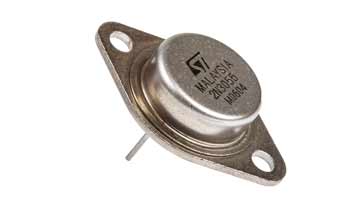
The device comes with complementary device, the MJ2955 enabling class B operation for linear amplifiers.
Both devices are still widely available and manufactured by a variety of manufacturers.
Key details and performance parameters for the 2N3055 transistor.
| Transistor Datasheet Parameters & Data |
|
|---|---|
| Parameters | Datasheet Details |
| Transistor type | NPN silicon power transistor |
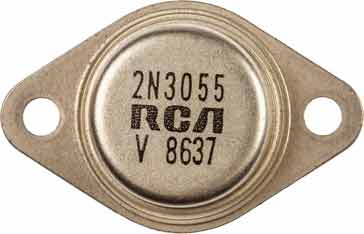
| Package type | TO3 |
| VCBO max (V) | 100 |
| VCEO max (V) | 60 |
| VEBOmax (V) | 7 |
| IC max (A) | 15 |
| TJ Max °C | 200 |
| PTOT W | 115 |
| fT min (MHz) | 2.5 (for current versions) |
| COB | |
| hfe | 20 - 70 |
| IC for hfe | 4 A |
| Similar / equivalents | |
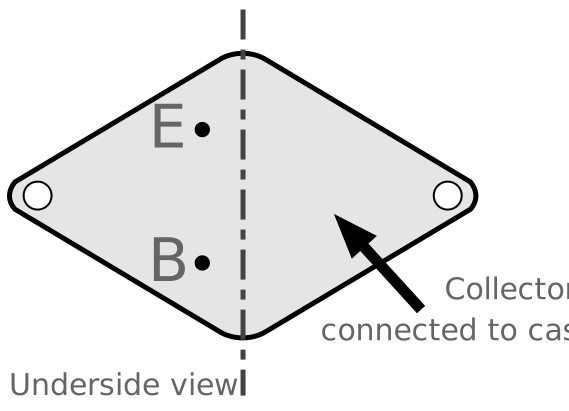
Outline:
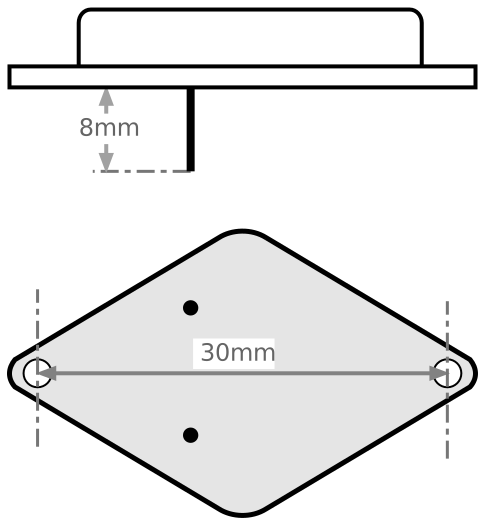
Pinout:
Explanation of transistor parameters
| Parameter | Explanation |
|---|---|
| VCBO Max | Maximum collector-base voltage with emitter open circuit . |
| VCEO Max | Maximum collector-emitter voltage with base open circuit. |
| VEBO Max | Maximum emitter-base voltage with collector open circuit. |
| VCEsat (included where applicable) | The voltage drop across the collector-emitter when the transistor is fully saturated (acting as a closed switch). |
| IC Max | Maximum collector current. |
| Parameter | Explanation |
|---|---|
| TJ | Maximum junction temperature. |
| PTOT Max | Maximum device dissipation normally in free air at 25°C unless other conditions indicated. |
| fT Min | Minimum cutoff frequency at which the current gain in a common emitter circuit falls to unity. |
| COB Max | Maximum collector capacitane, normally measured with emitter open circuit. |
| hFE | DC current gain for HFE at IC. [Note hfe is the small signal gain and although this may be slightly different, the transistor current gain will vary considerably from ne transistor to the next of the same type.] |
| PTOT Max | Maximum device dissipation normally in free air at 25°C unless other conditions indicated. |
These are the main transistor parameters that have been included in our list. There are others, but these help quantify the main elements of the performance of the transistor.
Please note, that the data given is the best estimate we can give within a tabulated summary of this nature. Parameters also vary between manufacturers. Electronics Notes cannot accept any responsibility for errors, inaccuracies, etc, although we do endevaour to ensure the data is as accurate as possible.
Notes and supplementary information
This silicon power transistor was for many years the standard power transistor for power supplies, audio amplifier output stages and for many other circuits. It was a great workhorse.
• Availability & sources
The 2N3055 is available from a number of stockists and electronic component distributors many of which are given in the table below.
2N3055 Component Distributor, Stock and Pricing
The 2N3055 transistor is widely manufactured these days and can be obtained through a variety of distributors.
Not only is it manufactured by some of the mainstream manufacturers, but also a large number of secondary companies as well.
The technology is old, and it is easy to manufacture, and accordingly it is easy for smaller manufacturers to pick the fabrication techniques up.
• Mounting the 2N3055
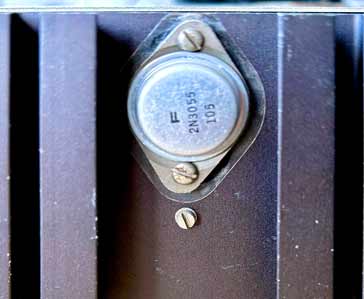
As the collector connection is the case to provide adequate heat-sinking, special insulation kits were available for mounting these power transistors onto a heatsink. A thin mica or similar washer shaped to the outline of the transistor and insulating washers for the screw connections were available.
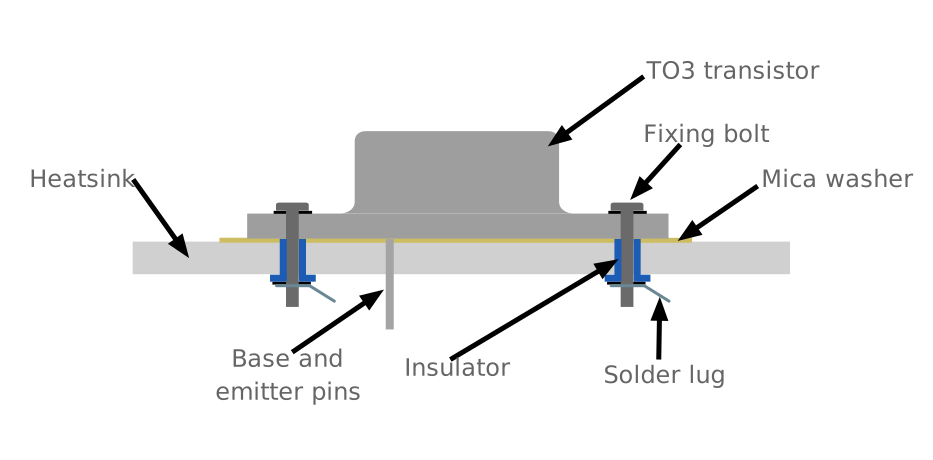
It was also standard practice to place a small amount of silicon grease on either side of the washer to ensure good thermal contact to the heatsink.
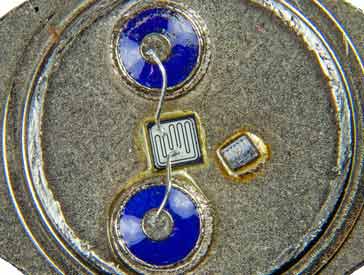
• 2N3055 internal structure
The original version of the 2N3055 used a revolutionary technique for creating a very robust silicon power transistor structure. This was the hometaxial structure.
The hometaxial structure was a proprietary process developed by RCA for the 2N3055. It was a revolutionary departure from the conventional diffused-base transistors of the time.
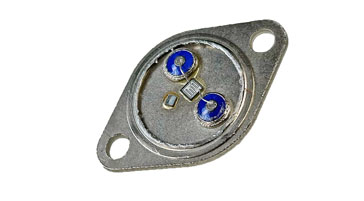
Unlike standard manufacturing where the base and collector junctions were created through separate, delicate diffusion steps, the hometaxial process began with a single, uniform slab of silicon — the "homo" (uniform) "axial" (axis) structure.
In this method, the impurity concentration was kept consistent throughout the entire thickness of the crystal, essentially using the base material as the starting point for the entire device.
This resulted in a rugged, monolithic slab where the collector and base regions were structurally integrated rather than formed as fragile, thin layers on the surface.
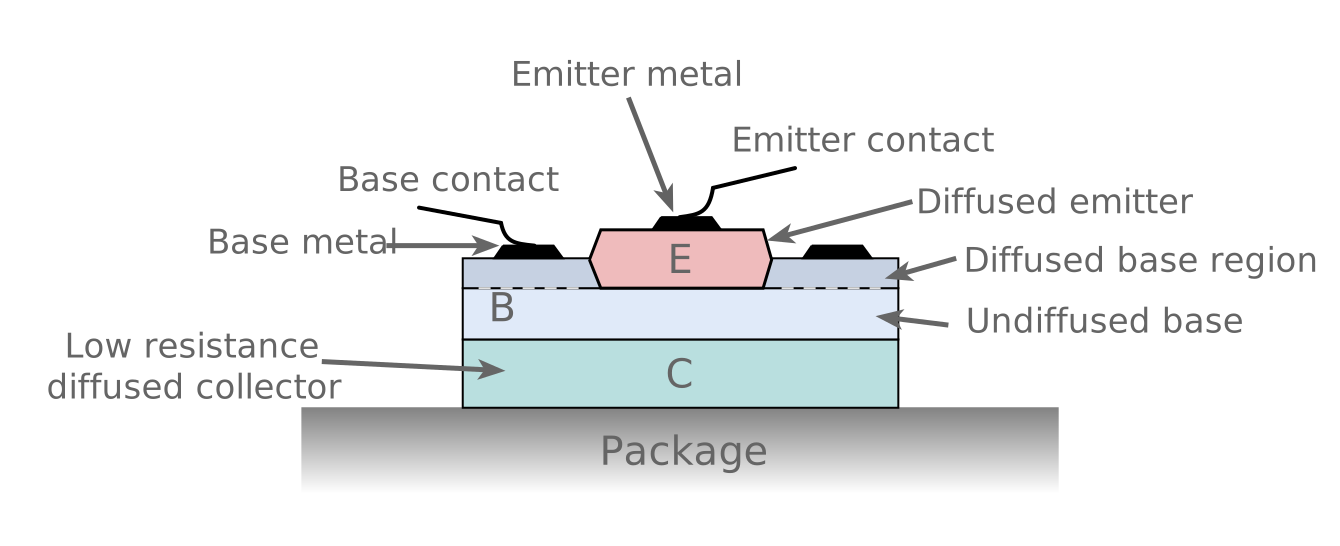
This unique structure was the main reason the 2N3055 was so rugged. It was created by maintaining a uniform impurity profile through the bulk of the silicon. This significantly reduced the occurrence of high-current "hot spots" within the device that typically led to secondary breakdown.
The fact that the internal structure was so robust and that heat could be distributed evenly throughout the entire volume of the transistor silicon die, the transistor was exceptionally resistant to the surge currents and voltage spikes common in linear power supplies and high-power audio stages.
However that structure that enabled the very robust operation also meant that it had traded the high-speed, thin-layer characteristics of signal transistors for a solid, reliable power-handling architecture that set the industry standard for durability for decades.
In short the 2N3055 was a low frequency heavy duty transistor that filled a significant need for the electronics industry.
• 2N3055 story
Developed by RCA, this NPN silicon power transistor was a direct response to the industry's need for a device capable of handling significant currents and voltages without the fragility of earlier power transistors.
At the time of its introduction the main power transistors were germanium and could not handle nearly as much power - compare the 115W of the 2N3055 with 30W for the OC36, both contained in a TO3 package.
Its inception marked a turning point in the shift from germanium-based devices to silicon, providing a much higher degree of thermal stability and operational reliability.
The 2N3055 was designed by Herb Meisel's engineering group within RCA; it was the first silicon power transistor to sell for less than one dollar. As a result of its performance and price, it because an industry standard.
One of the key aspects of the 2N3055 was the implementation of "hometaxial" base construction. In this process, the base material was diffused throughout the entire collector region, creating a uniform junction structure that allowed the device to handle extremely high current densities and significant reverse-bias conditions without entering secondary breakdown which was a common cause of failure in power transistors of that era.
Beyond its innovative construction, the 2N3055 was encased in the iconic TO-3 metal can package. This package was not merely an aesthetic choice; it was essential for the device’s performance. The large metal base and the robust lead configuration allowed for effective heat transfer, enabling the transistor to dissipate up to 115 watts when properly mounted to a heat sink.
As semiconductor technology developed, the hometaxial process became outdated and expensive to produce. As a result, in the mid-1970s an equivalent device was created using an epitaxial base process.
The maximum voltage and current ratings of the new device are the same as the original, but one drawback is that it is not as immune from secondary breakdown; this means that the power handling is limited at high voltage to a lower current than the original.
One advantage of the new device is that the cut-off frequency is higher and this enabled it to be used more successfully in many areas, and in particular in audio amplifiers.
Unfortunately the higher frequency response did result in some designs which had worked successfully with the olde device, were less stable and sometimes burst into oscillation.
The legacy of the 2N3055 is defined by its widespread use over time and even nowadays. By the 1970s and 80s, it had become the standard output device for countless linear power supplies, high-fidelity audio amplifiers, and motor controllers. Because it was so reliable and mass-produced, it became one of the most widely second-sourced components in history, manufactured by dozens of companies worldwide.
The 2N3055 is still popular as a series pass transistor in linear power supplies and is still used in for medium-current and high-power circuits generally, including low frequency power converters.
The device was used in many audio power amplifiers, but the rather low fT meant that especially the original hometaxial version of the transistor, even at 20 kHz there were problems with frequency response and the phase shift that occurs as the frequency response falls.
• Modern versions
As the T03 can is now old technology , many people will want to use either a TO220 or even a surface mount version.
There are two main TO220 versions of the original TO3 2N3055. The advantage of the TO3 package was that it was really good for thermal management and enabled the 2N3055 to dissipate the full 115W.
However there are more modern equivalents:
1. The TO-220 alternatives
There are two TO220 '
TIP3055: This is probably the more widely used TO220 version of the 2N3055. It is is essentially a 2N3055 silicon die housed in a plastic TO-220 package rather than the bulky, all-metal TO-3 package. The trade-off with this device is that the maximum power dissipation is typically a maximum of 90W when mounted on a suitable heatsink.
MJE3055: This version is often associated with ON Semiconductor (formerly Motorola's semiconductor division), although other manufacturers may also be seen. The "MJE" series was designed with slightly more emphasis on tighter manufacturing tolerances and specific performance characteristics in high-frequency or switching environments. Again the maximum heat dissipation is reduced and typically around 90W maximum.
2. The Surface-mount (SMD) versions
While there isn't an exact replica of the original 2N3055 silicon die in a tiny surface-mount package, there are many modern equivalents that share the same electrical characteristics but are packaged in modern SMD formats, although obviously not the small packages!
There are surface-mount power packages designed for these higher currents:
D2PAK (TO-263): This is the surface-mount equivalent of a TO-220. It has a large metal tab that is meant to be soldered directly to a large copper plane on your PCB, which acts as the heat sink.
It is worth noting that if a 2N3055 design is being migrated to an SMD format, it is necessary to look for NPN transistors in D2PAK packages with similar ratings (15A, 60V+). One device is the MJD3055 which is effectively an SMD version of the TIP3055.
• Applications
The 2N3055 was widely used in many electronic circuit designs that needed a power output device. The handling capability of the transistor made it ideal for many different designs.
Typically the device was mounted on a heatsink - the TO3 package that is used, is designed for this type of mounting and this enables the heat dissipated to be removed without the transistor overheating.
Typical applications include:
- Linear bench power supplies
- DC-to-AC inverters (low frequency)
- Heavy-duty motor controllers
- Audio amplifiers
The voltage and power handling capability meant that it was an ideal device as the series pass transistor.
 Written by Ian Poole .
Experienced electronics engineer and author.
Return to Component Data menu . . .