Home » Infographics » this page
American Railroad Morse Code Infographic
The American or Railroad Morse Code was the first type of code used on the Morse telegraph in America, but it had interesting charcters - see the differences on this infographic.
The American Morse code which was also referred to as the Railroad Morse code because if its extensive use on the American railroad system was the code first used with the More telegraph system.
The American Morse code was developed fundamentally by Alfred Vail, one of Morse's associates. He famously went to a local printer to see which letters were most widely used and as a result made these faster and easier to send.
The Railway Morse code had very different characters to those in the International Morse code which is the most common today.
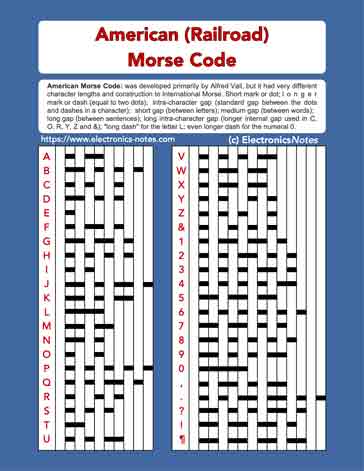
The lengths and construction are also different. Short mark or dot; longer mark or dash (equal to two dots); intra-character gap (standard gap between the dots and dashes in a character); short gap (between letters); medium gap (between words); long gap (between sentences); long intra-character gap (longer internal gap used in C, O, R, Y, Z and &); "long dash" for the letter L; even longer dash for the numeral 0.
The various lengths and characters made it more difficult to read and send. As a result, when there was the possibility of the Morse telegraph being used in Europe, a significantly modified code wasdeveloped, that ultimately became the International Morse code.
Nevertheless the American, Railroad, Morse code is of significant interest and as a result the infographic is very interesting to use.
The American Morse code characters are all summarised in the infographic below.
Buy Your Own Hi-Res Copy
Check out the hi-res version of this infographic on my online shop where you can buy a high-res download:
American (Railroad) Morse Code Infographic
Buy it now!
 Written by Ian Poole .
Experienced electronics engineer and author.