The Evolution of Morse Code: From Numeric Ciphers to a Global Digital Standard
Explore the evolution of Morse code from its 1835 numeric prototype to the International Morse Code: discover how dots and dashes became the world's first digital language.
Morse Telegraph History Includes:
Morse telegraph history
Morse code development history
Morse keys development
Vibroplex & mechanical bug keys
Telegraph sounder
Morse inker
Samuel Morse
Fascinating facts
Morse code SOS message
Morse keys:
Clipsal key
Camelback
Walters Electrical Patt 1056A Post Office key
Steel lever Morse telegraph key
RAF Bathtub Morse key
Samson ETM-5C electronic keyer
The evolution of Morse code is a journey from a clunky, mechanical system of digit-based "typesetting" to a fluid, universal language that remains the most enduring digital mode of communication in history.
While the hardware of the telegraph provided the physical medium, the code itself underwent a rigorous series of linguistic and technical refinements to become the streamlined International Morse Code used to this day.
The Numeral Foundation and the Portrule Era
In its earliest incarnation, the code (if it can be referred to as a Morse code) conceived by Samuel Morse was not an alphabet, but a numeric cipher.
Morse’s initial vision was to create a system where every word in the English language was assigned a specific number in a master dictionary.
The telegraph would transmit the numbers, and the recipient would look up the corresponding words. To achieve this, the first device built in 1835 utilized a "portrule," a metal bar device that functioned somewhat like a barrel organ.
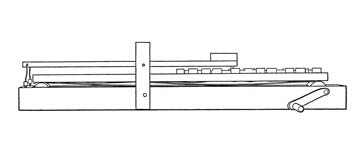
The portrule was an ungainly mechanical interface where metal teeth were loaded like movable type. These teeth represented digits; for example, a single tooth represented the digit "1," while the digit "6" was represented by a single tooth followed by an empty space.
When these teeth passed a contact point, the circuit opened and broke, causing an electromagnet at the receiving end to move a pencil against a paper tape.
This resulted in a wavy line that corresponded to the numeric teeth. This era of the code was characterized by mechanical rigidity, as the "sender" was limited by how quickly they could physically arrange the metal teeth in the portrule.
The Vail Revolution and Letter Frequency
The transition from a slow, digit-based dictionary to a rapid, character-based alphabet was driven by Alfred Vail.
Vail realised that the dictionary system was far too cumbersome for real-time communication. He proposed that each letter of the alphabet should have its own unique sequence of dots and dashes.
To make the system as efficient as possible, Vail famously visited a local newspaper office to count the number of typeset letters in their lead bins.
By analyzing the frequency of letters in the English language, Vail assigned the shortest and simplest codes to the most common letters. This is why the letter "E" is represented by a single dot and "T" by a single dash. This statistical optimization was the first example of data compression in telecommunications, ensuring that a standard message would require the fewest possible "bits" of information. This version of the code, often called the American Morse Code or the Railroad Code, became the standard for the expanding American telegraph network through the mid-19th century.
The American System and the Problem of Internal Spacing
While Vail’s code was a massive improvement, it contained a structural quirk that would eventually lead to its replacement on the international stage.
In the American Morse system, some letters utilised "internal spaces" — tiny pauses within the character itself that were longer than a gap between dots but shorter than a gap between letters.
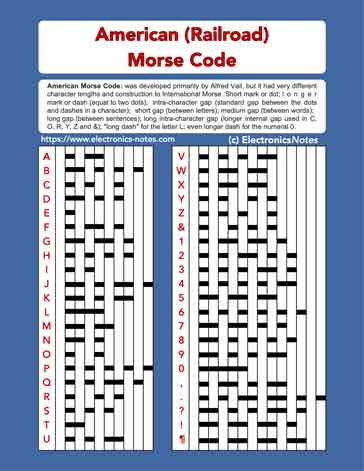
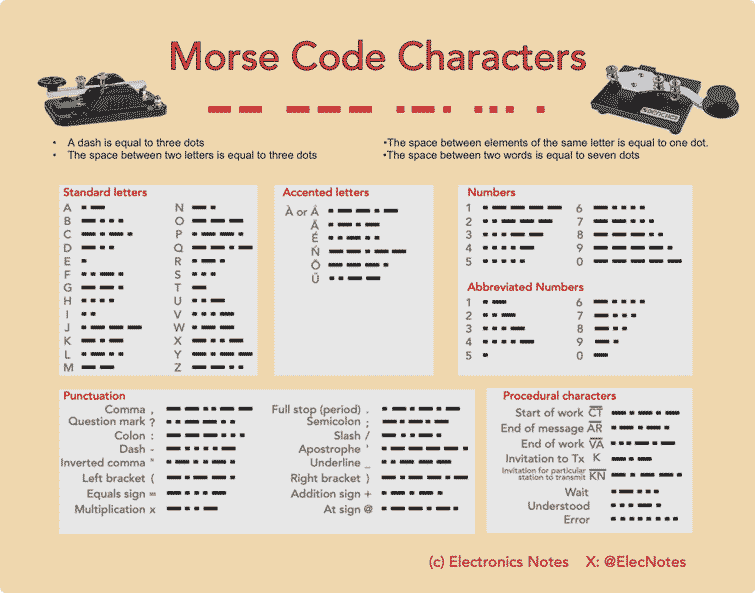
Click on the image for a better version
For example, the letter "C" was sent as dot-dot (space) dot. This was not easy to decipher and differentiate from i e which is two dots and one dot.
While experienced American operators could hear the rhythm of these spaced letters clearly, the system proved problematic when transmitted over long distances or through undersea cables.
The electrical characteristics of long cables tended to "smear" the signals together, making it nearly impossible to distinguish between an internal space and a space between separate letters.
Furthermore, as the telegraph spread to Europe, linguists realised that Vail’s English-centric code lacked necessary characters for accented letters common in other languages.
The Friedrich Gerke Revision and the Continental Standard
In 1848, a German musician and telegrapher named Friedrich Clemens Gerke was tasked with adapting the telegraph for the Hamburg-Cuxhaven line.
Gerke recognized that the "spaced letters" of American Morse were a liability for accuracy. He undertook a significant overhaul of the code, removing all internal spaces within letters and standardizing the dash to always be exactly three times the length of a dot.
Gerke’s revision also addressed the need for a more logical progression of symbols. He simplified several letters and added codes for German umlauts. His work formed the basis of what became known as "Continental Morse" or "Gerke's Code."
One of his most enduring changes was the reassignment of the letter "O," which in American Morse was a spaced dot-dot, to the now-familiar dash-dash-dash. This European version of the code was much more "rugged" and less prone to error over poor-quality lines, making it the preferred choice for the growing networks of the Old World.
The 1865 Paris Convention and the Birth of International Morse
As telegraph lines began to cross national borders with increasing frequency, the existence of multiple, competing codes became a significant barrier to commerce. An operator in France might use one set of symbols, while an operator in Prussia used another.
To resolve this, the International Telegraph Union, ITU, was formed, and at a conference in Paris in 1865, a unified version of the code was officially adopted.
This 1865 standard, heavily based on Gerke’s Continental Morse, became the "International Morse Code" that we recognize today. It successfully merged the efficiency of Vail’s frequency-based assignments with the technical reliability of Gerke’s space-free characters.
The convention also established strict "unit" timing rules that remain the gold standard for Morse proficiency. In this system, the length of a dot is the basic unit of time. A dash is exactly three units. The space between elements of the same letter is one unit, the space between letters is three units, and the space between words is seven units. This mathematical precision allowed for the eventual development of automated high-speed "creed" printers and paper-tape readers.
Linguistic Bridges: Non-Latin Adaptations
As the telegraph reached counties and continents like Asia, the Middle East, and Russia, the Latin-based International Morse Code had to be adapted for entirely different writing systems.
In Russia, Cyrillic Morse was developed by mapping Cyrillic characters to Latin symbols that shared similar sounds (e.g., the Cyrillic 'Ш' sounds like 'SH' and was assigned the Morse code for 'CH' or other extensions).
In Japan, the challenge was more significant. Rather than using the Latin alphabet, Japanese telegraphers developed "Wabun Code." This system represents the Japanese kana (phonetic syllables) using unique Morse sequences.
Because there are more kana than Latin letters, Wabun uses longer and more complex combinations of dots and dashes. Interestingly, many Japanese radio operators are proficient in both International Morse for overseas communication and Wabun for domestic use.
Chinese telegraphy presented perhaps the most unique solution. Because the Chinese language uses thousands of distinct characters, it was impossible to assign a Morse code to each one. Instead, the Chinese Telegraph Code utilized a numeric system reminiscent of Morse’s original 1835 idea.
A master dictionary assigned a four-digit number to every Chinese character. The operator would transmit these digits in standard International Morse, and the recipient would use a codebook to translate the numbers back into Chinese script.
Grammar of the Airwaves: Procedural Signs and SOS
As Morse code moved from landlines to wireless radio, a new set of "shorthand" symbols emerged to help operators manage communication under noisy conditions.
These are known as procedural signs, or "prosigns." One of the most famous is "SOS." Contrary to popular belief, SOS does not stand for "Save Our Souls" or "Save Our Ship." It was chosen by the 1906 International Radio Telegraphic Convention because it is a unique, rhythmic "prosign" consisting of three dots, three dashes, and three dots sent as a single, continuous string (...−−−...). Its distinct cadence made it easy to recognize even through heavy static or interference.
Other common prosigns include "AR" (dot-dash-dot-dash-dot) to signify the end of a message, and "K" (dash-dot-dash), which serves as an invitation for the other station to transmit. These prosigns function as the "traffic lights" of the airwaves, allowing operators who speak different native languages to coordinate their transmissions with perfect clarity.
Buy Your Own Morse Code Mouse Mat & Coffee Mug:
Express your interest in Morse code with these unique products: a fantastic Morse Code Mouse Mat, and a Morse Code Coffee Mug.
Buy your Mouse Mat now Morse Code Mouse Mat
Buy your Coffee Mug now Morse Code Coffee Mug.
Modern Continuity and the 2004 Update
The final significant update to the International Morse Code occurred in 2004, marking the first addition to the character set in several decades.
Recognizing the ubiquity of the internet and electronic mail, the International Telecommunication Union officially added the '@' symbol (the 'at' sign) to the Morse alphabet.
The code for '@' is a combination of 'A' and 'C' (dot−dash−dash−dot−dash−dot), sent without a pause between the letters. This addition ensured that Morse code could remain a functional tool for transmitting modern email addresses.
While Morse code is no longer a requirement for maritime safety as of 1999, it continues to thrive in the 21st century. It is widely used by the amateur radio community, where its ability to penetrate through noise and long-distance atmospheric conditions far exceeds that of voice or even some digital modes. Because Morse code is decoded by the human brain rather than a computer, it remains the ultimate "low-tech" backup for global communication — a testament to the enduring power of the dot and the dash.
Summary of differences between different Morse codes
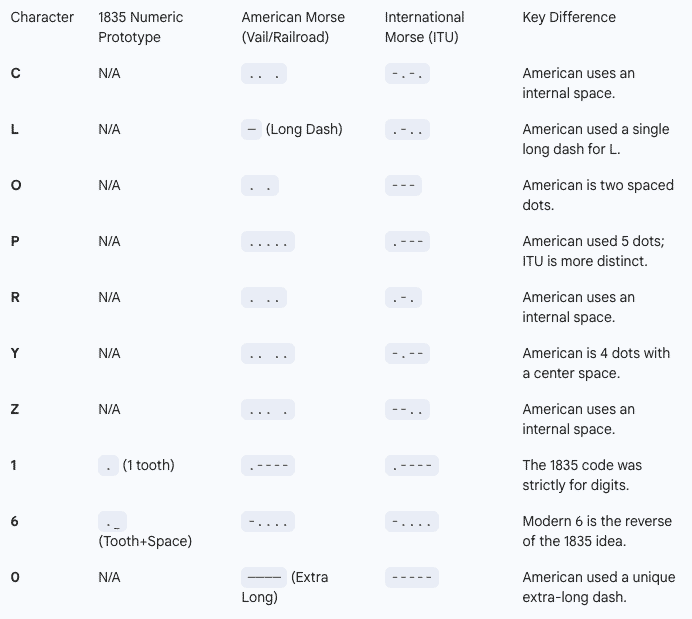
Highlight Dates in the Development of Morse Code
1832: Samuel Morse conceives a numeric dictionary-based code.
1835: The first telegraph prototype uses a "portrule" to transmit numeric digits.
1838: Alfred Vail replaces digits with a character-based code optimized by letter frequency.
1844: "What hath God wrought" is sent, cementing the American Morse Code system.
1848: Friedrich Gerke revises the code in Germany, removing "internal spaces" and creating the Continental Code.
1865: The International Telegraph Union (ITU) standardizes International Morse Code in Paris.
1872: The code reaches Australia via the Overland Telegraph, facilitating the growth of towns like Alice Springs.
1906: SOS is adopted as the international distress signal due to its distinct Morse rhythm.
1912: The Titanic disaster reinforces the need for standardised Morse procedures and 24-hour watches.
1999: International maritime law officially replaces Morse code with satellite-based GMDSS systems.
2004: The ITU adds the "@" symbol to International Morse Code, the first character update in over 60 years.
 Written by Ian Poole .
Experienced electronics engineer and author.
More History:
Radio history timeline
History of the radio
Ham radio history
Coherer
Crystal radio
Magnetic detector
Spark transmitter
Morse telegraph
Valve / tube history
PN junction diode invention
Transistor
Integrated circuit
Quartz crystals
Classic radios
Mobile telecoms history
Vintage mobile phones
Return to History menu . . .