TIDRADIO TD-H3 Dual Band Handheld Transceiver Review
If you want an up to date budget friendly V/UHF amateur radio handheld with better with better performance than the well establish Baofeng UV-5R, then look no further than the TIDRADIO TD-H3 and check out my review.
Home » Shop main page » this page
Check out more amateur radio gear:
Ham radio HF gear
Ham radio VHF / UHF gear
Ham radio Morse keys & ancilliaries
HF ham radio antennas, tuners, meters, etc
VHF / UHF ham radio antennas
Discone and wideband antennas
Ham radio equipment reviews
Please note: There are links to products in this review and ElectronicsNotes makes a small commission at no cost to you on any sales that are made from links on this article.
For many years the Baofeng UV-5R has been the go-to really budget friendly V/UHF handheld radio, but it is now showing its age and the RF performance leaves something to be desired.
Now, the TIDRADIO TD-H3 has rapidly become one of the most talked-about handheld transceivers in the amateur radio community.
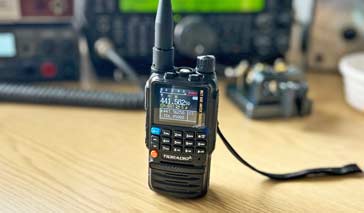
If the Baofeng UV-5R was the radio that brought the masses into the hobby, and the Quansheng UV-K series was the radio that invited the hackers, the TD-H3 is arguably the radio that finally brought modern, professional-feeling utility to the "budget" price point.
In this review, I’ll explore why the TD-H3 is currently the choice for many hams, I'll look at how it stacks up against the old guard, and where it truly shines in real-world field use.
First Impressions: Design and Build Quality
When the TD-H3 comes out of the box, the immediate impression is one of solidity. It is significantly more compact than the classic Baofeng UV-5R, yet it feels more substantial in the hand.

TIDRADIO TD H3 Dual Band Handheld
With an impressive specification including dual band operation, Bluetooth channel programming, CTCSS / DCS, USB-C charging, and much more, this is becoming the go-to low cost handheld amateur radio VHF/UHF dual bander.
When the box was opened there was the transceiver itself, the antenna, clip for belt mounting, a base charger, and a USB-A to USB-C lead for charging. And of course there was an instruction manual which wasn't bad in terms of how many instruction manuals go these days.
There are several factors that are particularly noticeable.
TIDRADIO H3 is clearly aimed for real portability and convenience: it is small enough to disappear into a shirt pocket, making it an excellent choice for carrying anywhere and everywhere or for SOTA/POTA hiking. The H3 uses a textured polymer that provides a confident grip even in damp conditions. It has a really nice sturdy feel to it.
The display is a 1.44-inch color TFT display which is a major improvement over its main rivals:
The Baofeng: Uses a dated, segmented LCD that is often hard to read in direct sunlight.
The Quansheng: Uses a monochrome dot-matrix display (though highly customizable via firmware).
The TD-H3: Features a vibrant, high-contrast screen with three selectable color themes. It provides a level of clarity—especially for signal strength and menu navigation—that simply hasn't been seen at this $30–$40 price bracket before.
But like many modern smartphones, the display goes blank after a few seconds to conserve battery charge.
Then there's the ease of programming. Historically, programming a budget Chinese radio involved a specialized "K-plug" cable, a specific Prolific or CH340 driver, and a lot of patience with COM ports. The TD-H3 solves this in two revolutionary ways:
Built-in Bluetooth: The TD-H3 features native Bluetooth integration. By using the Odmaster app on your smartphone, you can program the radio in the field without ever touching a computer. You can download repeater lists based on your current GPS location, edit channel names, and sync them to the radio in seconds. This puts it leagues ahead of the Baofeng UV-5R, which requires a separate Bluetooth dongle for similar functionality.
Native USB-C Programming: Even more impressive is the **direct USB-C port** on the side of the radio. Unlike many other radios where the USB-C port is "charge only," the H3 features a built-in serial chip. This means you can use a standard USB-C to USB-A data cable (the same one you use for your phone) to program the radio via CHIRP or the factory CPS software. No more hunting for specialized programming cables.
The ODmaster app is OK. It takes a little bit of getting used to, but there are plenty of videos around to help.
Spending a little time it is possible to get all the simplex channels and repeaters loaded up. It is also easy to prepare and upload new files of channels, so if you regularly visit another area, you could have a different set up channels prepared to load for this.
I found it useful to prepare which channels I wanted for what before actually programming. One very useful feature is that the app brngs up local repeaters with all their details: frequencies, name, CTCSS tones, etc. so these can be easily programmed in.
Video: Unboxing TIDRADIO TD-H3 & First View
Receiver performance and filtering
A common complaint with budget handhelds is "de-sensing" - in other words, the radio going "deaf" when close by strong out-of-band signals (like those from cell towers or broadcast stations) are present.
The Baofeng UV-5R: Famous for its "wide open" front end, it often struggles in urban environments.
The Quansheng UV-K8: While better, it is still prone to interference and harmonics.
The TD-H3: Testing indicates a noticeably superior receiver front end. While the TD-H3 isn't a really high end radio like an Icom, Kenwood or Yaesu, it handles local interference significantly better than its predecessors.
In terms of the receiver coverage the TD-H3 is marketed as an 8-band radio, including **AM Airband (108-136 MHz).
The H3 provides clear AM audio for aircraft monitoring, especially after recent firmware updates (look for version 240606 or later). It also covers 350-400 MHz and 470-600 MHz for reception, making it a capable little scanner for local public safety or utility monitoring. The concensus is that the airband reception is superior to that of the Quansheng.
Video: TIDRADIO TD-H3 - better than a Baofeng?
Transmitter purity
Budget radios are often disliked for the high level of spurious emissions: harmonics and general unwanted spurious outputs that apear other channels causing interference.
On the 2-metre band, the TD-H3 has shown improved spectral purity in recent batches compared to the very first release units. While some units may still show secondary harmonics that are borderline for strict FCC Part 97 compliance, they are generally "cleaner" than the average unbranded Baofeng clone. However, if you are a "purity purist," you should always check your specific unit on a spectrum analyzer if possible.
Battery life and power management
The TD-H3 comes with a 2500 mAh battery, which is a significant jump from the 1800 mAh labels usually found on Baofengs.
Real-World Use: In a 90/5/5 duty cycle (standby/receive/transmit), the H3 easily lasts two full days of casual use.
Charging Versatility: You can charge via the included desktop cradle or the side USB-C port. The ability to "top off" the radio using a power bank or a car charger while in the field is a massive quality-of-life improvement for hikers and emergency responders.
Advanced Features: Modes and Customisation
One of the "hidden" aspects of the TD-H3 is its flexibility in operating modes. By holding the PTT and the '*' key during power-on, users can switch between the following modes:
1. HAM Mode: Standard amateur bands.
2. GMRS Mode: Channelized for GMRS use (if you have the GMRS-certified version).
3. Normal/Unlocked Mode: For wide-band transmission (use with caution and only where legal).
The "H3 Plus" Upgrades
TIDRADIO recently released the H3 Plus, which adds some new features:
Anti-Mistouch Design: A physical switch to prevent accidental key presses.
Global Intercom: Integration with the Odmaster app to act as a "network radio" link.
Bluetooth Headset Support: The ability to pair directly with wireless earbuds or a Bluetooth PTT finger button.
Comparison: TD-H3 vs. The Rivals
The TIDRADIO has some impressive features, especially for the proice, but how does it compare with the competition: radios that have become well established in the amateur radio market?
| Summary Table of TIDRADIO TD-H3 Main Competition |
|||
|---|---|---|---|
| Feature | TIDRADIO TD-H3 | Baofeng UV-5R | Quansheng UV-K8 |
| Approximate price (USD) | $30 - $35 | $20 - $25 | $25 - $30 |
| Programming | Bluetooth & USB-C | K-Plug Cable Only | K-Plug Cable Only |
| Display | Full Colour TFT | Segmented B&W | Dot Matrix B&W |
| Supplied Battery | 2500 mAh | 1800 mAh | 1600 mAh |
| Airband | Excellent (AM) | No (FM only on some) | Good (AM) |
| Hackability | Moderate | Low | High (Open Firmware) |
So what is the overall summary and what are the strong points of the competing radios?
Baofeng UV-5R: remains the "disposable" choice. If you lose it in the mud, you won't cry. But it lacks the features and receiver quality of the H3.
The Quansheng UV-K8: is the "experimenter’s" radio. If you enjoy flashing custom firmware like *Egzumer* to add a spectrum analyzer to your handheld, the Quansheng is unbeatable. But as a "daily driver" radio out of the box, it isn't as polished as the TIDRADIO.
Final Verdict: Is it Worth It?
The TIDRADIO TD-H3 represents the pinnacle of what a current budget handheld be. It has successfully addressed the three biggest pain points of low-cost radios: terrible programming experiences, poor displays, and weak battery life.
Pros:
Bluetooth Programming: Genuinely useful for field updates.
USB-C Data/Charge: Eliminates the need for specialized "ham radio only" cables.
Compact & Rugged: Feels significantly more "professional" than a Baofeng.
Excellent Audio: Loud, clear, and punchy internal speaker.
Cons:
Slow Scan Speed: If you want to scan 200 channels, this radio is agonizingly slow compared to a dedicated scanner.
Small Buttons: Users with large hands or those wearing gloves might find the keypad a bit cramped.
So, if you are looking for your first amateur radio, or if you are a veteran looking for a reliable "glovebox" or "hiking" radio that doesn't feel like a toy, the TIDRADIO TD-H3 is arguably the best value on the market today.
It nicely bridges the gap between the ultra-cheap radios and the $150+ Japanese heritage brands, offering a feature set that makes it a joy to use rather than a chore to program.
TIDRADIO TD H3 Dual Band Handheld
With an impressive specification including dual band operation, Bluetooth channel programming, CTCSS / DCS, USB-C charging, and much more, this is becoming the go-to low cost handheld amateur radio VHF/UHF dual bander.
Not convenient to use the above links . . . Use My Amazon.com Store!
For tax and other reasons it may not be convenient to use the links provided to my selected partners. If this is the case then try my Storefront on Amazon.com
Please note: ElectronicsNotes makes a small commission on any sales that are made from links on this article.
 Written by Ian Poole .
Experienced electronics engineer and author.
Check out more sections of our store:
Ham radio HF gear
Ham radio VHF / UHF gear
Ham radio Morse keys & ancilliaries
HF antennas, tuners, meters, etc
VHF / UHF ham radio antennas
Signal generators
Multimeters
Oscilloscopes
Frequency meters & counters
Logic analyzers
Audio amplifier kits
Ebooks (PDF)
Coffee mugs
Downloadable infographics
Reviews: Ham radio eqpt reviews
Return to the Shop Front . . . .