Home » Component data » MOSFET data » this page
PMV240ENEA 30V N-channel Trench MOSFET Data
Data for the PMV240ENEA MOSFET including electrical parameters, maximum current and voltage, pin connections, package type and many other datasheet details.
The Nexperia PMV240ENEA is an N-channel enhancement mode FET which is packaged in an SOT23 SMD plastic package and the device is fabricated using Trench MOSFET technology.
The differentiator for this device is that it has an extended temperature range to 175°C for the semiconductor junction.
Key details and performance parameters for the PMV240ENEA MOSFET.
| PMV240ENEA MOSFET datasheet parameters & data |
|
|---|---|
| Parameters | Details |
| Brief description | 30V N channel Trench MOSFET with extended temperature |
| Package type | SOT23 |
| Operational mode | Enhancement |
| Channel type | N-channel |
| Drain to Source voltage VDSS | 30V |
| Gate to source voltage VGS | -20V to +20V |
| Maximum drain current continuous ID | 0.85A with VGS = 10V at 25°C |
| Zero gate voltage drain current IDSS | |
| Gate threshold voltage VGS(th) | |
| Static drain source ON resistance RDS(ON) | 240mΩ typ, 320mΩ max for VGS = 10V, ID = 0.85A at 25°C |
| Forward transconductance gFS | 1.2S typ |
| Input capacitance | 28.3pF |
| Output capacitance | 8.2pF |
| Transfer reverse capacitance | 5.6pF |
| TJ °C | 175 |
| PTOT mW | 320mW |
| Primary manufacturer | Nexperia |
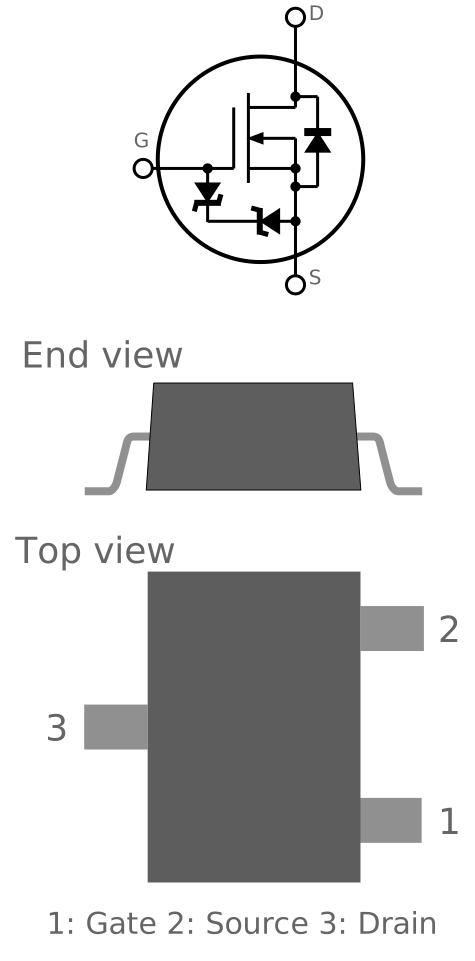
Outlines & pinout:
Explanation of MOSFET parameters
| Parameter | Explanation |
|---|---|
| Operational mode | This details whether the FET is an enhancement or depletion mode |
| Channel type | The channel of the MOSFET can either be an N-type channel where electrons are the majority carriers or P-type where holes are the majority current carrier. |
| Drain to Source voltage VDSS | This is the maximum voltage that can be sustained between the drain and source |
| Gate to source voltage VGSS | This is the maximum voltage that can be sustained between the drain and the gate. |
| Maximum drain current continuous ID | This is the maximum current that can be carried byt he device. Sometimes there may be a differentiation between the continuous and pulsed or peak values |
| Parameter | Explanation |
|---|---|
| Zero gate voltage drain current IDSS | This is the current carried by the device when the gate voltage is zero. The test conditions are normally stated for this. |
| Gate threshold voltage VGS(th) | This is the minimum gate-to-source voltage, VGS required to create a conductive channel between the source and drain terminals |
| Static drain source ON resistance RDS(ON) | This is the resistance of the device when turned on. The test conditions of voltage and current are normally given for this. |
| Drain source ON voltage VDS(ON) | This is the voltage across the device when it is turned on. Again the test conditions are given. |
| Forward transconductance gFS | Forward transconductance also given the letters gm is defined as the change in drain current (ΔID) for a small change in the gate-source voltage ΔVGS, with the drain-source voltage, VDS held constant. |
These are the main MOSFET parameters that have been included in our list. There are others, but these are the main ones and they help quantify the main elements of the performance.
Please note, that the data given is the best estimate we can give within a tabulated summary of this nature. Parameters also vary between manufacturers. Electronics Notes cannot accept any responsibility for errors, inaccuracies, etc, although we do endevaour to ensure the data is as accurate as possible.
Notes and supplementary information
• Availability & sources
The PMV240ENEA is available from a number of stockists and electronic component distributors many of which are given in the table below.
PMV240ENEA Component Distributor, Stock and Pricing
• Notable features
The PMV240ENEA is a 30 V, N-channel enhancement mode Trench MOSFET in a compact SOT23 surface-mount package, ideal for high-reliability low-side switching applications. [](grok_render_citation_card_json={"cardIds":["8ecfd1","557525"]})
Low Threshold Voltage : 1.3 V minimum (typ. 1.8 V), enabling logic-level drive from 3.3 V or 5 V systems without additional level shifting.
Ultra-Low Rds(on) : 240 mΩ typical at Vgs=10 V, minimizing power losses in switching applications.
Extended Temperature Range : Junction temperature up to 175 °C, suitable for harsh automotive and industrial environments.
Trench MOSFET Technology : Delivers superior on-state performance and fast switching with low gate charge (0.61 nC typical).
Robust ESD Protection : 500 V HBM rating, enhancing reliability during handling and assembly.
AEC-Q101 Qualified : Fully automotive-grade, ensuring high reliability in vehicle electronics.
High Current Handling : 0.85 A continuous drain current (Tamb=25 °C), with 6.8 A peak capability.
Compact SOT23 Package : Space-saving design with built-in strain relief for automated SMT assembly.
• Typical applications summary
| Application Category | Typical Use Case | Device Feature Utilised |
|---|---|---|
| Relay Drivers | Driving automotive relays and solenoids in ECUs. | Low Rds(on) and high peak current (6.8 A) for efficient coil energization. |
| Low-Side Load Switches | Battery-powered load switching in portable devices and automotive modules. | Low Vth and AEC-Q101 qualification for reliable logic-level control. |
| High-Speed Line Drivers | Signal driving in CAN/LIN bus interfaces and sensor circuits. | Fast switching (tr=2 ns typ) and low gate charge for minimal distortion. |
| Automotive Switching | LED drivers and motor controls in vehicle lighting/ infotainment. | 175 °C Tj range and ESD protection for harsh environments. |
| General Switching Circuits | Battery management and power distribution in IoT/ consumer electronics. | Compact SOT23 package and 320 mΩ max Rds(on)@4.5 V. |
 Written by Ian Poole .
Experienced electronics engineer and author.
Return to Component Data menu . . .