Home » Component data » Transistor data » this page
2N5400 Transistor Data
Key transistor data for the 2N5400 transistor including key electrical parameters, pinout, package type and many other key transistor datasheet details.
Key details and performance parameters for the 2N5400 transistor.
| 2N5400 transistor datasheet parameters & data |
|
|---|---|
| Parameters | Details |
| Transistor type | PNP high voltage transistor |
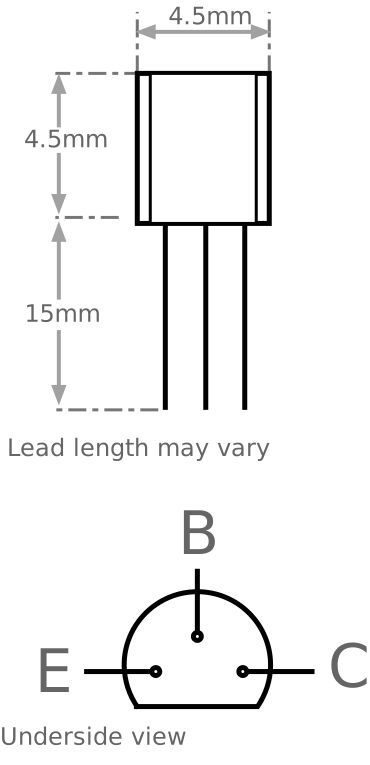
| Package type | TO92 |
| VCBO max (V) | -130V |
| VCEO max (V) | -120V |
| VEBOmax (V) | -5V |
| VCEsat (V) | 0.2V max for IC = -10mA and IB =-1mA, and 0.5V for IC = -50mA and IB = -5mA |
| IC max (mA) | -600mA |
| TJ Max °C | -55 - +150°C |
| PTOT mW | 625mW |
| Gain bandwidth product fT min (MHz) | 100 min, 400 max |
| Collector base capacitance CCBO | 6pF |
| hfe | 30 min, 200 max at IC = -1mA &; VCE = -5V |
| Similar / equivalents | |
Outline & pinout:
Explanation of transistor parameters
| Parameter | Explanation |
|---|---|
| VCBO Max | Maximum collector-base voltage with emitter open circuit . |
| VCEO Max | Maximum collector-emitter voltage with base open circuit. |
| VEBO Max | Maximum emitter-base voltage with collector open circuit. |
| VCEsat (included where applicable) | The voltage drop across the collector-emitter when the transistor is fully saturated (acting as a closed switch). |
| IC Max | Maximum collector current. |
| Parameter | Explanation |
|---|---|
| TJ | Maximum junction temperature. |
| PTOT Max | Maximum device dissipation normally in free air at 25°C unless other conditions indicated. |
| fT Min | Minimum cutoff frequency at which the current gain in a common emitter circuit falls to unity. |
| COB Max | Maximum collector capacitane, normally measured with emitter open circuit. |
| hFE | DC current gain for HFE at IC. [Note hfe is the small signal gain and although this may be slightly different, the transistor current gain will vary considerably from ne transistor to the next of the same type.] |
| PTOT Max | Maximum device dissipation normally in free air at 25°C unless other conditions indicated. |
These are the main transistor parameters that have been included in our list. There are others, but these help quantify the main elements of the performance of the transistor.
Please note, that the data given is the best estimate we can give within a tabulated summary of this nature. Parameters also vary between manufacturers. Electronics Notes cannot accept any responsibility for errors, inaccuracies, etc, although we do endevaour to ensure the data is as accurate as possible.
Notes and supplementary information
• Availability & sources
The 2N5400 is available from a number of stockists and electronic component distributors many of which are given in the table below.
2N5400 Component Distributor, Stock and Pricing
• 2N5400 vs 2N5401
The primary difference between the 2N5400 and 2N5401 is their voltage handling capability. The 2N5401 is the "higher spec" version, capable of withstanding higher voltages than the 2N5400.
Because the 2N5401 generally meets or exceeds the specifications of the 2N5400, it can almost always be used as a drop-in replacement. However, you cannot always use a 2N5400 to replace a 2N5401.
Quick Summary:
2N5400: Rated for 120V. Good for standard high-voltage switching.
2N5401: Rated for 150V. Better for higher voltage applications and generally has higher gain.
Detailed specification comparison:
Both are PNP, high-voltage general purpose amplifier transistors typically found in a TO-92 plastic package.
| Feature | 2N5400 | 2N5401 | Advantage |
|---|---|---|---|
| Collector-Emitter Voltage VCEO | 120V | 150V | 2N5401 (Higher is better) |
| Collector-Base Voltage VCBO | 130V | 160V | As above |
| Collector Current IC | 600mA | 600mA | Same |
| DC Current Gain hFE | 30 - 180 | 50 - 240 | 2N5401 is generally higher |
| Power Dissipation | 625mW | 625mW | Same |
 Written by Ian Poole .
Experienced electronics engineer and author.
Return to Component Data menu . . .