Home » Component data » Transistor data » this page
2N706 Transistor Data
Key transistor data for the 2N706 switching transistor including key electrical parameters, pinout, package type and many other key transistor details.
The 2N706 transistor stands as a landmark in semiconductor history, serving as one of the first commercially successful silicon devices to utilise what was in their day, the revolutionary planar manufacturing process.
By delivering very high switching speeds and reliability in a compact package, this component became the essential workhorse that powered the logic circuits of 1960s-era mainframe computing.
Although it has been superseded by other transistors, it still remains a landmark device in the development of silicon bipolar transistor technology.
Key details and performance parameters for the 2N706 transistor.
| Transistor parameters & data |
|
|---|---|
| Parameters | Details |
| Transistor type | NPN silicon |
| Package type | T018 |
| VCBO max (V) | 25 |
| VCEO max (V) | 20 |
| VEBOmax (V) | 3 |
| IC max (mA) | 200 |
| TJ Max °C | 150 |
| PTOT mW | 300 |
| fT min (MHz) | 200 |
| COB | 6 |
| hfe | 20 (min) |
| IC for hfe | 10 |
| Similar / equivalents | 2N2369 |
Outline:
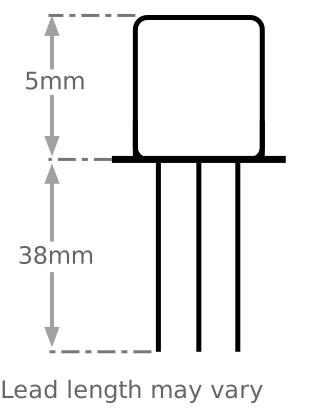
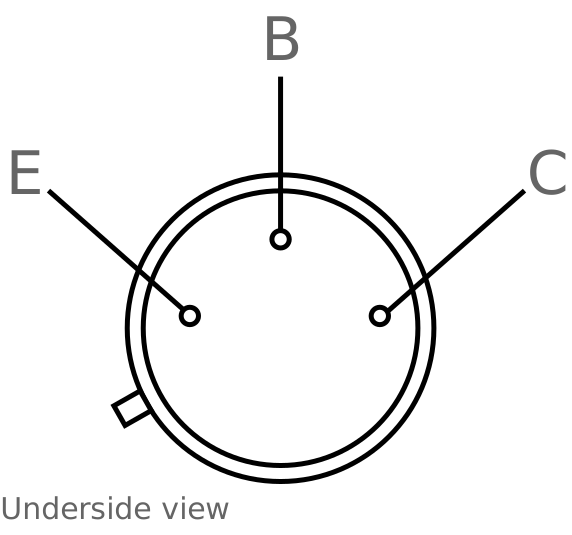
Pinout:
Explanation of transistor parameters
| Parameter | Explanation |
|---|---|
| VCBO Max | Maximum collector-base voltage with emitter open circuit . |
| VCEO Max | Maximum collector-emitter voltage with base open circuit. |
| VEBO Max | Maximum emitter-base voltage with collector open circuit. |
| VCEsat (included where applicable) | The voltage drop across the collector-emitter when the transistor is fully saturated (acting as a closed switch). |
| IC Max | Maximum collector current. |
| Parameter | Explanation |
|---|---|
| TJ | Maximum junction temperature. |
| PTOT Max | Maximum device dissipation normally in free air at 25°C unless other conditions indicated. |
| fT Min | Minimum cutoff frequency at which the current gain in a common emitter circuit falls to unity. |
| COB Max | Maximum collector capacitane, normally measured with emitter open circuit. |
| hFE | DC current gain for HFE at IC. [Note hfe is the small signal gain and although this may be slightly different, the transistor current gain will vary considerably from ne transistor to the next of the same type.] |
| PTOT Max | Maximum device dissipation normally in free air at 25°C unless other conditions indicated. |
These are the main transistor parameters that have been included in our list. There are others, but these help quantify the main elements of the performance of the transistor.
Please note, that the data given is the best estimate we can give within a tabulated summary of this nature. Parameters also vary between manufacturers. Electronics Notes cannot accept any responsibility for errors, inaccuracies, etc, although we do endevaour to ensure the data is as accurate as possible.
Notes and supplementary information
• Availability & sources
The 2N706 is available from a number of stockists and electronic component distributors many of which are given in the table below.
2N706 Component Distributor, Stock and Pricing
• Notable features
The 2N706 is a classic silicon NPN bipolar junction transistor introduced by Fairchild Semiconductor in the early 1960s. It was one of the early high-speed planar silicon devices that played a key role in the transition from germanium to silicon technology in digital electronics.
High-Speed Switching: Transition frequency (fT) of 200 MHz minimum, with very fast switching times (nanosecond range) suitable for saturated switching applications.
Planar Epitaxial Construction: Featured silicon dioxide passivation for improved reliability, higher manufacturing yields, and better protection against contamination compared to earlier mesa transistors.
TO-18 Metal Can Package: Hermetically sealed, rugged metal package (gold-plated leads in many versions) offering good thermal performance and mechanical durability for the era.
Low Power, Low Current: Designed for low collector current (up to 200 mA, typically used at 10–50 mA) with low power dissipation (300 mW), making it efficient for logic and small-signal tasks.
Historical Significance: One of the pioneering devices that helped establish the planar process, which became the foundation for modern integrated circuit manufacturing.
• Typical applications summary
| Application Category | Typical Use Case | Device Feature Utilised |
|---|---|---|
| High-Speed Digital Switching | Logic gates, flip-flops, and saturated switches in early mainframe computers and digital calculators | Fast switching times and high fT (200 MHz) |
| Small-Signal Amplification | Pre-amplifiers and buffer stages in radio and audio equipment | Good current gain (hFE 20–60) at low collector currents |
| General Purpose Switching | Relay drivers, indicator lamps, and low-power actuator control | Low VCE(sat) and high-speed saturated switching capability |
| Vintage & Educational Electronics | Repair and restoration of 1960s–1970s equipment, hobbyist projects, and teaching planar transistor technology | Classic TO-18 package and historical significance |
• 2N706 development history
The 2N706 transistor was introduced by Fairchild Semiconductor in the early 1960s. The device represents a pivotal moment in the history of silicon-based logic.
It was developed at the height of what can be called the "Fairchild era." This was when legendary engineers like Jean Hoerni and Robert Noyce were perfecting the planar process.
The 2N706 was designed specifically to meet the new demands of high-speed digital computing. While germanium transistors had previously dominated the market, they were notoriously heat-sensitive and unreliable.
The 2N706 arrived as a rugged, high-speed silicon NPN transistor that could withstand the thermal stresses of the tightly packed mainframe computer cabinets of the day.
The true innovation behind the 2N706 lay in the development of the "planar" structure. Unlike earlier mesa-style transistors, where the semiconductor junctions were exposed at the edges and highly susceptible to environmental contamination, the 2N706 used a layer of silicon dioxide to passivate and protect the junction surfaces.
This was a huge shift in manufacturing, because by keeping the silicon protected during the fabrication process, Fairchild achieved unprecedented yields and reliability.
The silicon itself was optimised for fast switching by carefully controlling the doping profiles. This allowed for the rapid transit of charge carriers that defined the "high-speed" classification of the device.
In terms of its structure, the 2N706 was fabricated using an epitaxial planar process. By growing a precise, thin layer of high-resistivity silicon (the epitaxial layer) onto a lower-resistivity substrate, engineers were able to optimise the collector-base junction capacitance to be as low as possible.
This design choice was critical for the transistor’s performance; it allowed the 2N706 to achieve switching speeds in the nanosecond range, which was essential for the increasing clock speeds of early digital processors.
Its robust TO-18 metal can package further ensured that it could reliably dissipate heat even when operating at these high frequencies.
The rise of the 2N706 was swift, and it became a standard active component for logic gates in systems ranging from early digital calculators to commercial and military mainframes. It was the backbone of a generation of hardware, cementing Fairchild's dominance in the market.
However, its decline was as inevitable. By the mid-to-late 1960s, newer devices like the 2N2222 offered a more versatile combination of power handling and high-speed performance in a similar footprint.
As manufacturing technology improved, the 2N2222 eventually eclipsed the 2N706 by being able to handle significantly higher collector currents, effectively rendering the specialized 2N706 design redundant.
Ultimately, the 2N706 serves as a vital bridge in semiconductor history—the link between early, experimental silicon devices and the mass-produced, high-performance transistors that would eventually power the integrated circuit revolution. While it has long since vanished from modern production lines, its development helped establish the planar process that remains the standard for all modern silicon manufacturing.
 Written by Ian Poole .
Experienced electronics engineer and author.
Return to Component Data menu . . .