Taking the Shack Outside: A Guide to Portable Amateur Radio
Amateur radio isn't just a hobby to be enjoyed inside the home, it can be taken out with you when you go out, and you can even join the growing band of SOTA and POTA operators activating new parks and summits.
What is Amateur Radio includes:
What is Amateur Radio
HF DXing
Portable operation
Operating POTA
Building your equipment
For many amateur radio operators, their radio "shack" is a cozy corner of the spare room filled with cables, monitors, and a base station.
But it can often be very interesting to take one's amateur radio operating outside the shack where there can be an entirely different side to the hobby — one that involves fresh air, and the thrill of making a contact from a different location: it could be time when you are out, from remote hilltop or a sun-drenched national park. It could be a special expedition, or just taking your equipment with you when you go out somewhere.
Portable radio activation is one of the fastest-growing niches in amateur radio or ham radio. Whether you are looking to test your gear’s limits or simply want to escape the rising noise floor of the city, "operating /P" (portable) offers a unique set of rewards and challenges.
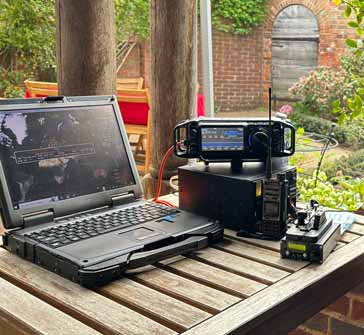
Why Go Portable?
Operating away from home isn't just about the scenery, but this can be an added enjoyment. But it forces you to become a better operator. When you are limited by battery power and temporary antennas, you learn the true nuances of propagation, antenna efficiency and generally how to make the best of what you have with you.
Noise-Free Operating: Escape the RFI (Radio Frequency Interference) of LED lights and power lines. In the woods, the noise floor often drops to near zero, letting you hear weak stations you’d never catch at home.
The Challenge of QRP: Many portable operators use low power (QRP), typically 5 watts or less. Making a transatlantic contact on 5W from a mountaintop is a "radio high" like no other.
Community & Awards: Programs like POTA and SOTA have turned portable operating into a global sport with digital logs, awards, and a massive community of "chasers" waiting to find you on the bands.
There are many opportunities to use amateur radio equipment in a 'portable environment. Often people may take some equipment with them when they go away fr a short shile, of they may just want to get out and about.
Portable operation does not need to be part of a recognised activity or award scheme, but there are two schemes that are really gaining in popularity: POTA, Parks On The Air, and SOTA: Summits On The Air.
These have been responsible to a really significant increase in portable amateur radio operation.
I thought you might like to see these . . . . . .
This equipment has been selected for your interest and it is available via AliExpress. Alternatively check out my Amazon .com Storefront.

uSDR uSDX+ V2 SDR HF 8 Bands All Mode High Frequency Transceiver
This is a full mode shortwave QRP SSB/CW transceiver. Ultra-small size design makes it easy to carry and use. It has a 1602N LCD screen and a built-in speaker to ensure superior performance. It supports connection to a PC and uses FT8, JS8, FT4 and other digital mode software control, and supports CW automatic decoding.

WINDCAMP-Portable Dipole Antenna for Amateur Radio
This dipole covers 5 - 55MHz and includes premarked resonant points for the different amateur radio bands. Ideal for POTA & SOTA.

PAC-12 7MHz-50MHz 100W Multi Band Portable HF Shortwave Antenna
This antenna comes in its own pack for easy transportation and covers 7MHz up to 6 metres. Power capability up to 100W. The contracted length is about 34.5cm, and the erected length is about 410cm.

AnyTone AT-778UV Dual Band V/UHF Mobile Transceiver
Dual Band VHF/UHF Mobile Radio Transceiver: 25W/15W/5W, Colour LCD. Frequency Range: VHF:136-174MHz UHF:400-480MHz, CTCSS, DCS, 200 channels etc. Narrow Band compliant.
Check out more items you might like from my HF amateur radio equipment.
More convenient to buy from Amazon.com? Check out Antennas and Amateur Radio Equipment on my Amazon Storefront.
Note: We make a small commission from any sales at no cost to you.
POTA vs. SOTA: Choosing Your Adventure
While both involve radio in the great outdoors, they cater to very different styles of operating.
The Vibe: Relaxed. You can often operate from a picnic table or even the comfort of your car.
The Gear: Since weight is less of a concern, many operators bring 100W "shack-in-a-box" radios and large deep-cycle batteries.
The Vibe: Adventurous. It’s as much about the hike as it is about the radio.
The Gear: Weight is everything. SOTA operators obsess over "grams per watt," often using ultralight wire antennas and tiny, pocket-sized CW transceivers.
• POTA (Parks on the Air)
POTA is the "approachable" sibling of portable radio. It focuses on activating state, provincial, and national parks.
• SOTA (Summits on the Air)
SOTA is for the radio-athlete. To "activate" a SOTA peak, you must reach the summit under your own power (no motorized vehicles) and operate away from any permanent power source.Is portable operation only for HF?
While the image of a portable ham radio operator often involves long wire antennas draped through trees and the rhythmic crackle of HF "skip," portable operation is by no means limited to the lower bands.
In fact, many operators find that the VHF and UHF bands offer a more accessible, lightweight, and surprisingly effective way to get on the air.
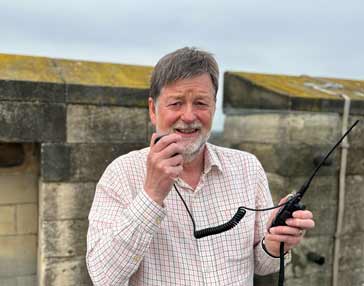
For those in urban environments or those who prefer "grab-and-go" activations, a simple handheld transceiver (HT) paired with a high-gain telescopic whip or a roll-up Slim Jim antenna can provide hours of entertainment without the need for heavy batteries, resonant wires, or complex tuners.
The primary advantage of taking VHF and UHF gear into the field is the ability to leverage terrain. Programs like Summits on the Air (SOTA) are built on the physics of line-of-sight communication; by removing a radio from the high noise floor of a residential neighborhood and placing it on a mountain peak or a high ridge, an operator’s "Height Above Average Terrain" (HAAT) increases dramatically.
This elevation allows a modest five-watt signal to reach stations 50 or 100 miles away—distances that would be impossible from a home station. This "height advantage" turns local FM simplex frequencies into a vibrant playground for long-distance contacts, often surprising newcomers with how much ground a simple HT can cover when the horizon is clear.
Beyond standard FM voice, portable operation on higher frequencies opens the door to specialized and high-tech modes that are perfectly suited for the field.
Many enthusiasts use portable Yagi antennas to work amateur radio satellites as they pass overhead, allowing for international contacts using only VHF and UHF equipment.
Additionally, the move toward weak-signal modes like WSJT allows portable operators to track their hikes in real-time or hunt for "DX" on bands like 2 metres and 70 centimetres.
Whether it’s the thrill of a satellite pass or the satisfaction of a clear simplex contact from a distant hill, VHF and UHF prove that portable operation is as much about the "reach" of the higher bands as it is about the "skip" of the lower ones.
| Comparison of HF and V/UHF Amateur Radio Portable Operation |
||
|---|---|---|
| Feature | VHF / UHF Portable | HF Portable |
| Antenna size | Smaller and can use vertical 'whips' or even Yagis | Typically wire antennas, or loaded vertical antennas |
| Weight | Usually much lighter - can even use handhelds | Usually heavier and often require antenna tuner and possibly larger battery |
| Set up time | Often shorter - with a handheld it can be very short | Usually much longer |
| Achievable range | Usually line of sight + | Often national and international |
| Activity | Often highly dependent on local activity levels | Usually always active, but depends on ionospheric conditions |
Essential Gear for the Portable Operator
Obviously it is not possible to take out a large base station rig when you need to go out to operate amateur radio from a portable location.
Regardless of which programme you choose, or it you just want to operate as a portable station, then there are some requirements for the equipment.
Your portable kit needs to be relatively small and light weight and it also needs to be durable and efficient.
Ready to start?
Portable operating is the ultimate way to prove that amateur radio is a "go-anywhere" hobby - you can take it with you almost wherever you go.
Whether you’re setting up a station or just using your handportable you can be on a rocky peak for SOTA or enjoying a quiet afternoon at a park for POTA, or just enjoying amateur radio wherever you happen to be, you are joining a vibrant community of outdoor radio amateurs.
 Written by Ian Poole .
Experienced electronics engineer and author.
More Ham Radio Topics:
What is ham radio
Callsigns
Morse code
Voice modes
Digital data modes
QRP operating
Operating awards
Codes & abbreviations
Ham bands overview
Operating via differnet propagation modes
Repeaters
Callsigns
Contact formats
Setting up a shack & buying equipment
Return to Ham radio menu . . .