MLA-30+ HF Loop Antenna: what it is & how it performs
The MLA-30+ is an active receive only antenna that provides a useful budget friendly antenna solution for many - check out the views people have of this."
Home » Shop main page » this page
Check out more amateur radio gear:
Ham radio HF gear
Ham radio VHF / UHF gear
Ham radio Morse keys & ancilliaries
HF ham radio antennas, tuners, meters, etc
VHF / UHF ham radio antennas
Discone and wideband antennas
Ham radio equipment reviews
Please note: There are links to products in this review and ElectronicsNotes makes a small commission on any sales that are made from links on this article.
Loop antennas have a lot to offer. As they primarily utilise the magnetic element of the e/m wave, they are able to receive signals with much lower levels of static interference, and on top of this, they are often small enough to be rotated.
Normally these antennas are quite expensive, but a receive only magnetic loop antenna, the MLA-30+ has become very popular.
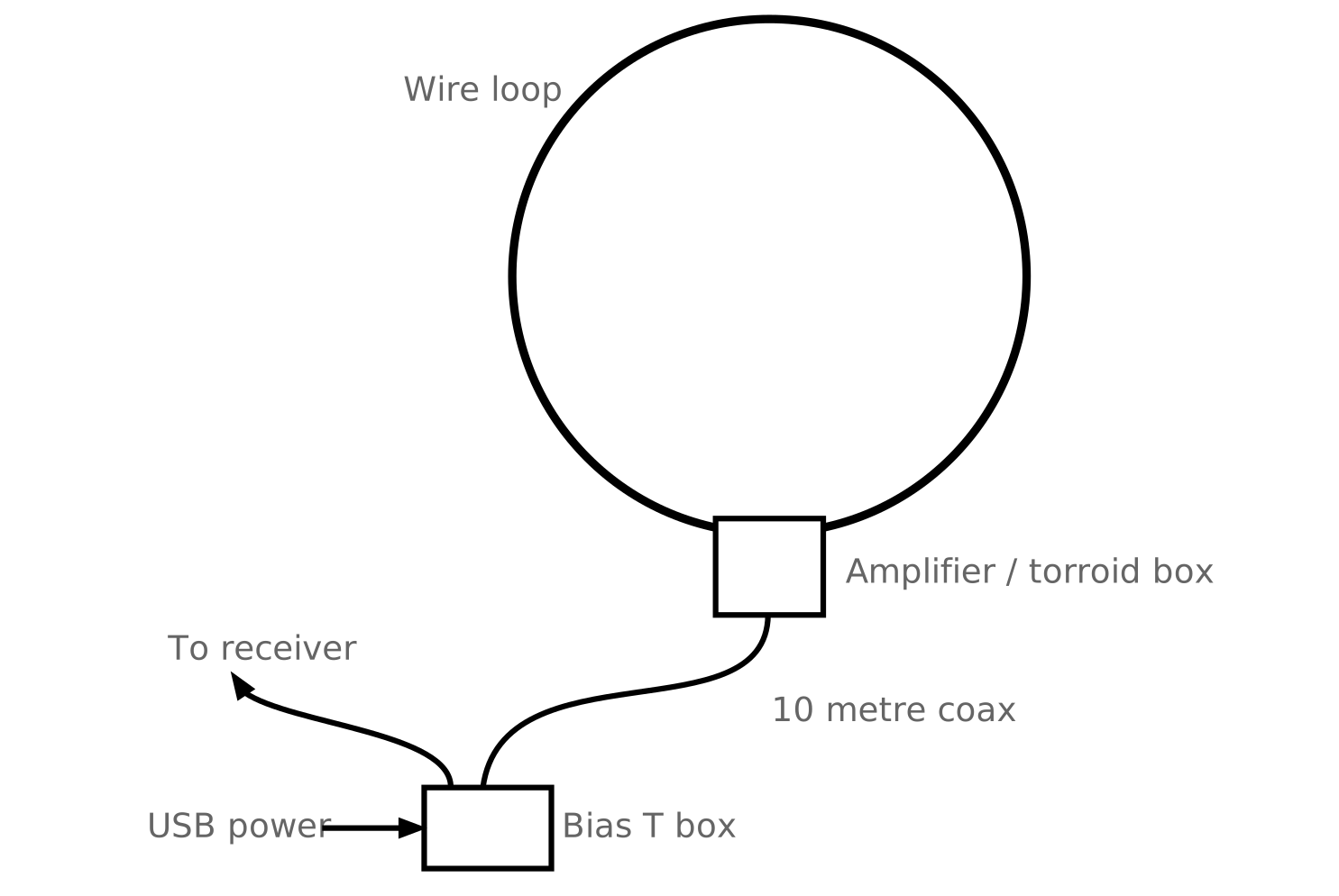
In fact the MLA-30+ has become one of the most discussed and widely used antennas in the Shortwave Listening (SWL) and DXing community.
In many ways, it is a classic budget active loop antenna that has lowered the barrier to entry for hobbyists who lack the space for a traditional 100-foot wire antenna.
Because this antenna is a staple of online marketplaces, there is a wealth of community feedback. Here is a review summarizing what the MLA-30+ is, its technical footprint, and the general consensus from the global radio community.
What is the MLA-30+?
The MLA-30+ is an active magnetic loop antenna designed specifically for receiving, i.e. RX only. It can receive signals across the HF and Medium Wave bands.
Unlike traditional "voltage" antennas (like a dipole or a long wire), which are sensitive to electrical interference, a magnetic loop primarily interacts with the magnetic component of the radio wave.
This makes it inherently more "quiet" in urban environments where electrical noise from LED lights, computers, and power lines is prevalent.
The "active" part of the name refers to the built-in pre-amplifier housed in a small waterproof box at the base of the loop, which boosts weak signals before they reach the receiver.
Specifications
While the MLA-30+ is a budget-friendly device, its specifications are quite broad:
Frequency Range: Covers 500 kHz to 30 MHz (covering AM broadcast, tropical bands, and all HF amateur/international bands).
Power Supply: USB-powered (5V), usually via a "Bias-T" injector that sends power up the coaxial cable to the antenna.
Construction: Typically consists of a flexible stainless steel wire loop, a plastic-encased amplifier, and a Bias-T unit.
Directionality: Being a loop, it has a "figure-eight" reception pattern. By rotating the antenna, a user can physically "null out" a source of interference.
Coaxial Connection: Usually supplied with an SMA connector, making it ready for modern SDRs (Software Defined Radios) like the RTL-SDR or Airspy.

MLA-30+ Active Loop Receiving Antenna, 0.5-30MHz
The MLA-30+ is an active, RECEIVE ONLY loop antenna covering 500kHz to 30MHz. Being a loop antenna and responding primarily tot he magnetic component of the e/m signal, it is less prone to picking up interference. It is also directional and can be rotated to optimise signal reception. Reviews across the amateur radio spectrum have been impressed with its performance for the very low price.
General User Perceptions
Since many users cannot put up a full-sized dipole, the MLA-30+ is often their first experience with "real" HF reception. Users generally fall into two camps:
1. The High Praise: "The Urban Noise Fighter" The most consistent positive feedback centers on noise reduction. Users living in apartments or densely populated suburbs frequently report that the MLA-30+ allows them to hear stations that were previously buried in a thick blanket of static on a wire antenna.
Ease of Assembly: Users appreciate how simple it is to set up. It can be mounted on a PVC pipe or even hung from a window hook.
Bang for Buck: At its price point (usually under £40/$50), users feel the performance-to-cost ratio is unbeatable.
2. The Critical View: "Gain vs. Quality" More experienced DXers often point out that the antenna’s amplifier has a lot of gain.
Overloading: Some users report that if they live near a powerful AM or FM broadcast tower, the MLA-30+ can "overload," causing ghost signals to appear where they shouldn't be.
Build Quality: Reviewers often note that the included coaxial cable is thin and poorly shielded. A common "pro-tip" found in reviews is to replace the stock cable with higher-quality RG58 or LMR195.
Weatherproofing: While rated for outdoors, some users suggest adding a bit of extra silicone sealant to the wire entry points to ensure it survives several winters.
High noise: One of the issues that was noted was that the preamplifier / bias T box utilises a DC-DC converter which adds a lot of noise. Anyone wanting to modify the antenna may be able to improve this.
Summary of Consensus
The general perception of the MLA-30+ is that it is an essential "starter" antenna. It is not a "magic bullet" that will outperform a professional £500 well-designed magnetic loop (like a Wellbrook or an LZ1AQ), but it isn't trying to be.
The community consensus is clear: If you are an SDR user or have a portable shortwave radio and find your current reception is plagued by local electrical noise, the MLA-30+ is a low-risk, high-reward upgrade. It is widely considered the "gateway drug" to more serious DXing.
The other benefit of te antenna is that many people think of the MLA-30+ as a "project" antenna as much as it is a finished product. Users love it because it works right out of the box, but they also enjoy the fact that it can be modified with better cable or a larger wire loop for even better performance.
Please note: ElectronicsNotes makes a small commission on any sales that are made from links on this article.
 Written by Ian Poole .
Experienced electronics engineer and author.
Check out more sections of our store:
Ham radio HF gear
Ham radio VHF / UHF gear
Ham radio Morse keys & ancilliaries
HF antennas, tuners, meters, etc
VHF / UHF ham radio antennas
Signal generators
Multimeters
Oscilloscopes
Frequency meters & counters
Logic analyzers
Audio amplifier kits
Ebooks (PDF)
Coffee mugs
Downloadable infographics
Reviews: Ham radio eqpt reviews
Return to the Shop Front . . . .