Review: The Nagoya UT-106UV – A Low-Cost Mobile Solution for Budget V/UHF Handhelds & Mobiles
There are plenty of good ham radio VHF / UHF dual band mobile antennas available, so is this really budget Nagoya UT-106 really worth considering?
Home » Shop main page » this page
Check out more amateur radio gear:
Ham radio HF gear
Ham radio VHF / UHF gear
Ham radio Morse keys & ancilliaries
HF ham radio antennas, tuners, meters, etc
VHF / UHF ham radio antennas
Discone and wideband antennas
Ham radio equipment reviews
Please note: There are links to products in this review and ElectronicsNotes makes a small commission at no cost to you on any sales that are made from links on this article.
Sometimes a budget friendly car antenna for VHF and UHF can exceedingly useful if not essential for operation with handheld and mobile amateur radio equipment.
In my case I wanted a low cost car antenna for use with a TIDRADIO TD-H3 so I could use it when I drove to a local high point with a good radio take-off. I didn't need soemthing for everyday use and I didn't want to spend a fortune.
Operating a handheld radio from a car can be challenging as a result of the screening effect of the car bodywork - you don't always want to sit on a chair or stand outside the car to transmit, especially if it is cold or wet.
If you take the trouble driving to a good vantage point, you don't want to use the standard "rubber Duck" antenna supplied with the HT, as these are not particularly effective.
So, I found myself looking for a low-cost, "no-fuss" solution to get my signal radiating better.
My search led me to the Nagoya UT-106UV, a super-affordable magnetic mount (mag-mount) antenna designed specifically for SMA-equipped handhelds like my TIDRADIO TD-H3 or a Baofeng UV-5R, etc.
The antenna came from one of the reputable dealers on AliExpress so the quality could be assured.

UT-106UV SMA-Female Car Magnetic Dual Band Antenna for Baofeng UV-5R, etc
Connector: SMA-F(Female), Frequency: 144/430MHz(UHF+VHF), Gain: 3.0dB / 2.15dB, Impedance: 50 Ohm, Max power: 20W, Cable: RG-174, Cable length: 3m, Magnet Sucker Size: 31mm, Antenna Length: 376mm, Weight: 88g.
REVIEW: Nagoya UT-106UV antenna.
Initial perceptions
It’s worth taking a look at it to see how it worked out. Was it no good as you might expect as a result of the cost, or was it a great bargain?
The first thing that strikes you about the Nagoya UT-106UV is the price. Often found for well under $15–$20 it sits firmly in the "budget experiment" category. I think because of some offers on AliExpress mine was under $5, making it incredible value.
It is designed to be a "plug-and-play" accessory, eliminating the need for expensive adapters or heavy-duty permanent drilling. Mine came with the female SMA connector to connect directly to my TD-H3 or for that matter it would also easily interface to HTs from Baofeng, Qansheng, etc.
Mechanical Build
First of all it’s worth taking a look at the mechanical attributes to see what I was physically getting for my $5.
I confess it did appear to be relatively small, and just a wire bent to shape, and I wondered if it would work well enough or be robust enough.
Total Height: Approximately 39 cm (15.3 inches).
Base: A small 31mm magnetic base. While compact, the magnet is surprisingly strong for its size, though I would recommend being careful to avoid scratching your car’s paint. Also, although it seemed quite frirm ont he roof, I'm not sure I would want to drive at high speed with it there - or may be, am I being too cautious?
Cable: It comes pre-terminated with 3 meters (approx. 10 feet) of RG-174 coax. This cable is thin, which is both a pro and a con. It’s thin enough to be snaked through a car door seal without crimping the wire, but the small diameter means higher signal loss over long runs (though at 3 metres, this is might not be an issue as it is still likely to give enough gain over the HT antenna.
Connector: My version featured a SMA-Female connector, which is a direct fit for the TIDRADIO TD-H3. No adapters required—simply unscrew the stock "rubber duck" and screw on the UT-106UV lead.
Electrical Specification
On paper, the UT-106UV is a dual-band antenna covering the 2-metre (VHF) and 70-centimetre (UHF) amateur bands.
Frequency Range: 144/430 MHz (TX), with extended RX capabilities (136-174 / 400-520 MHz).
Gain: Rated at 3.0 dBi. While "gain" on such a short whip is often an optimistic marketing figure, the real advantage here isn't the raw dBi; it's the fact that the antenna is outside the vehicle, and it has the car body to act as a great ground plane. Also remember that the gain of a dipole is +2.15dBi.
Max Power: Rated for 20 Watts. This is more than enough for the TIDRADIO TD-H3, which typically outputs around 5 Watts, but care must be taken not to put too much power into it as it is only a low power antenna.
Impedance: 50 Ohms. This is the expected impedance for an antenna such as this, although I would expect it will vary considerably over the frequency range.
Practical Findings: Real-World Performance
I took the car to a familiar vantage point near my home — a spot where I could expect a good "take-off" for the rado signals and where I would have a good selection of repeaters.
On-air experiences
Using the TD-H3 with its stock antenna, even from this vantage point I had difficulty opening the repeaters. I was able to open one or two repeaters using the antenna on the handheld from outside the car, but not inside it. Even then the reception was a bit hit and miss.
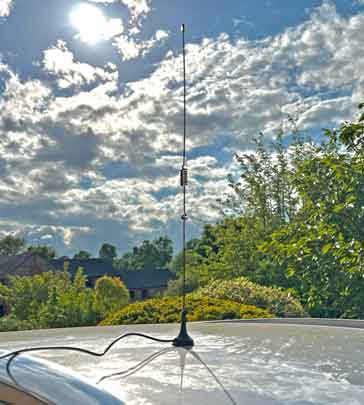
The Nagoya UT-106UV was on the roof towards the centre with the wire dangled through the window. Using this antenna the repeaters I just about managed to access before were limiting and I was reliably able to access them. There were also many other repeaters that wee further afield that I could now access, giving me a much greater level of choice. The range of my transmissions ahd been considerably increased.
While I cannot provide laboratory-grade decibel measurements, the subjective improvement was massive. It effectively turned a "decent" handheld into a functional mobile station.
SWR (Standing Wave Ratio)
For any antenna, SWR is the critical metric of efficiency. If the SWR is too high, power reflects back into the radio, which can eventually damage the transmitter's final stages, although most radios tend to have some PA protection these days, but this can limit the output power. So it is always wise to operate with a reasonable SWR.
Note: I am currently awaiting my antenna analyzer to get exact figures for this specific unit.

SURECOM SW-33Plus 100W Mini Power & SWR Meter 125-525MHz
Covering the main VHF and UHF amateur radio bands, this mini SWR meter comes with SMA connectors and a convenient adapter set to enable it to be connected to most handheld transceiver when using them with an external antenna. An ideal addition for your portable or mobile operating.
Final verdict
However, based on the antenna's design (a 1/4 wave whip on VHF), the car roof acts as a great ground plane. For best results, the antenna should be placed in a reasonably central position on the roof.
I would advise against using it for high-power transmissions (above 10W), but in view of the connector on it, the antenna is definitely aimed at providing a low cost antenna for these lower power HTs and it is ideally suited for this application.
If you are looking for a professional-grade, long-term mobile setup, you might want to look at one of the mainstream antennas, but at a significantly higher cost. However, for general usage with HTs like my TIDRADIO TD-H3 or ones such as the Baofeng UV-5R or the Quansheng radios, to drastically improve your range for the price of a pizza, the Nagoya UT-106UV is an absolute winner.
It’s small enough to throw in a corner in your car when not in use, and the performance boost gained by simply moving your signal outside the car's cabin is the single best upgrade you can make for mobile operating.
Pros:
- Incredibly affordable.
- Direct fit for TD-H3 (SMA-Female).
- Thin cable is easy to route through door seals.
- Massive improvement over stock antennas.
Cons:
- Thin RG-174 cable is fragile; don't slam it in the door too hard.
- Small magnet base may move at high highway speeds or in heavy wind.
UT-106UV SMA-Female Car Magnetic Dual Band Antenna for Baofeng UV-5R, etc
Connector: SMA-F(Female), Frequency: 144/430MHz(UHF+VHF), Gain: 3.0dB / 2.15dB, Impedance: 50 Ohm, Max power: 20W, Cable: RG-174, Cable length: 3m, Magnet Sucker Size: 31mm, Antenna Length: 376mm, Weight: 88g.
REVIEW: Nagoya UT-106UV antenna.
Please note: ElectronicsNotes makes a small commission on any sales that are made from links on this article.
 Written by Ian Poole .
Experienced electronics engineer and author.
Check out more sections of our store:
Ham radio HF gear
Ham radio VHF / UHF gear
Ham radio Morse keys & ancilliaries
HF antennas, tuners, meters, etc
VHF / UHF ham radio antennas
Signal generators
Multimeters
Oscilloscopes
Frequency meters & counters
Logic analyzers
Audio amplifier kits
Ebooks (PDF)
Coffee mugs
Downloadable infographics
Reviews: Ham radio eqpt reviews
Return to the Shop Front . . . .