Home » Component data » Transistor data » this page
2N3904 Transistor Data
Key transistor data for the 2N3904 general purpose transistor including key electrical parameters, pinout, package type and many other key transistor details.
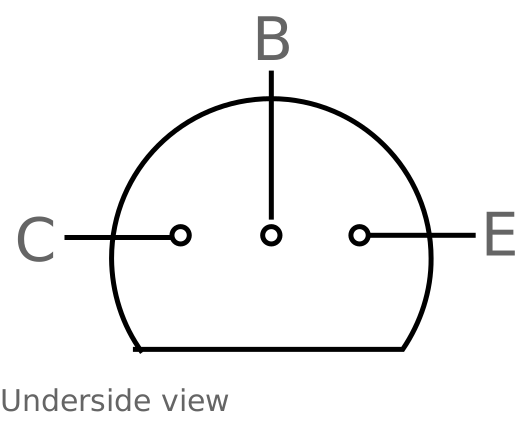
The 2N3904 is a general purpose NPN silicon transistor encapsulated in a TO92 case with the standard E B C pinout.
Although a general purpose transistor, the datasheet shows it is able to provide fast switching with a turn-off time of less than 1nS.
Key details and performance parameters for the 2N3904 transistor.
| Transistor parameters & data |
|
|---|---|
| Parameters | Details |
| Transistor type | NPN silicon switching transistor |
| Package type | TO92 |
| VCBO max (V) | 60 |
| VCEO max (V) | 40 |
| VEBOmax (V) | 6 |
| VCEsat (V) | 300mV @ I |
| IC max (mA) | 200 |
| TJ Max °C | |
| PTOT nW | 625 |
| fT min (MHz) | |
| COB | 4p |
| hfe | 300 max |
| IC for hfe | 10 mA |
| Similar / equivalents | |
Outline:
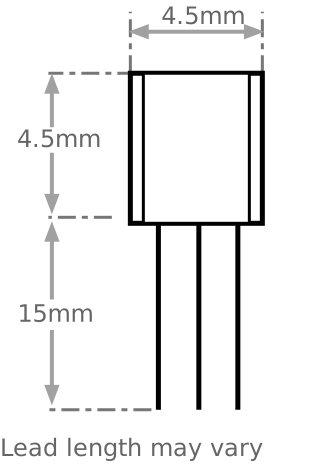
Pinout:
Explanation of transistor parameters
| Parameter | Explanation |
|---|---|
| VCBO Max | Maximum collector-base voltage with emitter open circuit . |
| VCEO Max | Maximum collector-emitter voltage with base open circuit. |
| VEBO Max | Maximum emitter-base voltage with collector open circuit. |
| VCEsat (included where applicable) | The voltage drop across the collector-emitter when the transistor is fully saturated (acting as a closed switch). |
| IC Max | Maximum collector current. |
| Parameter | Explanation |
|---|---|
| TJ | Maximum junction temperature. |
| PTOT Max | Maximum device dissipation normally in free air at 25°C unless other conditions indicated. |
| fT Min | Minimum cutoff frequency at which the current gain in a common emitter circuit falls to unity. |
| COB Max | Maximum collector capacitane, normally measured with emitter open circuit. |
| hFE | DC current gain for HFE at IC. [Note hfe is the small signal gain and although this may be slightly different, the transistor current gain will vary considerably from ne transistor to the next of the same type.] |
| PTOT Max | Maximum device dissipation normally in free air at 25°C unless other conditions indicated. |
These are the main transistor parameters that have been included in our list. There are others, but these help quantify the main elements of the performance of the transistor.
Please note, that the data given is the best estimate we can give within a tabulated summary of this nature. Parameters also vary between manufacturers. Electronics Notes cannot accept any responsibility for errors, inaccuracies, etc, although we do endevaour to ensure the data is as accurate as possible.
• Availability & sources
The 2N3904 is available from a number of stockists and electronic component distributors many of which are given in the table below.
2N3904 Component Distributor, Stock and Pricing
• Current gain
Although the general current gain is categorised by some manufacturers as being up to 300, Limimax, one of the manufacturers, have three bands for the gain:
O - 100-200Y - 200-300
G - 300-400
When designing high-precision circuits, it is advisable to check the specific manufacturer's datasheet for the gain band, as this parameter can vary significantly from one batch to the next.
Surface mount version
The standard 2N4904 is encapsulated in a TO-92 plastic package but it is also available in a surface mount version: MMBT3904 in the SOT-23 surface-mount package.
Pinout
The 2N3904 utilises the standard Emitter-Base-Collector (E-B-C) pinout. This makes it exceptionally easy to integrate into breadboard prototypes and printed circuit boards (PCBs).
It is ideal for many hobbyist circuits and as a result it is widely referred to as a jellybean transistor.
Complementary design
One major reason for the great popularity of the 2N3904 is that it is part of a "complementary pair." For the 2N3904 NPN transistor, there is the corresponding PNP transistor, the 2N3906.
This pairing simplifies the design of push-pull amplifiers and H-bridge circuits for motor control, as the electrical characteristics of the 2N3906 are carefully matched to the 2N3904.
This complementarity ensures that circuit symmetry is maintained, reducing distortion in audio applications and balancing current draw in switching designs.
Real-world applications
Because of its combination of high gain (hFE) and its low saturation voltage (VCE(sat)), the 2N3904 is found in an enormous range of circuits:
Signal Amplification: Used extensively in pre-amplifiers and small signal processing stages.
Switching: Serving as a reliable electronic switch to drive relays, LEDs, small buzzers, or to interface low-power microcontrollers (like those used in Arduino or ESP32 projects) with higher-voltage loads.
Logic Gates: Essential in early digital circuit designs and as a level-shifter in modern mixed-signal designs.
An engineering essential
The 2N3904 is a classic example of an "engineering workhorse." While more specialized transistors exist for high-frequency or high-power applications, the 2N3904 remains the most economical and accessible choice for the vast majority of day-to-day electronics tasks.
Whether you are building your first light-sensitive circuit or designing a complex instrumentation amplifier, keeping a handful of 2N3904s in your component bin is a foundational practice that every electronics engineer follows.
Its combination of performance, reliability, and low cost ensures it will continue to be a standard component in circuits for decades to come.
 Written by Ian Poole .
Experienced electronics engineer and author.
Return to Component Data menu . . .