Top Tips for Buying VHF / UHF Ham Radio Antennas
There are many considerations to think about when buying a VHF / UHF antenna for your amateur radio station - cut though the confusion with my top tips and explanations.
Home » Shop main page » this page
Check out more amateur radio gear:
Ham radio HF gear
Ham radio VHF / UHF gear
Ham radio Morse keys & ancilliaries
HF ham radio antennas, tuners, meters, etc
VHF / UHF ham radio antennas
Discone and wideband antennas
Ham radio equipment reviews
Please note: There are links to products in this review and ElectronicsNotes makes a small commission at no cost to you on any sales that are made from links on this article.
Choosing the right VHF or UHF antenna is one of the most critical decisions needed when setting up an amateur radio station.
While a high-power transceiver can compensate for some system losses, when receiving the antenna is crucially important.
Whether you are looking for a base station vertical, a mobile whip, or an upgrade for your handheld (HT), here are my thoughts on what to look for.
Categorising the Application: Base, Mobile, or Handheld?
The antennas used for base stations, for mobile and on handhelds are very different - not in the basic concepts of their operation, but in the sizes, fixings, mounting methods and antenna types used.
This means that the first step in selecting an antenna will be to define the antenna use and its environment.
Each environment presents unique mechanical and electrical challenges, and this is why there is such a wide variation of the antenna types available.
Base Station Antennas
For a home station, height is king. Base antennas are usually large, fixed structures designed to be mounted on masts or chimneys.
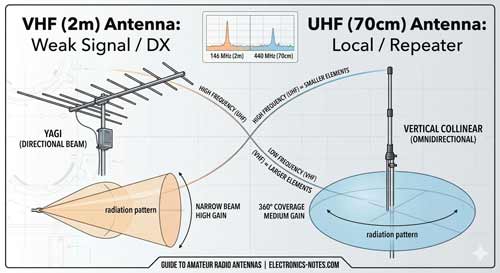
Vertical Collinears: These are the most common. They consist of multiple stacked elements inside a fibreglass radome. They provide 360-degree coverage and are ideal for local repeater work.
Yagis (Beams): If you are interested in "weak signal" work, SSB, or satellite communication, a directional Yagi is essential. It focuses all your energy in one direction, significantly increasing range.

UV Dual Band (2 metre & 70cm) Omni Fibreglass Antenna
Supports up to 100W, 3.5/5.5 dBi gain for extended signal reach, durable fibreglass construction.
Mobile Antennas
There are many requirements for antennas used on cars. The antenna must not only be able to survive highway speeds, low-hanging branches, car washes, and the like, but it must also have a suitable form of mounting and a good level of performance.
Mounting Styles: Look for magnetic mounts (temporary), hole-mounts (permanent and best for RF grounding), or lip-mounts (attaches to the trunk or hood).
Physical Strength: Look for "fold-over" features that allow you to tuck the antenna away in garages.

VHF UHF Dual Band Vehicle Radio Antenna with Magnetic Base PL259
Dual Band 144MHz & 430MHz, Gain: 2.5/3dB, Max Power: 50W, VSWR: LESS 1.5, Impedance:50 ohm, connector: PL-259/UHF M Male, antenna connector socket: NMO Type, antenna height: 9cm, length of coaxial cable: 5m/16.40ft.
Handheld (HT) Upgrades
The "rubber duck" antenna that comes with your radio is a compromise designed for durability, not performance. Many people will want to improve on this because the HT will be limited by its power and also normally by the location - typically at the height of one person.
Telescopic vs. Flexible: A 1/4 wave or 1/2 wave telescopic antenna can vastly improve your HT's range, but they are fragile. High-gain flexible "whips" offer a middle ground.
Note: Remember that it is well worth buying a speaker mic so that you can keep the antenna away from your eyes and head in general to reduce the levels of RF that are absorbed.

ABBREE Walkie Talkie Antenna SMA Female Male VHF UHF
AR-771 walkie-talkie antenna for Baofeng. SMA-female for BaoFeng UV-5R UV-82 BF-888S Quansheng UV-K5 K6, etc handheld radios.
Key technical aspects
When looking at antenas there are a number of specifications that can be seen. It is useful to have a good understanding of these.
• Polarisation: Horizontal vs. Vertical
At VHF and UHF in particular, polarization matters immensely. If the antenna receiving and transmitting antennas have different polarisations, e.g. horizontal to vertical, a signal loss of up to 20 dB can often be seen. Although this is only a very rough guide, it can be seen that this a massive reduction in signal strength.
As a result it's necessary to determine the best polarisation for the particular application envisaged.
Vertical Polarization: The standard for FM repeaters, mobile operation, and handhelds. It is easier to mount vertically on vehicles and provides omnidirectional coverage.
Horizontal Polarization: The standard for "weak signal" modes like SSB (Single Sideband), CW, and FT8. Horizontal antennas tend to pick up less man-made noise (which is often vertically polarized).
Summary: If you want to talk on FM or repeaters, use a vertical because all FM communications are FM and this is dictated by the fact that an omnidirectional antenna is required on cars and this will be vertically polarised. However, if you want to hunt long-distance, typically using SSB or CW then horizontal is the type of polarisation needed.
• Understanding Gain: dBi vs. dBd
Gain is often the most misunderstood specification. An antenna does not "create" power; it simply takes the power available and squashes it into a flatter, more concentrated shape.
dBi: Gain relative to an "isotropic" source (a theoretical point that radiates in a perfect sphere).
dBd: Gain relative to a standard dipole antenna.
Here's a useful relationship:
What to look for: Be wary of cheap antennas claiming "10 dBi" gain in a 20-inch package. Physics dictates that higher gain requires more physical aperture (length). For a base station, look for at possibly 6 – 9 dBi for significant repeater reach.
For a mobile, 3 – 5 dBi is usually the "sweet spot" to avoid a radiation pattern so flat that it misses repeaters located on hills.
• Bandwidth and Multi-Band Capability
In the UK and many other regions, the most popular VHF/UHF bands are 2 Metres (144–146 MHz) and 70 Centimetres (430–440 MHz).
Dual-Band Antennas: Most modern amateur antennas are "Dual-Banders." They use traps or phased elements to work on both 2m and 70cm with a single feedline. This is the most practical choice for 90% of hams.
Triband and Quad-Band: Some antennas include the **6 Metre (50 MHz)** or even 10 Metre (28 MHz) bands.
The Trade-off: While convenient, quad-band antennas are often "compromise" antennas. They are physically large and can be difficult to tune (SWR) across all four bands simultaneously. If you have the space, a dedicated 10m/6m antenna usually outperforms a "do-it-all" whip.

Quad-Band Base-Station Antenna,29.6/50.5/144/430MHz
Covering the four main amateur radio bands from 29MHz up to 440MHz, this quad band vertical is ideal for base station use as it cna handle up to 100W and also provides a useful level of gain dependent upon the band in use.
• Mounting and the "Ground Plane"
How an antenna is mounted is just as important as the antenna itself.
Ground-Plane Dependent: Many mobile antennas (like 1/4 wave whips) require a large metal surface (the car roof) to act as the "other half" of the antenna. Without this, the SWR will be high, and the antenna won't radiate properly.
Ground-Plane Independent: If you are mounting an antenna on a fiberglass boat, a plastic roof, or a wooden balcony, look for "Half-Wave" or "Radial-less" designs. These do not require a metal surface to function.
• Durability and material quality
Since VHF/UHF antennas are often high up or on a moving vehicle, they take a beating from the elements.'Radome' Material: For base stations, look for high-quality **fiberglass (FRP)**. It protects the internal copper elements from corrosion and wind vibration.
Hardware: Look for stainless steel U-bolts and mounting brackets. Zinc-plated hardware will rust within a year in coastal or rainy climates.
Connectors: SO-239/PL-259 is the standard for VHF, but can be "lossy" at higher UHF frequencies, especially if low quality versions are used - high quality is not too bad, but best not used above about 150MHz anyway. N-Type connectors are the gold standard for UHF (70cm and above). These are meant to be waterproof and have much lower signal loss, but again, only get the high quality versions. It is also wise to seal over any external connectors with self amalgamating tape to prevent any water ingress.
• Operational bandwidth and SWR
"SWR" (Standing Wave Ratio) measures how well the antenna is matched to the feeder. A low SWR can indicate an optimal system.
The Problem: An antenna might have a perfect 1.1:1 SWR at the bottom of the 2m band but jump to 2.0:1 at the top.
It is necessary to be aware that a good SWR reading in the shack may not mean an efficient system. If the coax has a high loss, it will mean that the signal going to the antenna will be attenuated, resulting in less reflected power and hence a lower SWR reading, and also the reflected power is attenuated, still further reducing the visualised SWR in the shack.
• Other Considerations: The "Hidden" Factors
Visual impact
In many neighbourhoods, "Antenna Restrictions" or "Neighbourhood Watch" might be an issue. There can be legal restrictions imposed on any external antennas allowed.
There are some ways in which some restrictions and limitations might be overcome:
Slimline Collinears: Look for white or grey fiberglass that blends into the sky.
Disguised Antennas: Some mobile antennas are designed to look like standard car cellular or FM antennas to prevent theft or unwanted attention.
Wind Loading
A high-gain collinear antenna is effectively a long lever. In a storm, it puts immense stress on any mast or fixing mast. Check the "Max Wind Speed" rating of the antenna, especially if you live in an exposed area. Also check the fixings and mast used for compatibility with the size of antenna, etc.
Feedline loss
At VHF and especially UHF, the cable *between* the radio and the antenna is a major factor. Even the best antenna in the world will perform poorly if you use cheap RG58 cable over a 50-foot run.
Recommendation: Use very low loss coax for base stations to ensure the gain of the antenna isn't lost in the feeder.
Checklist
When shopping for your next VHF/UHF antenna, ask these four questions:
Does the antenna match my radio? (Dual-band vs. Single-band)
Does it match my mode? (Vertical for FM/Repeaters, Horizontal for SSB)
Is it ground-plane independent? (Do I have a metal surface to mount it on?)
Connector type For example N type is better for high frequencies like 70cms, and for handhelds, SMAs are often used. Also with SMA connectors, check that it is the right gender.
The "perfect" antenna is the one that gets you on the air consistently. For most, a high-quality dual-band fibreglass vertical for the home and a 5/8 wave mag-mount for the car is the ideal starting point.

Nagoya NA-771 SMA-F Female Dual Band VHF/UHF 144/430MHz
Dual Band VHF/UHF 144/430MHz; power: 10W, VSWR: Less Than 1.5, impedance: 50ohm, connector: SMA-Female, length: 39cm, compatible with many HTs: UV-5R, etc.
Not convenient to use the above links . . . Use My Amazon.com Store!
For tax and other reasons it may not be convenient to use the links provided to my selected partners. If this is the case then try my Storefront on Amazon.com
Please note: ElectronicsNotes makes a small commission on any sales that are made from links on this article.
 Written by Ian Poole .
Experienced electronics engineer and author.
Check out more sections of our store:
Ham radio HF gear
Ham radio VHF / UHF gear
Ham radio Morse keys & ancilliaries
HF antennas, tuners, meters, etc
VHF / UHF ham radio antennas
Signal generators
Multimeters
Oscilloscopes
Frequency meters & counters
Logic analyzers
Audio amplifier kits
Ebooks (PDF)
Coffee mugs
Downloadable infographics
Reviews: Ham radio eqpt reviews
Return to the Shop Front . . . .