Morse Code Keys: A Comprehensive Buyer’s Guide for Beginners and Pros
Choosing the right Morse key is vital for CW success. Compare straight keys vs. iambic paddles, explore top brands like Begali and Kent, and find the perfect key for your budget and speed.
Home » Shop main page » this page
Check out more amateur radio gear:
Ham radio HF gear
Ham radio VHF / UHF gear
Ham radio Morse keys & ancilliaries
HF ham radio antennas, tuners, meters, etc
VHF / UHF ham radio antennas
Discone and wideband antennas
Ham radio equipment reviews
Please note: There are links to products in this review and ElectronicsNotes makes a small commission at no cost to you on any sales that are made from links on this article.
Selecting the right Morse key can be surprisingly difficult for any amateur radio operator.
The market is surprisingly vast, spanning from $15 plastic kits to $600 gold-plated Italian masterpieces.
This guide will walk you through the fundamental choice between a Straight Key and an Iambic Paddle, I'll look at the "Expensive vs. Cheap" debate, and the mechanical considerations and nuances that make a key a joy to use.

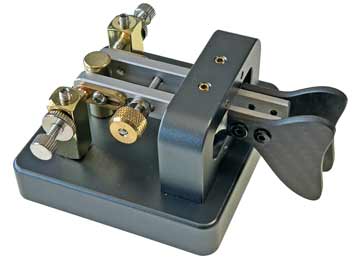
MK-03 Brass CW Morse key / paddle for amateur radio
The MK-03 Brass CW Morse Code Key is engineered for amateur radio enthusiasts and professional operators seeking precision and durability. Its adjustable contact tension and gap allow fine-tuning to match your sending style, and the pure silver contacts provide a low resistance cntact. The robust brass upper components and weighted alloy steel base ensure stability, which is ideal for high speed sending. This heavy-duty telegraph key combines classic craftsmanship with modern reliability.
The Great Debate: Straight Key vs. Iambic Paddle
The first decision you’ll face is how you want to physically generate the code. This isn’t just about speed; it’s about the "fist" — the unique rhythmic signature of your sending.
Sending Morse code properly will make the messages you send very much easier to read, and therefore having the right key, or even keys for different situations is a really important choice.
It's first necessary to look at the different types of key that are available - the main types used by most radio amateurs.
The Straight Key: The "Standard" Experience
The straight key is the classic telegraph lever that we all imagine when anyone talks about a Morse key. It is a simple on/off switch, and has an up/down movement. When it is down the contact is closed and the sound is made and when it is up, the key is open and there will be a gap in the sound.
How it works: You press down to close the circuit and release to open it. You are responsible for the timing of every "dot" and every "dash."
The Advantage: It forces you to internalize the 1:3 ratio of Morse code. Many elmers (mentors) argue that starting here builds a better "ear" for the rhythm.
The Limit: It is physically demanding. Most operators top out at 15–18 words per minute (WPM) before "Telegrapher's Cramp" (RSI) becomes a risk.
The Iambic Paddle: for higher speeds
This type of key is not the standard type of key most people would imagine. Modern ones typically have two paddles which can move side to side or be squeezed together. Most modern transceivers have the electronics to interface with these mechanical paddles to create the required Morse code characters.
How it works: Pressing the left paddle inwards sends a continuous string of dots; the right sends dashes. In "Iambic" or squeeze mode, pressing both at once creates alternating dot and dash patterns.
The Advantage: The radio handles the precision timing. Your dits and dahs will always be perfectly weighted. It is much easier on the wrist and allows for effortless speeds of 25–40+ WPM.
The Limit: There is a learning curve to "squeeze keying," but once mastered it makes sending Morse code much easier, but initially it is usual to make lots of mistakes!
The Verdict: If you love the history and "organic" feel of Morse, start with a Straight Key. If you want to get into contesting or high-speed DXing quickly, us an Iambic Paddle. In fact most Morse contacts made ont he "DX" bands are at such a speed that the use of a paddle key is necessary, only the QRP stations tend to send more slowly on the QRP frequencies.
It is should also be mentioned that there are some other types of Morse key that have their original in the late nineteenth century and are still used even now even though they are more specialist.
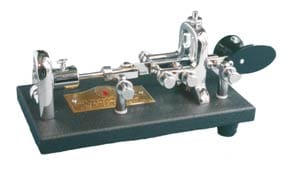
The Bug (Semi-Automatic): A mechanical marvel the most common of which is the Vibroplex, and this type uses a vibrating pendulum to make dits automatically, while you make dahs manually. They are difficult to master but have a legendary "swing" sound.
The Sideswiper (Cootie): A side-to-side manual key. It was the original "arm-saver" for telegraphers. It requires a unique "alternating" rhythm that is very fun to play but takes weeks to learn.
Expensive vs. Cheap: Is a $400 Key Worth It?
Good Morse keys can be surprisingly expensive, but good ones are precision made instruments. Accordingly you tend tog et exactly what you pay for.
Although you can spend huge amounts of money on a key, it is worth considering exactly what you want and how much you are willing to pay. Ask yourself what is good enough?
The Budget Tier ($20 – $70)
These are obviously made to a real budget and tend to be either plastic or the better budget ones may be aluminium.
Examples: Plastic 3D printed keys really at the bottom, then MFJ-550, Hi-Mound and many others.
What you get: Functional tools. They often use spring-loaded contacts and basic plastic or light metal bases.
The Downside: They can feel "mushy." Lightweight keys tend to slide across the desk during a heated QSO unless you bolt them down.

Xiegu Morse Code Manual Key VK-5 with Aluminum Alloy Base
The Xiegu VK-5 Morse code manual or hand key is fully adjustable, it has an aluminium alloy base which gives it weight (381g) and a rubber base to prevent it slipping in use. There is a convenient 3.5mm jack connector and lead to connect it to the rig. This is a nice quality key.
The Mid-Range ($100 – $220)
These Morse keys are not cheap, and they offer much better performance compared to the budget end. Normally they will be ideal for most base stations and offer excellent performance. But they may lack some of the real refinements that might be wanted by the connoisseurs.
Examples: Xiegu manual and paddle keys, Kent Hand Key, and others.
What you get: Heavy cast-iron or brass bases and better bearings. These are "lifetime" keys for many operators.
The Sweet Spot: The Kent keys (now made in the Germany, although the originally from the UK) are famous for their rugged, "tank-like" feel that provides excellent tactile feedback.
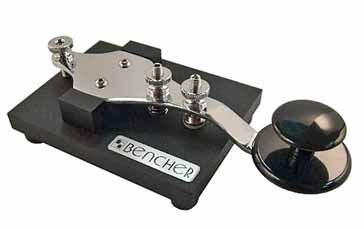
The Premium Tier ($300 – $600+)
Examples: Vibroplex, GHD and particularly Begali and some others.
What you get: Precision engineering. Brands like Begali use gold-plated contacts and **dual-ball-race bearings.
The Feeling: Operating a Begali, for example, has been described as being like driving a luxury car. The movement is so effortless and the "return" so crisp that your sending speed often naturally increases by 2–3 WPM just from the lack of mechanical friction.
Key Mechanical Considerations
When evaluating a key (especially at a hamfest where you can "test drive" them), look for these four technical markers:
Mass and Stability
A Morse key should be heavy. High-end keys often weigh 1.5kg to 2.5kg. If the key moves while you are sending, your timing will suffer. Look for a heavy steel, brass, or marble base with high-friction rubber feet.
Bearing Quality
On a straight key, check for sideways play. If the lever wobbles left-to-right, the contacts won't meet squarely, leading to "scratchy" sounding code or "chirp." Premium keys use ball bearings to ensure the lever only moves in the intended axis.
Contact Material
Silver: The standard for high conductivity. Great for most users but can tarnish over time, so be aware of this if the keying starts to become a little intermittent.
Gold: Found on premium keys. It never oxidizes, ensuring a perfect connection even with the lightest touch.
Tungsten: Used in high-voltage "old school" switching; overkill for modern solid-state radios but very durable.
Adjustability (The "Feel")
You should be able to adjust two things independently:
The Gap: How far the lever has to move before it hits the contact.
The Tension: How much force your finger needs to apply.
Some keys use springs, while others (like the Begali Simplex) use magnets. Magnetic tension is often preferred because it provides a consistent "snap" back to center that springs can't quite match.

K4 Manual Morse Code Key
This is a nice looking key based on the American steel lever key concept. It is made of stainless steel and plated. It weighs 0.8kg and there are for pads on the bottom to protect your desk and equipment from scratches. A 3.5 mm jack is provided on the key and there is a lead to connect it to the rig.
Please note: ElectronicsNotes makes a small commission on any sales that are made from links on this article.
 Written by Ian Poole .
Experienced electronics engineer and author.
Check out more sections of our store:
Ham radio HF gear
Ham radio VHF / UHF gear
Ham radio Morse keys & ancilliaries
HF antennas, tuners, meters, etc
VHF / UHF ham radio antennas
Signal generators
Multimeters
Oscilloscopes
Frequency meters & counters
Logic analyzers
Audio amplifier kits
Ebooks (PDF)
Coffee mugs
Downloadable infographics
Reviews: Ham radio eqpt reviews
Return to the Shop Front . . . .