Digital Multimeter Buyer’s Guide: Essentials for Selecting Your Next DMM
A digital multimeter is a particularly important piece of test equipment but with so many different options and capabilities, what is the best one to buy - my guide helps cut through the noise to help your decision.
Home » Shop main page » this page
Check out more test gear:
Signal generators
Multimeters
Oscilloscopes
Frequency meters & counters
Logic analyzers
Power supplies
DMM buyers guide
Please note: There are links to products in this review and ElectronicsNotes makes a small commission at no cost to you on any sales that are made from links on this article.
A Digital Multimeter or DMM is possibly the most important item of test equipment in any home electronics workshop, radio shack or in any professional electronics laboratory.
Whether you are troubleshooting a non-starting car, testing ot an electronics project or component, or fine-tuning a homebrew radio circuit, the DMM is the tool you will reach for most.
However, the market is flooded with options ranging from £10 "pocket meters" to £500 professional-grade units. This guide provides unbiased, technical advice to help you cut through the marketing jargon and choose a meter that is safe, accurate, and built to last.
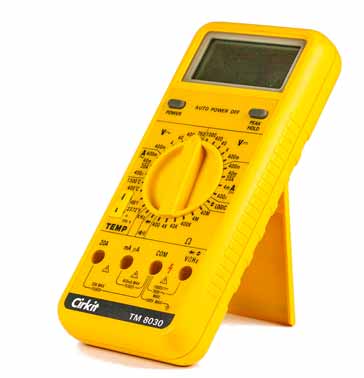
The First Question: Electronics or Electrical?
Before looking at specs, identify your primary use case, as it dictates the safety and features you need.
Electronics (Low Voltage): You are working on PCBs, battery-powered gadgets, or ham radio gear. You need high precision, resolution, and features like diode and capacitance testing.
Electrical (Mains/High Power): You are testing wall sockets, circuit breakers, or industrial machinery. You need ruggedness, Safety CAT ratings, and perhaps a Non-Contact Voltage (NCV) detector.

ANENG AN870 Profesional Smart Digital Multimeter Digital: 19999 Counts
Battery powered smart multimeter: DC & AC voltage, DC & AC current, resistance, capacitance, frequency, duty cycle. True RMS, autoranging.
Safety First: Understanding CAT Ratings
This safety section is probably the most important part of the guide. A multimeter’s Category (CAT) rating tells you how much "transient" (high-voltage spike) the meter can withstand.
Any digital multimeter that is to be used on mains or line power should have a very good CAT rating, and the . . . . . . .
| Digital Multimeter Cat Ratings |
||
|---|---|---|
| Rating | Where it is used | Example Applications |
| CAT I | Protected electronic circuits | Signal level, PC components |
| CAT II | Single-phase plug-in loads | Appliances, TVs, standard outlets |
| CAT III | Fixed installations / Distribution | Circuit breakers, lighting systems |
| CAT IV | Origin of the utility supply | Electricity meters, outside service drops |
The Golden Rule: Never use a CAT II meter on a CAT III circuit. If you plan to touch a UK wall socket or a consumer unit, ensure your meter is at least CAT III 600V and has HRC (High Rupture Capacity) ceramic fuses inside. Cheap glass fuses are a major safety risk in high-energy circuits.
Also be wary of using meters from unknown suppliers of anything apart from low voltage signal boards and the like.
Key Technical Specifications
there are several key technical specifications for any scope that need to be investigated closely.
A. Counts and Resolution
You’ll see numbers like "2000-count" or "6000-count." This can be considered to refer to how many increments the meter can display before it has to change ranges.
2000-count: Can display up to 19.99V. If you measure 20.01V, the decimal moves, and you lose a digit of precision (it shows 20.0V).
6000-count: The "gold standard" for hobbyists. It can show 5.999V with high precision, which is vital for 5V digital logic circuits.
B. Accuracy
Accuracy is usually listed as something like ±(0.5% + 2). But what does this really mean?
- The 0.5% is the error relative to the reading.
- The + 2 is the "least significant digit" (the last number on the right can be off by 2 units).
Verdict: For general repair, 0.5% to 1.0% is fine. For precision calibration, look for 0.1% or better. But really precision meters are much more expensive.
C. True RMS vs. Averaging
Standard meters "guess" the voltage of AC signals by assuming they are perfect sine waves. True RMS (Root Mean Square) meters actually calculate the heating value of the waveform, and they will work regardless of the type of waveform being measured.
Why it matters: If you are measuring "dirty" power from a PC power supply, a dimmer switch, or a motor controller, a non-True RMS meter can be off by as much as 40%. If possible, try to buy a true RMS meter. It will be worth it in the long run.

ANENG 683 Smart Digital Multimeter Touch Screen, Rechargeable, 6000 Counts
This DMM is a 3 5/6 digital multimeter with an LCD display screen and analogue bar display. It can measure DC voltage, AC voltage (sine RMS), DC Current, AC current (sine RMS), resistance, capacitance, live-line indication, duty cycle, diode on/off test, data hold and automatic power off.
Essential Features for the Modern Lab
There are several features which can be expected on modern digital multimeters and these can make using them much easier and more convenient.
Auto-Ranging: The meter chooses the best range (mV vs V) for you. It’s much faster for beginners, though manual ranging is sometimes preferred for "bouncy" signals.
Continuity Beeper: This is the most used function. Look for a meter with a **"Latched" or "Fast" continuity**—if you tap the probes together, the beep should be instant. If there's a delay, troubleshooting becomes frustrating.
Capacitance & Frequency: Essential for radio hams and electronics repair. Being able to check if a capacitor has "dried out" or if a crystal oscillator is running is invaluable.
LoZ (Low Impedance): High-end meters have a LoZ mode to eliminate "ghost voltages"—stray readings caused by wires running parallel to each other.
Build Quality: The "Feel" Test
A multimeter is a physical tool. Look for:
Input Protection: Does it have thick internal traces and proper fuses?
Display Quality: Is the backlight even? Can you read it from an angle?
The Leads: High-quality silicone leads stay flexible in the cold; cheap PVC leads become stiff and annoying.
Brand Hierarchy & Pricing
| Comparison of Levels of Oscilloscope |
||
|---|---|---|
| Category | Price Range | Top brands |
| Budget / Hobbyist | $40 – $80 | Kaiweets, Aneng, Uni-T |
| Intermediate / Prosumer | $90 - $250 | Extech, Brymen, Siglent, Klein |
| Professional / Industrial | $300+ | Fluke, Keysight, Hioki |
Final Checklist Before You Buy
- Does it have HRC Ceramic Fuses? (Essential for safety).
- Is it True RMS?** (Essential for accuracy on modern electronics).
- Is the CAT rating appropriate for your work?** (CAT III 600V for most home/lab work).
- Does it include a Temperature probe?** (Very useful for checking if components are overheating).

ANENG SZ305 Digital Multimeter Professional AC/DC Voltage Ammeter Capacitance hFE
The SZ305 is a handheld digital multimeter, designed and produced according to international electrical safety standards, used to measure AC/DC voltage, AC/DC current, resistance, capacitance, diode and other functions.
Please note: ElectronicsNotes makes a small commission on any sales that are made from links on this article.
 Written by Ian Poole .
Experienced electronics engineer and author.
Check out more sections of our store:
Ham radio HF gear
Ham radio VHF / UHF gear
Ham radio Morse keys & ancilliaries
HF antennas, tuners, meters, etc
VHF / UHF ham radio antennas
Signal generators
Multimeters
Oscilloscopes
Frequency meters & counters
Logic analyzers
Audio amplifier kits
Ebooks (PDF)
Coffee mugs
Downloadable infographics
Reviews: Ham radio eqpt reviews
Return to the Shop Front . . . .