
Jack Phillips: Wireless Operator on RMS Titanic
At the centre of the story of the Titanic is the wireless operator, Jack Phillips, born in a Surry, England town who showed bravery and dedication during this infamous disaster.
Very few people have heard of Jack Phillips, but indirectly he was a pivotal person in the development of maritime and his story is fascinating, if rather sad.
In the chilling, early hours of April 15, 1912, as the RMS Titanic tilted precariously into the icy depths of the North Atlantic, a frantic rhythmic tapping echoed from a small, cramped room on the boat deck.
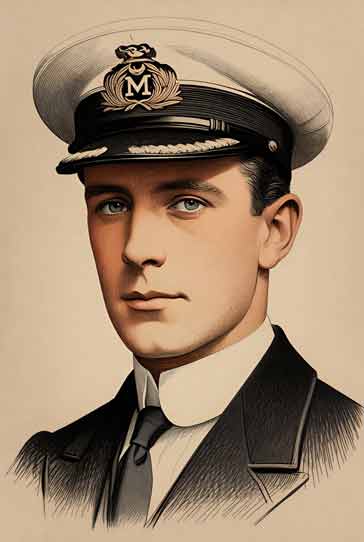
That sound—the sharp, percussive crackle of a rotary spark-gap transmitter - was the only thread connecting more than 2,200 souls to the rest of the world. At the key was John George "Jack" Phillips.
To history, he is often remembered as the man who stayed at his post until the water lapped at his feet. But to understand the weight of his sacrifice, one must look at the life of the boy from Surrey, England who became the voice of the world’s most famous shipwreck.
The Surrey Boy: Early Life and Upbringing
John George Phillips was born on April 11, 1887, in Farncombe, Surrey, England. He was born into a comfortable, hardworking Victorian environment.
His father, George Alfred Phillips, was a draper’s assistant, and his mother, Anne, managed the household. Jack was one of six children, though only three survived to adulthood.
Jack’s childhood was defined by the quiet rhythm of town life and a solid education at Godalming Grammar School which was not too far away from Farncombe. He was described by those who knew him as a bright, enthusiastic boy with a penchant for choir singing and a burgeoning interest in the "new" technologies of the era.
By the time he finished school in 1902, the world was on the cusp of a communications revolution. Guglielmo Marconi’s successful transatlantic radio transmission in 1901 had captured the public imagination, and for a young man looking for adventure, the "wireless" was the ultimate frontier.
Entry into the Wireless World
Phillips began his career not at sea, but at the Godalming Post Office, where he learned the fundamentals of telegraphy.
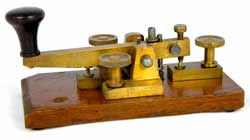
This British Post office key dates from around 1900 and was manufactured by Walters Electrical.
In 1906, at the age of 19, he moved to Seaforth, Liverpool, to attend the Marconi Company’s wireless telegraphy school.
It is important to note that Phillips was not a "sailor" in the traditional sense. He was a Marconi employee — a "telegraphist" contracted out to shipping lines.
This distinction would later play a crucial role in the Titanic disaster. After graduating, Phillips spent several years honing his craft on a variety of notable vessels, including:
The RMS Teutonic: His first assignment, where he adjusted to the rigours of life at sea.
The RMS Lusitania and RMS Mauretania: The "greyhounds" of the Atlantic. Serving on these prestigious Cunard ships cemented Phillips' reputation as a first-rate operator who could handle high volumes of traffic with speed and accuracy.
The RMS Oceanic: His final post before being assigned to the "Ship of Dreams."
By 1912, Jack Phillips was considered one of the senior "sparks" in the Marconi service. When he was appointed as the Senior Wireless Operator for the Titanic’s maiden voyage, it was seen as a crowning achievement for a man just turning 25.
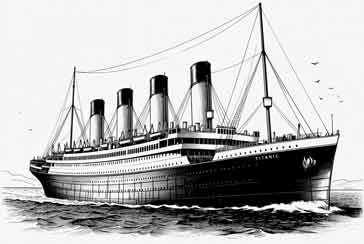
The Marconi Suite: The Heart of the Titanic
The wireless room on the Titanic, located in the Officers' Quarters on the Boat Deck, was officially known as the Marconi Suite. It was divided into three sections: the Sleeping Quarters, the Main Operating Room, and the Silent Room.
The "Silent Room" was arguably the most impressive. It contained the massive 5-kilowatt rotary spark-gap transmitter, housed in a lead-lined box to dampen the deafening noise of the electrical sparks. This was the most powerful wireless set in the world at the time, capable of reaching across the Atlantic under the right atmospheric conditions.
Phillips was joined by a Junior Operator, Harold Bride. The two men worked in shifts to ensure 24-hour coverage—a rarity at the time, as many ships only operated during the day.
Their primary job, however, was not navigation; it was commerce. They were there to send and receive "Marconigrams" for the wealthy passengers—stock tips, dinner invitations, and greetings to loved ones.
The Fatal Sunday: Overload and Breakdown
The voyage began with a technical crisis that would haunt history. On the night of April 13, the wireless set broke down.
For hours, Phillips and Bride painstakingly disassembled the equipment, eventually discovering that the leads to the secondary coil had burnt out.
Under Marconi rules, they should have waited for a shore-based engineer. Instead, they spent six hours fixing it themselves.
While this showed incredible initiative, it created a massive backlog of passenger messages. By the morning of Sunday, April 14, Phillips was exhausted and under immense pressure to clear the "Cape Race" traffic (the shore station in Newfoundland).
Throughout that day, the Titanic received several ice warnings from other ships: the Caronia, the Baltic, and the Amerika.
Phillips dutifully passed these to the bridge. However, the sheer volume of personal messages meant the wireless room was a frantic hub of activity.
The "Shut Up" Incident
The most controversial moment occurred at 11:00 PM. Cyril Evans, the sole operator on the nearby SS Californian, tried to signal Phillips to warn him they were stopped in ice.
The signal was so close that it blasted into Phillips' headphones, nearly deafening him. Evans was known as being very chatty and Phillips did not have time for this.
Exasperated and trying to push through the backlog of messages for Cape Race, Phillips tapped back:
"Keep out! Shut up! I am working Cape Race."
Note: "Working" was the terminology used by radio operators to indicate they were communicating with another station, and Cape Race was the Marconi station in Newfoundland.
Evans, feeling rebuffed and having reached the end of his scheduled shift, turned off his radio and went to bed. This meant that when the Titanic struck the iceberg 40 minutes later, the closest ship was effectively deaf to her cries for help.
The Collision and the Distress Calls
At 11:40 PM on 14th April, the Titanic struck the iceberg. Initially, Phillips and Bride were unaware of the severity, but as the severity of the situation unfolded, they started sending out distress calls.
They used both the old CQD distress call and the more up to date and now more familiar, SOS messages.
CQD had adopted by the Marconi International Marine Communication Company from 1 February 1904. Even in 1912 it was still in use.
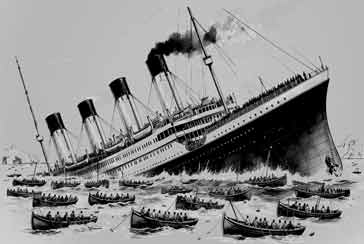
However the newer and internationally agreed SOS distress signal was introduced from 1908, and although this had been established for some years, Phillips and Bride did not initially use this, only later in the emergency did they start to use it.
Interestingly Bride reported later that he said:
"Send SOS; it's the new signal, and it may be your last chance to send it."
Phillips laughed and began sending a mix of both. This was one of the first times in history that the SOS signal was used in a major maritime disaster.
The first time SOS was used was when the Cunard liner RMS Slavonia was shipwrecked off the Azores on 10 June 1909.
For two hours, Phillips was a whirlwind of focused energy. He contacted other ships in the vicinity including the Frankfurt, the Mount Temple, and most importantly, the RMS Carpathia.
As the power on the Titanic began to fade, the "spark" of his transmitter grew weaker and the tone flatter.
Another issue with these early wireless transmissions was that many shore based stations tried to help with the communications, but sadly this only introduced more confusion because the transmissions were all very broadband spark transmissions and the additional stations only created a huge amount of interference.
The Final Moments
By 2:00 AM, the Titanic was at a steep angle. Captain Smith returned to the shack and told the men, "Men, you have done your full duty. You can do no more. Abandon your cabin. Now it's every man for himself."
Despite the "release," Phillips stayed for several more minutes, trying to send one final burst of information. As he worked, a stoker reportedly crept into the room and tried to steal Phillips' lifebelt from his back. A scuffle ensued, and Bride later recounted that he held the man while Phillips "finished him" (likely knocking him unconscious).
The two operators finally ran from the shack as the water began to flood the bridge area. Phillips ran aft, while Bride headed toward the collapsible lifeboats.
Phillips' exact end is a matter of historical debate, but the most widely accepted account comes from Charles Lightoller, the Titanic's Second Officer. He reported that Phillips made it to the overturned Collapsible B lifeboat. In the freezing dark, the men clung to the hull, struggling to keep it balanced.
Throughout the night, Phillips reportedly informed the others about the ships that were on their way, using his knowledge to keep their spirits up.
However, the combination of exhaustion and the 28°F, -2°C water was too much. Before dawn broke, Jack Phillips slipped away into the sea. His body was never recovered.
The Rescue
It took some time for help to arrive. Amongst the ships that responded was the RMS Carparthia.
However the CS Mackay-Bennett was the first ship to arrive at the Titanic wreck site in search for survivors and bodies.
Legacy and Memory
The death of Jack Phillips sparked an immediate wave of public mourning and a long-overdue conversation about maritime safety.
He likely died on 15th April 1912
The Phillips Memorial
In his hometown of Godalming, the "Phillips Memorial Cloister" was built—the largest memorial to a single Titanic victim in the world. It stands as a quiet, garden-filled tribute to a man who remained at his post.
Legislative Change
The tragedy led directly to the Radio Act of 1912 and the International Convention for the Safety of Life at Sea (SOLAS). These regulations mandated that:
- All sea-going vessels must maintain 24-hour wireless watch.
- Wireless operators must be under the direct authority of the ship’s Captain, not a private company.
- Distress signals must take absolute priority over commercial traffic.
The Voice in the Void
Jack Phillips represents the bridge between the Victorian age of "stiff upper lip" duty and the modern age of global connectivity. He was a young man caught in a transition of technology and class, tasked with an impossible burden.
While critics point to the "Shut up" message to the Californian as a fatal error, historians largely view Phillips as a victim of a system that prioritized the telegrams of millionaires over the safety of the sea.
In the end, his heroism outweighed his exhaustion. He died ensuring that the world knew where the Titanic was, ensuring that 712 people would live to tell the story he could not.
 Written by Ian Poole .
Experienced electronics engineer and author.
More Famous Scientists in Electronics and Radio:
Volta
Ampere
Armstrong
Appleton
Babbage
Bardeen
Brattain
Edison
Faraday
R A Fessenden
Fleming
Heaviside
Hertz
Ohm
Oersted
Gauss
Hedy Lamarr
Lodge
Marconi
Maxwell
Morse
H J Round
Shockley
Tesla
Return to History menu . . .