The Beverage Antenna: A Classic Low-Noise Receiving Antenna for LF, MF and HF
The Beverage antenna may be thought of as outdated, but it can be used to great effect on the modern LF, MF and HF bands where it is able to receive signals with lower noise levels than other antennas.
Home » Antennas & Propagation » this page
Wire Antennas Includes:
End fed / long wire antenna
Multiple wavelength long wire
End fed half wave antenna
W3EDP antenna
Random wire antenna
Terminated long wire antenna
V beam antenna (bidirectional)
Unidirectional V beam antenna
Rhombic antenna
Beverage antenna
The Beverage antenna – sometimes called the “Beverage wave antenna” or simply “Beverage” – is one of the oldest specialised receiving antennas still in regular use by radio amateurs, short-wave listeners and professional monitoring stations.
First described in 1921 by Harold H. Beverage (then at RCA) and his colleagues, it remains unmatched in certain applications for its ability to deliver an extremely low noise floor and a clean cardioid pattern on the low bands (typically 160 m through 30 m, and sometimes higher).
Despite its simplicity – just a single wire one or two wavelengths long, a few metres above the ground, and terminated at the far end – the Beverage is capable of outperforming much more elaborate directional arrays when the goal is weak-signal reception in the presence of man-made noise or strong local signals.
How the Beverage Antenna Works
The Beverage antenna is a classic example of what is called a travelling-wave antenna.
Unlike resonant antennas (dipoles, Yagis, loops, etc.) that depend on standing waves, the Beverage supports a single-direction travelling wave along its length.
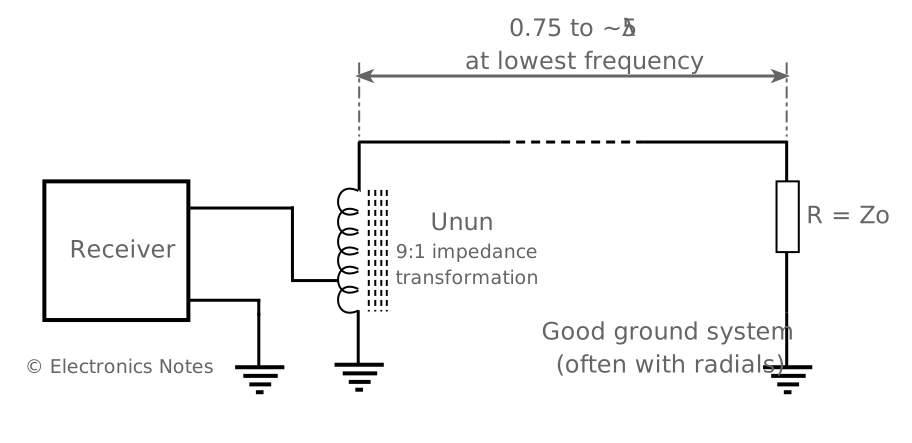
From the diagram of the basic Beverage antenna concept, it can be seen that the remote end of the antenna is terminated in a resistor. It is this resistor that absorbs any power that would otherwise be reflected and set up standing waves on the antenna element. As a result, this antenna becomes unidirectional rather than have the typical long wire bidirectional radiation pattern.
The basic principles can be explained in very basic terms.
A horizontally polarised radio wave arriving from the direction the wire is pointing travels along the ground and induces a current in the wire.
Because the wire is relatively close to the ground (0.5 – 3m is typical), the phase velocity of the wave along the wire is slightly slower than the speed of light. This velocity factor (typically 0.89 – 0.95c depending on height and soil) is critical – it allows the induced current to add constructively as it travels toward the feed end.
At the far (terminating) end of the wire, a non-inductive resistor (usually 400 – 600Ω carbon composition) to ground dissipates any current that would otherwise reflect and create a bidirectional pattern.
The result is a unidirectional cardioid pattern with a good front to back ratio and a broad main lobe toward the feedpoint.
The antenna has an inherently low gain. This may be typically –6 to +5 dBi depending on length and soil conductivity.
However its its real advantage is the great signal-to-noise ratio it achieves by rejecting noise arriving from most directions, especially vertically-polarised local noise.
It is interesting to note that the antenna performs better when it is located over ground with poor conductivity but this does mean that the earth or grounding system for the terminating resistor needs to be very good.
Historical Context
Harold H. Beverage, Rice, and Peterson published their findings in 1921 – 1922 while trying to solve transatlantic communication problems on long wave frequencies, i.e. below 500 kHz.
One of the major issues that was trying to be solved was that of receiving the weak tranatlantic signals against a background of high static noise levels.
it was on 7th June 1921 that Beverage obtained his first patent for his radio receiving system antenna.
At that time it was known that a long wire antenna had a bidirectional pattern, but Beverage's system enabled the antenna to have a unidirectional system.
The RCA receiving site at Riverhead, Long Island used multiple Beverage antennas hundreds of metres long pointed at Europe.
These antennas allowed reliable reception of weak signals that were completely buried in noise on verticals or loops. The basic design has changed very little in a century.
Construction Details
A practical amateur-radio Beverage is remarkably easy and cheap to build, although it does require a good amount of space.
Some useful pointers are given in the lists below that help in determining how one may be made.
Length
Minimum useful length is about 0.75 – 1&lambda at the lowest frequency. If the length is below about 0.75λ then the noise rejection capability id reduced. Above about 5λ then the efficiency reduces.
Classic “two-wavelength” antennas (e.g., 500–550 m on the 160m amateur radio band) tend to give the best pattern and around +4 to +5 dBi gain.
Shorter versions (0.75 – 1 λ) still work surprisingly well, especially on 80 m and 40 m.
Height above ground
1.5–3 metres is the usual range.
Lower heights improve forward gain slightly but make the antenna more lossy and more sensitive to ground quality.
Higher than 4 – 5m starts to destroy the travelling-wave mechanism.
Wire
Almost anything works: insulated 0.5–1.5 mm² hookup wire, electric fence wire, or even surplus military field telephone wire.
Insulation is highly recommended to prevent corrosion and detuning in wet weather.
Characteristic impedance
Roughly 400 – 600 Ω depending on height and ground conductivity.
Most builders simply use 470Ω or two 1 kΩ carbon-composition resistors in parallel (≈ 500Ω) as the terminating load. Carbon composition is preferred because it remains non-inductive at HF.
Feed system
A 9:1 impedance transformer (unun) at the feedpoint is almost universal today as this will enable it to provide a good match 50 a 50Ω feeder.
Primary (50 Ω side) connects to the coax; secondary (450–600 Ω side) to the antenna wire and a short counterpoise or direct ground stake.
Many builders use a common-mode choke on the coax just before the transformer to prevent the feedline itself becoming part of the antenna.
Grounding
The terminating resistor must go to a good RF ground (this may be a stake or earth rod, and possibly the addition of radials to ensure the best performance).
The feedpoint ground can be modest – a single 1–2 m stake is usually sufficient when using a transformer.
Directivity and gain
The Beverage antenna perfoms well in terms of gain and diretivity. It provides an almsot cardiod radiation pattern and reasonable levels of gain cab be achieved.
Although the antenna is able to oeprate over a wide bandwidth, its gain and directional pattern will vary over its operating range.
The longer the antenna, the greater the gain and the narrower the beamwidth as might be expected.
However it is found that for antennas that are longer than 5λ, the performance starts to fall, both gain and directivity are impacted.
The reason for this is that the voltages and currents induced by the travelling wavefront travelling start to interfere with the voltages and currents on the wire itself, impactingt he performance.
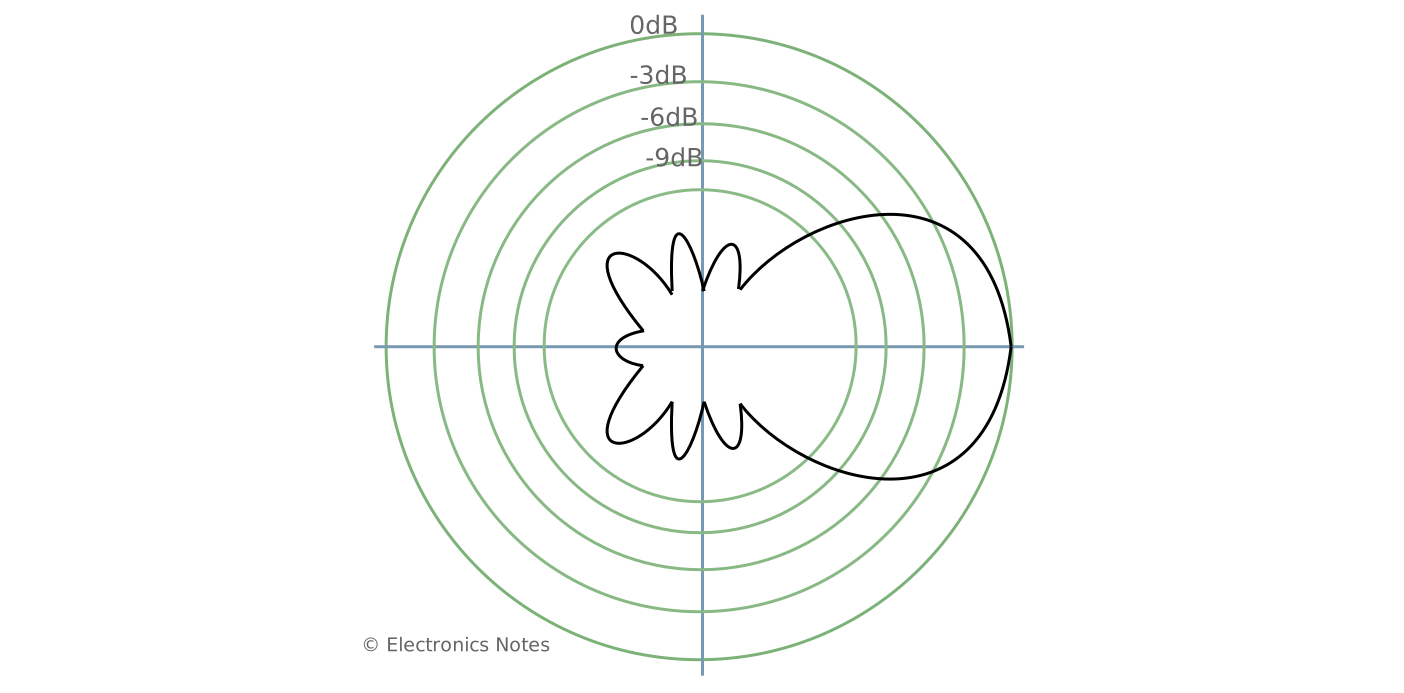
In terms of the actual peformance that might be expected a typical 2&lambda antenna erected over average ground might exhibit the following:
Front-to-back ratio: This might be as much as 20dB which is ideal for redicng strong signals from the opposite direction.
Beamwidth: Beamwidth might be around 60° or possibly as much as 80° dependent uppn the particular installation.
Take-off angle: This can be very low, usually 10–25° and this is ideal for long-distance low-band DX.
Gain: The gain might be up to 8 dBi over average soil, but figures are very dependent upon the situation and figures up to about 5dBi are often achieved with an antenna of around 2λ in length.
It must be remembered that the typical gain figures are given to provide an idea of the range of performance achievable and the actual figures will depend upon a whole variety of factors.
Limitations and Myths
It is worth looking at some of the issues associated with Beverage antennas to see whether or not they are true.
It needs enormous space: A 160 – 200m long single-direction Beverage is still extremely effective on 80 m and 40 m and fits many rural European or North American gardens and available space. While this is not small and the antenna needs to be straight, it does not require a complete farm allocated to the antenna.
Poor soil kills performance: While very dry sandy soil may impact the performance of many antennas, the Beverage actually benefits from it because very conductive soil can impact the travelling wave. However, the grounding or earthing of the antenna can become more of an issue.
Only for 160 m: Many top DXers use 250–350 m Beverages on 80 m and even 40 m with outstanding results.
Difficult to match: Modern 9:1 transformers give SWR under 2:1 from 1.8–10 MHz on a correctly built antenna. However it is always advisable to use an antenna tuning / matching unit to ensure that a good match is always presented to the receiver.
Practical Tips
As with any antenna there are a few practical considerations that can be learned from people who have used these antennas in the past and learned from their experiences.
Use UV-resistant insulated wire and good egg insulators; a Beverage often stays up for 10–20 years.
Place the wire over the poorest-conductivity ground you have (dry field, woods) rather than over wet salt marsh if possible – counter-intuitively, lower ground conductivity often gives a cleaner pattern.
In winter, ice loading can detune the antenna dramatically; a slight upward slope helps shed ice.
If you have only 100–150 m, consider a “terminated folded Beveridge” or a reversible pair offset by 30 – 50 m – you’ll still outperform most transmit antennas used for receiving.
These few tips can help improve the installation, performance and long term sustainability of this type of antenna.
Over a century after its invention, the Beverage antenna remains the gold standard for low-band weak-signal reception but obviously it can only be used where space permits.
Its combination of simplicity, low cost, superb front-to-back ratio, and unmatched ability to dig weak signals out of noise continues to make it a favourite of contesters, DXers, and low-frequency experimenters worldwide.
 Written by Ian Poole .
Experienced electronics engineer and author.
More Antenna & Propagation Topics:
EM waves
Radio propagation
Ionospheric propagation
Ground wave
Meteor scatter
Tropospheric propagation
Antenna basics
Cubical quad
Dipole
Discone
Ferrite rod
Log periodic antenna
Parabolic reflector antenna
Phased array antennas
Vertical antennas
Yagi
Antenna grounding
Installation guidelines
TV antennas
Coax cable
Waveguide
VSWR
Antenna baluns
MIMO
Return to Antennas & Propagation menu . . .