The SWR Lie: Why I Found the SWR Looked Good But The Antenna Match was Poor
It's often good practice to monitor the SWR and usually we look for a low SWR reading, but sometimes a low SWR may actually indicate a problem.
Home » Antennas & Propagation » this page
VSWR & Transmission Line Theory Tutorial Includes:
What is VSWR?
Reflection Coefficient
VSWR formulas & calculations
How to measure VSWR
How to use a VSWR meter
The SWR lie - what is means in practice
Simple SWR bridge circuit
What is return loss
VSWR / Return Loss Table
Some years ago, I was using an HF vertical with some old coax cable. All seemed well because the SWR was low, but the trouble was that the antenna did not appear to be operating as it should. Signal levels were low and I was not getting as many contacts as I should ahve been getting.
Later I even found that the traps in the vertical were not operating correctly. The antenna was definitely not operating correctly, but even so the SWR was good. Why was this?
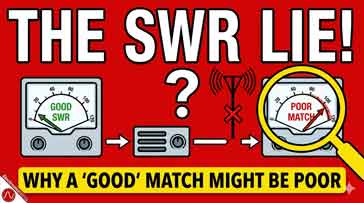
This is a classic example of what may be termed the SWR lie - the SWR is good, but the antenna is not working and not properly matched.
The truth is that a low SWR reading at the transmitter end of a long or lossy feedline is not a guarantee of an efficient antenna system.
In fact, it can be a symptom of a failing one. To understand why, I had to look past the meter and into the physics of what happened to a RF signal as it travelled fromt he transmitter to the antenna.
The Anatomy of a Reflection
In an ideal world, a transmitter generates power (Pfwd), sends it down a lossless cable, and the antenna radiates 100% of it into space.
In the real world, if the antenna’s impedance doesn't perfectly match the feedline’s characteristic impedance (usually 50Ω), a portion of that energy is rejected and sent back down the cable toward the transmitter (Pref).
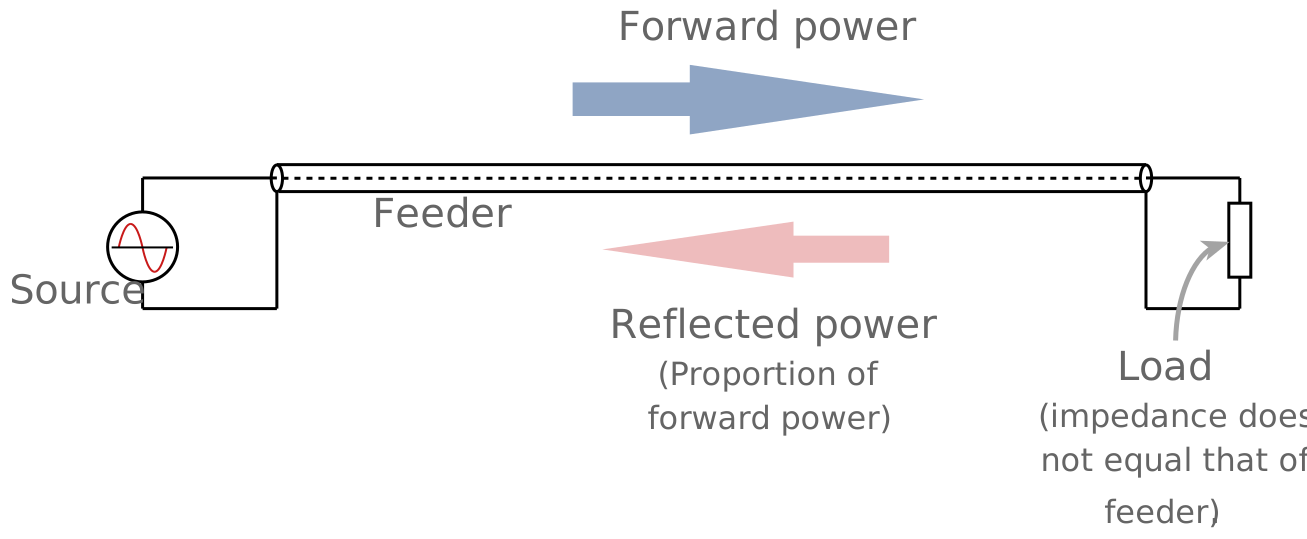
SWR meters are able to detect the power flowing in the forward direction and that being reflected.
The formula for the Voltage Reflection Coefficient (Γ) is:
It is then possible to calculate the SWR from these figures:
The problem is that your meter can only measure what actually reaches it. It has no idea what is happening at the other end of 30 meters of coaxial cable. It only knows what is happening at the "shack end."
The Round-Trip Trap: How Loss Masks Reality
The reason for the "SWR Lie" can be found by looking at the feeder attenuation. The coaxial cable has a specific amount of loss, and this is typically measured in decibels (dB) per hundred feet or metres.
This loss is caused by the resistance of the centre conductor and less so the outer braid, and also the dielectric absorption between the core and the shield, as well as leakage through the braid and some other factors.
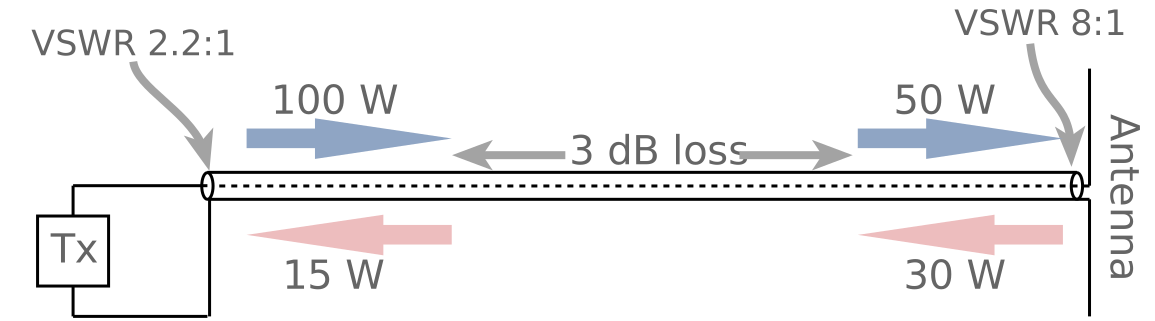
To understand why this affects the SWR, take the example of a transmitter transmitting 100 watts through a feeder with a loss of 3 dB - which is not too bad in reality. This means that only 50 watts reaches the antenna.
If the antenna has a poor match and the resulting VSWR is 8:1, i.e. 60% or 30 watts of the power reaching the antenna is reflected.
This reflected power is further attenuated by 3 dB meaning that only 15 watts reflected power is seen at the transmitter.
The reflected power has been attenuated by 2 x 3dB, i.e. 6 dB and this means that a VSWR at the antenna of 8:1 is seen at the transmitter as a VSWR of 2.2:1 which is not bad.
The "Dummy Load" Effect
If your cable is lossy enough, you could disconnect the antenna entirely, and your SWR meter would still show a perfect match.
This is exactly how a dummy load works: it is a device designed to turn 100% of RF energy into heat so that none of it reflects back.
A damaged, water-ingress-soaked, or simply poor-quality feedline (like a long run of thin RG-58 at VHF/UHF frequencies) acts as a distributed dummy load.
It absorbs the forward power before it can be radiated and any reflected power is also dissipated before it can be measured.
You aren't operating a radio station; you’re operating a very long, very expensive heater.
I thought these products may be of interest . . . . . .
These SWR meters might be useful when looking into antennas, feeders and SWR:

NISSEI RX-103 Mini SWR/Watt Meter 2KW 1.6-60MHz
RS-103 can measure forward and reverse power, as well as SWR for AM, SSB, etc. Frequency range: 1.6 - 60MHz, Measurable power range: 1W up to 2KW.

Original Nissei Dg-503 Digital LCD 3.5" SWR & Wattmeter 1.6 - 60 MHz / 125 - 525 MHz
The digital meter can be used to measure forward power, reflection power and VSWR, 0 - 200W; 3.5 inches LCD display for easy reading; LCD backlight display, Forward / Reflective / VSWR Ratio in one push button.

LED RF Powered SWR Meter 3-30MHz
A novel RF powered SWR meter with a frequency range from 3 - 30MHz. Although you would not want to leave this in circuit all the time because of the RF loss, it is able to provide a useful indication of SWR. Ideal for amateur radio enthusiasts to use in the field.
Check out more items you might like from our Antennas, Tuners & Meters store.
More convenient to buy from Amazon.com? Check out my Amazon Storefront.
Note: We make a small commission from any sales at no cost to you.
How to Find the Truth: Tools and Techniques
So, how do you avoid being lied to by your equipment? SWR meters in themselves do a great job, but only when they can see the full picture which happens when there is little loss in the feeder.
But what tools can be used to get the right picture and what is the best overall solution>?
1. Use a VNA or Antenna Analyzer at the Feed Point
The only way to know the true state of your antenna is to measure it where the feedline meets the radiator itself, i.e. the antenna.
But often the feed point can be quite inaccessible, especially if the antenna needs to be measured when it is in place. So if you can’t get to the top of the tower, measure the antenna with a short "jumper" cable first before connecting the main run. If the SWR jumps from 1.5:1 (at the antenna) to 1.1:1 (in the shack), your cable is doing the "lying."
2. Calculate the Expected Loss
Know your cable. If you are using 30 metres of RG-213 at 144MHz, look up the loss charts. If the SWR at the shack is significantly better than you expect for that type of antenna, be suspicious.
3. The "Open/Short" Test
One simple test that can be performed is called the open / short test. If done with care and under the right conditions it should be safe. However I am always wary of doing it.
The first stage is to set the transmitter to the lowest poer that the SWR meter will operate with..
Then, if you can access the far end of the cable, disconnect the antenna so that it leaves an open circuit. A short circuit is equally effective.
Make sure again that the transmitter is set to low power and that the transmitter is able to withstand an open / short circuit.
If this is all OK, then check the SWR level at this low power level.
In a perfect loss-less cable, the SWR should be infinite, i.e. the needle should max out and the reverse power should equal the formward power.
In a real system there will be some loss and a non-infinite SWR will be measured. If the SWR is 3:1 or 5:1, the cable is sufficiently lossy that it is providing a "match" all by itself. At this sort of level, consider replacing it as it might have had water ingress or it may not be a sufficiently low loss cable, or it may just be too long.
4. Invest in Quality Feedlines
The best way to prevent the SWR Lie is to use high-quality, low-loss cables like LMR-400 or Westflex 103, especially for VHF, UHF, and long HF runs.
The lower the "matched loss" of the cable, the less it can mask a poor antenna match.
Conclusion: The Total System View
The SWR meter is a vital tool, may be considered as a local indicator of the SWR. Placed next to the transmitter, it is very useful to ensure that the transmitter is seeing a good match. But it tells you only what is happening at its specific location in the circuit.
To be a successful with running a radio station, amateur or professional, it is necessary to think in terms of the total system.
A 1.5:1 SWR at the end of a high-quality, low-loss line is infinitely better than a 1.1:1 SWR at the end of a "leaky" dummy-load cable. Don't let a "perfect" needle position lull you into a false sense of security.
If the performance doesn't match the meter, stop trusting the shack-end SWR and start looking at the line.
In the world of RF, the truth is rarely found at the bench — it’s found at the antenna. Trust your ears, trust your signal reports, and always verify your match at the source.
 Written by Ian Poole .
Experienced electronics engineer and author.
More Antenna & Propagation Topics:
EM waves
Radio propagation
Ionospheric propagation
Ground wave
Meteor scatter
Tropospheric propagation
Antenna basics
Cubical quad
Dipole
Discone
Ferrite rod
Log periodic antenna
Parabolic reflector antenna
Phased array antennas
Vertical antennas
Yagi
Antenna grounding
Installation guidelines
TV antennas
Coax cable
Waveguide
VSWR
Antenna baluns
MIMO
Return to Antennas & Propagation menu . . .