Why Use a Bipolar Transistor When MOSFETs Are Available
Despite the fact that MOSFETs are the go-to electronic component for many design, bipolar Junction Transistors, BJTs still beat them hands down in some areas.
Home » Electronic components » this page
Transistor Tutorial Includes:
Transistor basics
Gain: Hfe, hfe & Beta
Transistor specifications
BJT Early Effect
BJT vs MOSFET - which to use
Transistor and diode numbering codes
Choosing replacement transistors
Transistor component data:
Transistor component data
Within electronic circuit design a choice sometimes needs to be made for which type active device to use.
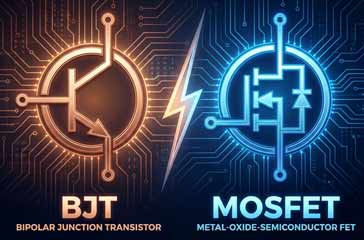
There are two main contenders: the Bipolar Junction Transistor (BJT) and the Metal-Oxide-Semiconductor Field-Effect Transistor (MOSFET).
For decades, these components have been the building blocks of everything from simple hobbyist breadboard circuits to the complex microprocessor based circuits powering our modern world.
While MOSFETs have largely taken over digital computing and high-efficiency power conversion, the BJT—the older of the two technologies, remains indispensable.
Choosing between them isn't about which is the best device; it’s about understanding the physics of their operation and identifying the specific environments where one outshines the other.
Defining the devices
To understand their differences, we must first look at how they move charge.
Bipolar Junction Transistor (BJT)
The BJT is a current-controlled device. It consists of three layers of semiconductor material (either NPN or PNP) and three terminals: the Base, Collector, and Emitter.
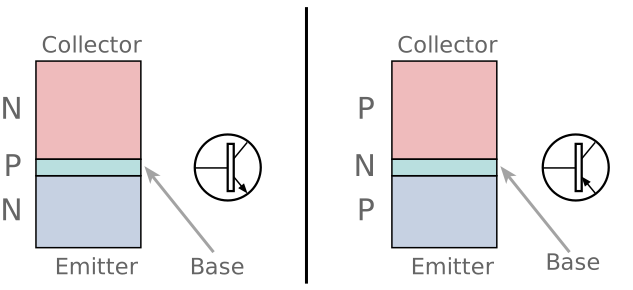
The fundamental principle of a BJT is that a small current flowing into the Base controls a much larger current flowing between the Collector and Emitter.
This type of transistor is called "bipolar" because its operation involves both types of charge carriers: electrons and holes.
MOSFET
The MOSFET is a voltage-controlled device. It also has three terminals: the Gate, Drain, and Source.
Unlike the BJT, the Gate of a MOSFET is electrically insulated from the rest of the device by a microscopic layer of silicon dioxide (glass).
When a voltage is applied to the Gate, it creates an electric field that opens a "channel" for current to flow between the Drain and Source.
Because the Gate is insulated, almost zero DC current flows into it, making it exceptionally efficient for digital logic.
Core Comparison: BJT vs. MOSFET
| Bipolar Junction Transistor vs MOSFET Key Characteristics |
||
|---|---|---|
| Feature | Bipolar Junction Transistor, BJT | MOSFET |
| Control Signal | Base current | Gate Voltage |
| Input impedance | Low | Very High |
| Switching speed | Moderate (limited by charge storage) | Fast (limited by capacitance) |
| Power loss | Constant: VCE(sat) voltage drop | I2R loss due to RDS(on) |
| Sensitivity to static | Relatively robust | Highly sensitive to ESD |

Click here for the infographic page version
Where BJT still shines
It is a common misconception that MOSFETs have made BJTs obsolete. While MOSFETs dominate CPUs and high-frequency power supplies, the BJT possesses unique physical characteristics that make it superior in several specific domains.
1. Superior Linearity and Analog Fidelity
One of the most significant areas where BJTs excel is in analogue signal amplification, particularly in high-fidelity (Hi-Fi) audio.
The relationship between the input and output in a BJT is remarkably linear over a wide range.
In contrast, MOSFETs have a "square-law" characteristic (the output current is proportional to the square of the gate voltage), which introduces more harmonic distortion when used in simple amplifier stages.
For designers of precision audio equipment, the BJT’s predictable, linear gain makes it the gold standard for producing "warm," accurate sound.
2. Low-Voltage Operation
A MOSFET requires a certain "Threshold Voltage" (VGS(th)) to even begin conducting. For many standard MOSFETs, this might be 2V to 4V.
Even "logic-level" MOSFETs struggle when the supply voltage drops below 1.8V.
A BJT, however, only requires about 0.7V (the forward bias of a silicon P-N junction) across the Base-Emitter to turn on.
In ultra-low-voltage circuits—such as those powered by a single 1.2V NiMH battery, a BJT is often the only viable choice for a switching or amplifying element.
3. Constant Saturation Voltage
This is a critical "hidden" advantage of the BJT in power applications. When a BJT is fully "on" (saturated), the voltage drop across it (V_CE(sat)) is relatively constant, typically between 0.1V and 0.3V, regardless of how much current is flowing.
A MOSFET, however, behaves like a resistor (R_DS(on)). According to Joule’s Law (P = I2 R), as the current (I) increases, the power loss in a MOSFET increases as the square of the current.
Example: If you are switching a high-current load (e.g., 20A) at a low voltage, the I2R losses of a MOSFET might exceed the V I losses of a BJT.
In these specific high-current, low-frequency scenarios, a BJT can actually run cooler than a MOSFET.
4. Robustness and Static Resistance
MOSFETs are notorious for their sensitivity to Electrostatic Discharge (ESD). Because the oxide layer at the Gate is so thin, a tiny spark of static electricity, often too small for a human to feel, can punch a hole through the insulation and destroy the device instantly.
BJTs are significantly more robust. They do not have a fragile glass insulation layer and are much harder to kill with stray static during handling or in harsh industrial environments. That said, even bipolar junction transistors should be treated as static sensitive when handling them. But for "rough" applications where the environment isn't perfectly controlled, the BJT provides a layer of physical reliability that MOSFETs lack.
5. Higher Transconductance
In technical terms, "transconductance" (gm) is the measure of how much output current changes for a given change in input voltage.
BJTs generally have much higher transconductance than MOSFETs of a similar size. This means a BJT can provide much higher "gain" or sensitivity in a circuit.
This makes them ideal for weak-signal applications, such as the initial stages of a radio receiver or a sensor interface, where you need to turn a microscopic signal into something usable.
When to use each
Use a MOSFET when:
High-Speed Switching: You are building a DC-DC converter or a motor controller operating in the hundreds of kilohertz (kHz) or megahertz (MHz).
Battery Power: You need to minimize "idle" power consumption. Since the Gate draws no current, MOSFETs are better for keeping batteries alive.
Microprocessors: You are packing billions of switches into a tiny space. MOSFETs (specifically CMOS) generate far less heat in digital logic.
Use a BJT when:>
Audio/Analogue: You are designing an amplifier where sound quality and low distortion are the priority.
Low Voltage: Your circuit operates on 1.5V or less.
Cost-Sensitive Projects: Standard BJTs (like the 2N2222 or BC547) are often cheaper than their MOSFET equivalents.
Simple Constant Current: You need a predictable, current-controlled circuit for driving LEDs or simple relays without complex gate-driver circuitry.
Conclusion
The BJT and MOSFET are not rivals so much as they are specialized tools in an engineer's toolkit. While the MOSFET has won the "digital war," the BJT remains the king of high-fidelity analog and low-voltage robustness.
For the modern hobbyist or professional designer, the best approach is often a hybrid one. Many advanced integrated circuits use BiCMOS technology—combining the high-input impedance of MOSFETs with the high-speed linear performance of BJTs on a single chip. By understanding exactly where the BJT excels, you can design circuits that aren't just functional, but optimized for the physical reality of the signals they carry.
Would you like me to help you design a specific circuit using one of these components, such as a BJT-based audio pre-amp or a MOSFET-based motor driver?  Written by Ian Poole .
Experienced electronics engineer and author.
More Electronic Components:
Batteries
Capacitors
Connectors
ADC
DAC
Diodes
FET
Inductors
Memory types
Phototransistor
Quartz crystals
Relays
Resistors
RF connectors
Switches
Surface mount technology
Thyristor
Transformers
Transistor
Unijunction
Valves / Tubes
Return to Components menu . . .