AM Broadcasting: the rise, fall & its legacy
Once the warm soundtrack of news, music, and night-time static, AM broadcast radio faces an uncertain future. Explore its rich history and enduring legacy.
Broadcasting History Includes:
Broadcasting history & legacy
Pirate radio broadcasting & Radio Caroline
There was a time when the Medium Wave broadcast band was filled with a cacophony of different radio stations, and it became even more crowded at night as more distant stations could be heard. Now the heyday of this medium is over and fewer listeners use AM and the stations disappear one by one.
If you tuned a radio dial in the quiet hours after midnight, the airwaves came alive with distant voices drifting across hundreds of miles.
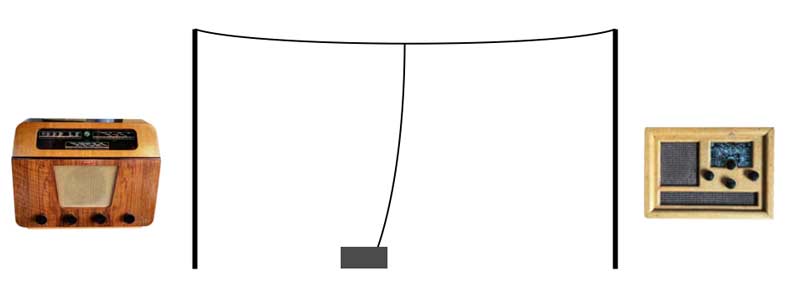
Through a low hum of static and the gentle, ocean-like fading of skywave propagation, you could catch the crackle of a sports broadcast from across the continent, an orchestra playing in a distant capital, or a weak distant 'pop' music or other station fading in and out of the whistles, pops and bangs.
Along with this, many people still have fond memories of the warm glow of a valve / vacuum tube radio tuned to their favourite station.
For over a century, Amplitude Modulation - AM radio was the primary means of broadcasting to everyone. It informed populations during global crises, broadcasted the world’s greatest music, and created a shared cultural experience across continents.
Yet today, the AM dial is growing quiet. As digital streaming, Internet radio, podcasts, and other formats take over, we are witnessing the twilight of the medium that started it all.
Video: Vanishing AM Radio: will you miss these iconic broadcasts
Many stations are closing down, channels are becoming vacant and antenna towers are disappearing from the skyline.
But where did it all start? And what were the main stepping stones and milestones?
The spark of creation: Fessenden’s Christmas miracle
The story of AM broadcasting does not begin with code, but with the human voice. Early wireless telegraphy - pioneered by Guglielmo Marconi and others—relied on spark-gap transmitters that produced damped waves. These could send the sharp "dit-dahs" of Morse code, but were entirely incapable of transmitting speech or music.
Enter Reginald Fessenden, a brilliant Canadian inventor. Fessenden realised that to convey complex sound, one needed a continuous high-frequency wave whose amplitude or strength—could be modified (modulated) in direct proportion to an audio signal.
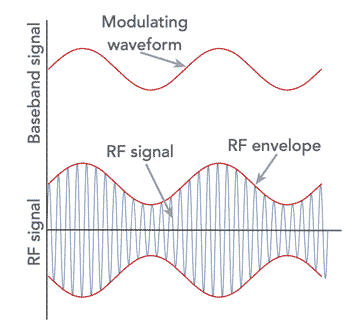
On Christmas Eve in 1906, operating from a station at Brant Rock, Massachusetts, Fessenden turned his high-speed alternator transmitter toward the Atlantic.
Wireless operators aboard ships of the United Fruit Company, accustomed to hearing only the harsh click-clack of Morse code, were stunned to hear a human voice speaking, followed by Fessenden playing "O Holy Night" on his violin and reading a passage from the Bible - the Gospel of Luke.
The radio operators on board ships could hardly believe their ears.
This was the world’s very first wireless AM audio broadcast. The seed of broadcast radio had been planted.
The Golden Era Begins: 1920s USA and the UK (2MT & 2LO)
While experimental transmissions continued through the 1910s, it was the early 1920s that transformed radio from a specialized laboratory curiosity into a public phenomenon.
In the United States, regular commercial broadcasting started in late 1920, highlighted by Westinghouse station KDKA in Pittsburgh broadcasting the Harding-Cox presidential election results on 2nd November 1920.
Almost overnight, a broadcasting boom erupted across America and other stations soon started to broadcast music and news.
Across the Atlantic in the United Kingdom, the trajectory was equally thrilling, albeit strictly regulated. In February 1922, the Marconi Company launched station "2MT" (known affectionately as "Two-Emma-Tock") operating from a wooden hut in Writtle, near Chelmsford, Essex. Run by the charismatic Captain Peter Eckersley, 2MT won the hearts of early listeners with its informal mix of records, live plays, and lighthearted commentary.
The success of 2MT led directly to the establishment of "2LO" in London, situated at Magnet House in Kingsway, which began broadcasting in May 1922. Later it moved tot he building of the Institution of Electrical Engineers next toth e Savoy Hotel.
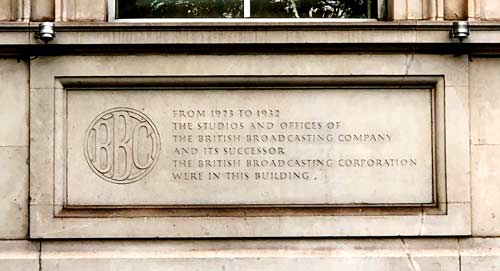
By November of that year, 2LO was incorporated into the newly formed British Broadcasting Company (the precursor to the BBC). AM radio had officially arrived in the British living room.
Radio receiver development: from crystal sets to superhets
The early years of broadcasting saw huge developments in radio receiver technology: the receiver technology had to evolve rapidly to keep pace with the growing density of stations on the dial.
The crystal set: In the earliest days of broadcasting, the most common receiver was the crystal set. Completely passive, requiring no mains power or batteries, a crystal set extracted tiny electrical currents caught by a long outdoor wire antenna.
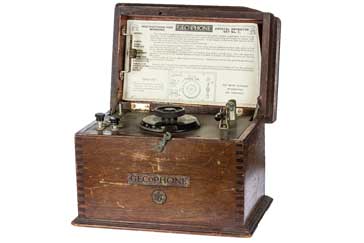
Gecophone BC1001 Crystal Set Type Number 1
This actually shows the BC1001 version as there is no cover on the crystal detectorThe user painstakingly adjusted a tiny wire (the "cat’s whisker") onto a piece of galena crystal to rectify the signal, listening through sensitive high-impedance headphones.
Tuned radio frequency (TRF) radios: As thermionic valves (vacuum tubes) became cheaper and more reliable, Tuned Radio Frequency (TRF) receivers took over. Utilizing multiple valve stages to amplify the signal before detection, TRF radios could drive a loudspeaker, allowing the entire family to sit around the cabinet and listen together.
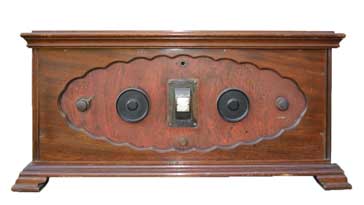
Front view of the GECoPHONE BC2830 vintage TRF radio However, tuning a multi-stage TRF radio often required adjusting three or four separate dials in unison to select a station without causing deafening squeals of oscillation.
Superheterodyne radios: By the late 1920s and early 1930s, as dozens of powerful stations began crowding the airwaves, TRF sets struggled with selectivity—they simply could not isolate one weak station from a strong neighbour.
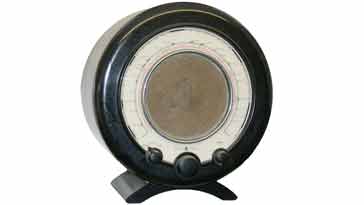
EKCO A22 round radio The solution was Edwin Armstrong’s genius invention: the superheterodyne receiver. The superhet converted all incoming radio signals down to a fixed intermediate frequency (IF), where high gain and much greater selectivity could be applied easily. With a single main tuning control, excellent audio clarity, and an acceptable level of frequency stability, the superheterodyne became the undisputed standard for AM radio design for the remainder of the century.
Wartime lifeline
During the dark years of World War II, AM radio became an absolute lifeline. For millions of households, the comforting chime of the BBC's Big Ben or the steady voice of Edward R. Murrow reporting live from London during the Blitz brought news directly into the home.
Radio was also heavily weaponised for propaganda - from Axis Sally and Lord Haw-Haw to the clandestine resistance broadcasts of the BBC European Service.
1950s & 60s pop explosion
By the 1950s and 1960s, two revolutions reshaped the medium once more: the transistor and the growing demand by young people for 'pop' music.
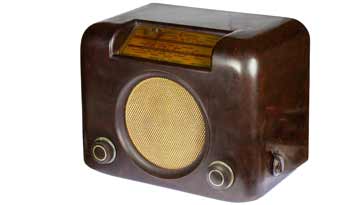
The first of these changes occurred at Bell Labs in the USA when the first transistor was invented in the late 1940s.
It took some while for this to be produced in quantities and costs that would enable them to be widely adopted in consumer equipment, but by the late 1950s and early 1960s many transistor radios were being made and sold.
Their introduction meant that, a radio was no longer a heavy piece of living room furniture; it was a pocket-sized personal companion powered by a small 9-volt (or similar) battery. Teenagers could take music everywhere
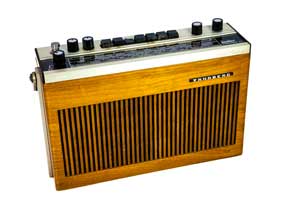
The transistor radio era coincided with the explosion of rock 'n' roll. In Europe, where state broadcasters maintained strict monopolies and played minimal popular music, listeners turned their dials to medium wave at night. Station Radio Luxembourg beamed pop music across the continent on 208 meters (1439 kHz).
By the mid-1960s, pirate radio stations operating from ships and abandoned military forts in the North Sea — such as Radio Caroline and Radio London and many others — captured the ears of millions of British youth. They played non-stop pop records on medium wave, defying government bans and permanently changing the landscape of modern broadcasting.
The broadcast antenna towers
Any radio transmitter requires a good antenna and as a result many broadcast stations developed some huge antenna systems, although more local stations often used much more modest antennas.
The fact that AM stations use relatively low frequencies meant that the wavelengths were long and in turn this meant that the radiating antenna elements wer large.
An impressive selection of antennas large and not so large were seen around the country and manya re still in use to this day.
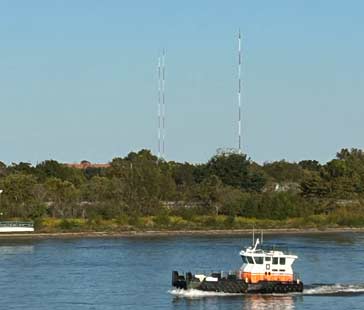
The twin antenna is most likely the system for WWL near New Orleans
In terms of the techniques used, some antennas used large vertical radiators - the towers themselves which were guyed - note the insulators in the guy lines that stopped these lines affecting the radiation. Other systems used wires between the towers, often a 'T' configuration was used.
I've assembled a selection images of AM radio antenna system from around the globe.
WROW (Albany, New York, USA): A prime example of American directional array engineering, utilizing multiple tall guyed towers to shape the radio signal, to concentrate signal strength into target population areas. There are three antenna towers which are 149 metres tall (488 feet) tall and using three enables the required directional radiation pattern to be achieved. This huge array is driven by a transmitter delivering 5kW during the day and 760 watts at night to reduce distant interference with other stations when the ionospheric D region reduces and longer distances are achieved.
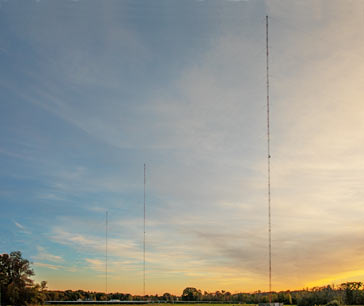
WROW medium wave broadcast antenna in Albany, New York State Brookmans Park (Hertfordshire, UK): Opened by the BBC in 1929, this iconic twin-tower site introduced dual-program regional broadcasting to London and the South East, serving as a flagship transmission centre for decades. It is still in use.
Pearce's Hill (Near Exeter, Devon, UK): This is another of what was the BBCs transmitter sites. Atop a hil just outside Exeter it has a commanding view of the surrounding countryside. The antenna uses a wire 'T' configuration and carries a variety of transmissions including 'BBC Radio Five Live.'
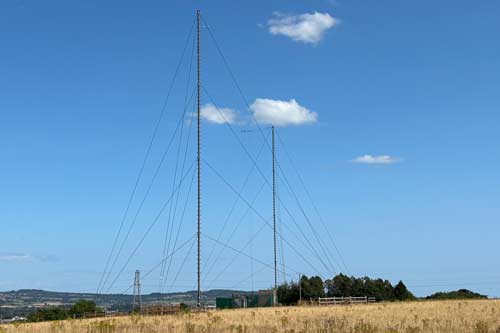
BBC Pearce's Hill AM broadcast station antenna
Often the tower is only part of the overall antenna system. Underneath them are vast radial earth networks - often miles of bare copper wire is buried just beneath the turf, extending outward from the transmitter base like the spokes of a wheel to provide a low-resistance path for ground currents.
The Gathering Shadows: Twilight of the AM Band
Nothing stays static in technology. By the late 20th century, the shortcomings of AM broadcasting became increasingly difficult to ignore. AM is inherently susceptible to electrical interference. The power lines, fluorescent lights, computers, digital displays, and wall-plug power adapters of modern life all produce electrical noise that manifests as crackles, hums, and buzzes on the AM band.
Furthermore, FM (Frequency Modulation) offered high-fidelity stereo sound free from static, making it the preferred choice for music. By the 21st century, the rise of DAB (Digital Audio Broadcasting), internet streaming, podcasts, and mobile apps delivered clear audio directly to listeners' devices without requiring an external antenna or a low-noise radio environment.
The European Shutdown
In Europe and the UK, the decline of AM has been swift and dramatic. High energy costs to run massive multi-kilowatt valve transmitters, combined with plummeting listenership, led public and commercial broadcasters to turn off their transmitters.
The BBC shut down numerous local medium wave transmitters, along with iconic long-wave outlets. Stations across France, Germany, the Netherlands, and Scandinavia have systematically decommissioned their historic antenna fields, felling towers that stood for over half a century to make way for digital-only distribution.
The European shutdown has had the advantage for many 'DX' listeners in Europe that they have the chance of hearing much more distant stations.
The Current Status in the USA
What is the state of AM in the United States? While it is certainly facing a decline, it has proven far more resilient than its European counterpart.
In America's vast rural geographic landscape, medium wave’s wide groundwave footprint remains essential. AM in the US transformed itself into the home of news, sports, and talk radio. Clear-Channel Class A stations—broadcasting at up to 50,000 Watts—still cover vast areas of the continent after sundown.
However, AM faces a major new battleground in North America: the automobile dashboard. As automobile manufacturers transition to Electric Vehicles (EVs), the high-frequency switching electronics in EV powertrains generate electromagnetic interference that disrupts AM reception. Several automakers began omitting AM radios from their new models entirely.
This sparked a major pushback from emergency management officials, rural communities, and radio advocates, leading to bipartisan legislative efforts in the U.S. Congress—such as the 'AM Radio for Every Vehicle Act' to mandate that automakers keep AM radio in passenger vehicles as a critical infrastructure safeguard for public emergency alerts. While listenership is lower than in its prime, AM radio in North America remains a vital safety net.
The Enduring Legacy
The legacy of AM broadcasting is woven into the fabric of modern world history. It was the medium that proved human speech could cross oceans without wires. It created the very concept of electronic mass media, shared national events, and commercial broadcasting networks.
Without AM radio, there would have been no golden age of live radio drama, no widespread distribution of early jazz, blues, and rock 'n' roll, and no blueprint for the television and digital media networks that followed. It pushed the boundaries of RF engineering, vacuum tube development, high-power transmitter design, and antenna theory.
1906: Fessenden Speech: First Audio Broadcast
1920s: 2MT, 2LO, KDKA: Birth of Public Radio Networks
1930s: Superhet Radios: Mass-Market Consumer Electronics
1960s: Transistor Revolution: Portable Personal Media
Today: Digital Audio: Built on AM Foundations
For those who grew up adjusting a smooth-feeling vernier dial in the dark, watching the soft orange glow of valves / vacuum tubes warm up behind a glass scale, the decline of AM broadcast radio brings a real sense of loss.
There was a genuine magic in tuning across a noisy medium wave band on a cold winter night—gently nudging the dial past a maze of static, heterodynes, and distant fading signals until a clear voice suddenly broke through from hundreds of miles away.
That warm, analogue connection across the ether was our first taste of a connected world, and though the great high-power towers may slowly fall silent, the faint echo of those distant voices will linger in our collective memory forever.
 Written by Ian Poole .
Experienced electronics engineer and author.
More History:
Radio history timeline
History of the radio
Ham radio history
Coherer
Crystal radio
Magnetic detector
Spark transmitter
Morse telegraph
Valve / tube history
PN junction diode invention
Transistor
Integrated circuit
Quartz crystals
Classic radios
Mobile telecoms history
Vintage mobile phones
Return to History menu . . .