Inside a Bluetooth Speaker: Electronics & Hardware Teardown Guide
Discover what's inside a Bluetooth speaker with our detailed teardown, exploring the circuit board, Bluetooth SoC, audio amplifier, and acoustics.
Bluetooth Tutorial / Summary Includes:
Bluetooth technology basics
How Bluetooth works
Bluetooth Classic: how it works
Bluetooth Low Energy: how it works
File transfer
Bluetooth profiles
Pairing & networking
Security
Bluetooth 2 EDR
How to connect Bluetooth devices
How to troubleshoot Bluetooth pairing problems
Loudspeaker teardown
Bluetooth loudspeakers have become ubiquitous household items, offering a convenient way to stream high-quality audio wirelessly from mobile phones, tablets, and laptops.
While these devices appear as seamless, self-contained enclosures from the outside, inside they house a surprisingly sophisticated mix of RF engineering, digital signal processing, power management, and acoustic design.
To see exactly how these compact devices work, I performed a teardown on a low-cost portable Bluetooth speaker to see exactly what was inside. Below, I break down the key mechanical and electronic subsystems—from the RF antenna trace to the Class-D audio amplifier and acoustic passive radiator—that allow these units to deliver impressive sound from a tiny footprint.
Watch the Full Bluetooth Speaker Teardown Video
Before diving into the detailed breakdown below, you can watch the complete step-by-step disassembly and board-level overview in our YouTube video:
Video: Bluetooth Speaker Teardown - The Electronics Inside a Wireless Speaker
One of the key stages is knowing how to get access toth e system. Often this is achieved by removing the front grill over the speakers themselves as you see in the video.
External Features & Enclosure Mechanical Design
Before opening the speaker, the external interface gives a clear indication of the features supported by its internal circuitry. Most budget-to-midrange portable Bluetooth speakers feature a rugged plastic or fabric-wrapped enclosure designed to minimize unwanted mechanical cabinet resonances.
- Control Interface: Top-mounted tactile switches for power, volume up/down, track skip, play/pause, and often a dedicated telephone call button may be included. The presence of the phone button indicates an integrated electret condenser microphone for hands-free speakerphone functionality.
- Rear I/O Panel: A micro-USB or USB-C port for battery charging, a 3.5 mm auxiliary (AUX) jack for wired stereo input, a standard USB-A port, and a MicroSD / TF card slot for direct local audio playback.
A notable aspect of the mechanical design is the complete absence of external screws. Manufacturers typically seal the outer housing using snap-fit plastic clips or rubberized bezels hidden beneath the front speaker grille.
Removing this outer mesh reveals the front baffle assembly, which houses the active acoustic transducers and passive bass radiator.
Acoustic System: Active Drivers & Passive Radiator
Once the front cover is pried away and the retaining screws are removed, the front acoustic baffle can be extracted. Portable wireless speakers rely on clever mechanical acoustics to produce acceptable low-frequency (bass) response within a cabinet that is far too small for traditional ported enclosures.
The acoustic setup consists of two primary elements:
- Dual Active Full-Range Drivers: Two small dynamic loudspeakers equipped with heavy ferrite or neodymium magnets, lightweight paper/polymer cones, and flexible rubber surrounds. These drivers handle the stereo mid-range and treble frequencies.
- Passive Radiator: Located between or alongside the active drivers, the passive radiator consists of a diaphragm without a voice coil or magnet assembly. It is acoustically tuned to react to the internal air pressure changes created by the movement of the active drivers, artificially boosting low-frequency extension (bass response) without requiring additional electrical power.
To prevent air leaks that would spoil the acoustic suspension, dense foam gaskets and synthetic acoustic insulation line the perimeter of the driver mounting frames and internal chamber walls.
The Main Printed Circuit Board (PCB) & System Architecture
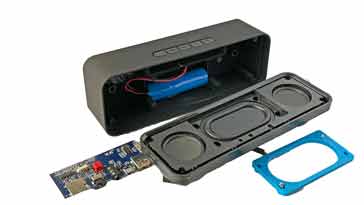
Extracting the internal assembly reveals the core electronics: a single main printed circuit board (PCB), a rechargeable lithium-ion battery cell, and interconnection wiring harnesses fitted with polarized, vibration-resistant locking connectors.
Despite the low cost of modern portable speakers, the main PCB is a highly integrated, surface-mount technology (SMT) board containing all system functions:
| Subsystem | Primary Components Identified | Functional Description |
|---|---|---|
| Bluetooth System-on-Chip (SoC) | Main Processor Chip, Quartz Crystal, PCB Trace Antenna | Handles 2.4 GHz RF transceiver, Bluetooth protocol stack, A2DP audio decoding, and auxiliary button scanning. |
| Audio Power Amplifier | Stereo Amplifier IC (often class-D for efficiency), Filtering Capacitors | Drives the left and right active loudspeaker drivers with high power efficiency to minimize thermal dissipation and extend battery life. |
| Power Management & Charging | Li-ion Charge Controller IC, Protection Circuitry, USB Port | Manages the 5V USB input, controls constant-current/constant-voltage (CC/CV) battery charging, and provides overcharge/over-discharge protection. |
| User Interface & Auxiliary I/O | Tactile Switches, Electret Microphone, MicroSD Slot, 3.5mm AUX Jack | Provides physical user controls, hands-free voice pickup, and wired/local audio input paths. |
1. Bluetooth SoC & RF Front-End
The core of the wireless system is a single-chip Bluetooth Controller / System-on-Chip (SoC). This integrated circuit combines a 2.4 GHz radio frequency (RF) transceiver, a baseband processor, and a digital signal processor (DSP). A dedicated quartz crystal resonator (typically operating at 26 MHz) provides the precise reference clock required for stable frequency-hopping spread spectrum (FHSS) communication in the 2.4 GHz ISM band.
Because Bluetooth is a two-way communication link, the antenna must transmit status signals (such as battery levels and media controls) back to the host device while continuously receiving the incoming digital audio stream. The RF antenna on this board is implemented directly as a meandering microstrip PCB trace antenna, eliminating the cost of a ceramic chip antenna.
2. Audio Signal Chain & Class-D Amplifier
Once the Bluetooth SoC decodes the incoming wireless data stream into analog audio signals (or receives analog input via the 3.5 mm AUX jack), the signal is routed to the audio power amplifier stage.
Virtually all battery-powered Bluetooth speakers utilize Class-D audio amplifiers. Unlike traditional Class-A or Class-AB amplifiers, which operate transistors in their linear regions and waste significant power as heat, Class-D amplifiers operate switches rapidly between fully ON and fully OFF states using pulse-width modulation (PWM). This yields power conversion efficiencies often exceeding 85% to 90%, which is critical for preserving battery capacity and avoiding the need for bulky metal heatsinks inside a sealed plastic enclosure.
The speaker output connections on the PCB feature dedicated differential driver lines (Left+, Left-, Right+, Right-) routed straight to a multi-pin connector harness that wires directly into the dynamic speaker voice coils.
3. Power Management & Battery Safety
Portability is provided by a single-cell cylindrical or pouch-type Lithium-ion (Li-ion) rechargeable battery, typically providing a nominal voltage of 3.7 V. Because Li-ion chemistry requires strict operational boundaries, safety is paramount during disassembly:
- Dedicated Charge Controller: A small power management IC handles the step-down conversion from the 5 V USB charging supply, executing a proper Constant Current / Constant Voltage (CC/CV) charging cycle.
- Over-Discharge & Short-Circuit Protection: A small protection module (often taped directly onto the battery cell casing) isolates the battery if the terminal voltage drops too low or if an external short circuit occurs.
Safety Warning: When servicing or taking apart any battery-powered consumer device, take extreme care around the Li-ion cell. Accidental short circuits across the battery leads or physical punctures can lead to thermal runaway.
Summary
While a modern Bluetooth loudspeaker is relatively inexpensive to purchase, its internal design represents a well-engineered balance between high-frequency RF design, modern Class-D audio amplification, efficient acoustic chamber tuning, and low-cost manufacturing.
By combining a single-chip Bluetooth SoC with modern surface-mount passive components and a passive radiator enclosure, manufacturers are able to deliver full-bodied stereo sound from a lightweight, handheld package.
 Written by Ian Poole .
Experienced electronics engineer and author.
Wireless & Wired Connectivity Topics:
Mobile Communications basics
2G GSM
3G UMTS
4G LTE
5G
Wi-Fi
Bluetooth
IEEE 802.15.4
DECT cordless phones
Networking fundamentals
What is the Cloud
Ethernet
Serial data
USB
LoRa
VoIP
SDN
NFV
SD-WAN
Return to Wireless & Wired Connectivity