The Ultimate Guide to TVS Diodes: Protecting Your Electronics from the Unseen
TVS diodes are one of the go-tos for protecting electronic circuits and their components from transient spikes that may appear on any external interface, but what are they and how do they work?
Home » Electronic components » this page
Diode Tutorial Includes:
Diode types
Diode specs & ratings
PN junction diode
Fast recovery diode
LED
PIN diode
Schottky barrier diode
SiC diode
Solar cell / photovoltaic diode
Transient voltage suppressor diode
Varactor / varicap
Zener diode
Diode component data:
PN junction diode data
Schottky diode data
Silicon carbide, SiC Schottky diode data
Modern electronic components are getting smaller, faster, and this means that they become more fragile and less robust when it comes to voltage spikes, however short lasted.
A microscopic surge of static electricity, something as simple as walking across a carpet and touching a charging port, can deliver a localized bolt of "lightning" that fries sensitive integrated circuits, or even other electronic components.
This is where the Transient Voltage Suppression (TVS) diode excels. It's basically a high speed protection device that can easily be added to any external lines to remove the transients.
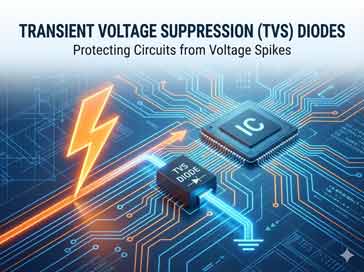
What is a TVS Diode?
A Transient Voltage Suppression or TVS Diode is a solid-state device specifically designed to protect sensitive semiconductors from the damaging effects of high transient voltages such as ESD or induced transients from switching spikes, lightning strikes (not direct!), etc.
Unlike standard diodes meant for rectification or Zener / reference diodes meant for voltage regulation, the TVS diode is built for speed and power.
As the transients by their nature are short lived, the diodes only dissipate these high power levels for a very short time.
Transient voltages are short-lived bursts of energy. They are characterized by a very fast rise time, typically reaching peak voltage in nanoseconds and they have a relatively short duration.
Despite their brevity, these spikes can reach thousands of volts—far beyond the withstand tolerance of a 3.3V or 5V processor or many other devices. In fact these days virtually all semiconductor devices and even some small resistors, capacitors and other devices are treated as static sensitive, and of course they are open to damage by other transient high voltage spikes.
Key Characteristics
It's worth taking a quick look at the highlight characteristics of these diodes:
- Response Time: Near-instantaneous (picoseconds to nanoseconds).
- Power Handling: High peak pulse power (P_{PP}) ratings, often ranging from 400W to 5000W+.
- Voltage Range: Available in "stand-off" voltages from 5V up to hundreds of volts.
It is also worth noting that there are thyristor TVS devices. These have slightly different characteristics and along with all thyristor type devices, they latch on until the voltage is removed. This means that they are not suitable for all situation, especially for use protecting power rails from transients as they will go short circuit until the power is removed.
How Does a TVS Diode Work?
The TVS diode is very similar to a Zener or voltage reference diode, although it is designed very differently to enable it to perform a very different purpose.
The "Off" State (Normal Operation): Under normal operating conditions, the TVS diode is "transparent" to the circuit. It is connected in parallel with the load it is protecting. As long as the circuit voltage remains below the diode’s Reverse Standoff Voltage (V_{RWM}), the diode maintains high impedance. It draws a negligible amount of "leakage current," allowing the circuit to function as if the diode weren’t there.
The "Clamping" Action (The Surge Hits): When a transient event occurs—such as an Electrostatic Discharge, ESD, or a nearby lightning strike—the voltage across the diode rises rapidly. Once it exceeds the Breakdown Voltage (V_{BR}), the TVS diode exceeds its reverse breakdown and current flows through it due to avalanche breakdown.
The diode’s resistance drops to almost zero instantly. This creates a low-impedance path that "shunts" the excess current away from the sensitive components and toward the ground.
The Clamping Voltage (VC): During the surge, the diode limits the voltage across the load to a specific, safe level called the Clamping Voltage (V_C). This is the maximum voltage the protected IC will ever "see" during the event.
Recovery: Once the energy of the pulse is dissipated, the TVS diode automatically resets. Its internal resistance returns to a high state, and the circuit resumes normal operation. This is a major advantage over fuses or varistors, which often need to be replaced after a single significant event.
Unidirectional vs. Bidirectional TVS Diodes
TVS diodes come in two primary configurations, and choosing the right one depends on the nature of your signal.
Unidirectional TVS Diodes
A unidirectional diode acts like a rectifier in the forward direction and a protector in the reverse direction. It is used in DC circuits where the signal only stays on one side of the zero-volt line (e.g., a 5V power rail).
Forward Direction: Functions like a standard diode (VF approx 0.7V). In this way it does not let the voltage stray more than -0.7V from the zero line.
Reverse Direction: Functions as the protector against surges. Reverse breakdown will protect the circuit above the specified voltage for the device.
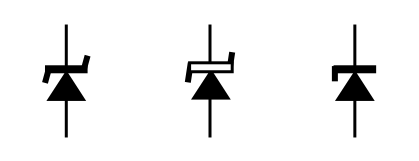
A number of different circuit symbols are used to denote the unidirectional TVS diode. Although the diode is basically an avalanche breakdown diode, very similar to a 'Zener' diode, its function is very different and it is optimised to provide its performance to suppress transients rather than provide a continuous steady state regulated voltage.
Bidirectional TVS Diodes
A bidirectional diode consists of two TVS diodes internally connected in series but with opposing polarities. These diodes are designed for AC circuits or high-speed data lines where the signal swings both positive and negative relative to the ground e.g., RS-485 or audio lines.
When the voltage rises above the breakdown voltage of the diode, one diode will conduct in reverse or avalanche breakdown and the second diode will conduct in the forward direction.
Bipolar protection: It protects against spikes in both the positive and negative directions. It will turn on above its designated voltage.
Acts equally on both polarities: The diode should perform equally for both polarities.
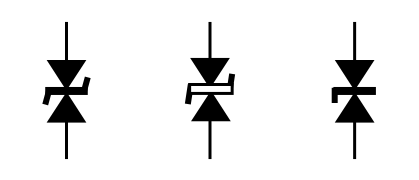
Like the unidirectional transient voltage suppressor diode, the bidirectional version also has a number of circuit symbols that are seen.
Where are TVS Diodes Used?
TVS diodes are found in almost every modern electronic device. Their versatility makes them the go-to choice for board-level protection.
Data and Communication Ports: High-speed data lines like USB, HDMI, and Ethernet are incredibly sensitive. Because these ports are frequently touched by human fingers (a prime source of ESD), TVS diodes are placed right at the connector to catch the spark before it travels into the motherboard.
Automotive Electronics: Cars are "electrically noisy" environments. Alternators, motors, and ignition systems create massive voltage spikes (known as "Load Dump"). TVS diodes protect the Engine Control Unit (ECU) and infotainment systems from these harsh conditions.
Power Supplies: TVS diodes are often placed across DC power input rails to prevent damage from "hot-plugging" (the spark that happens when you plug in a live adapter) or unstable power sources.
Industrial Control Systems: In factories, long cable runs for sensors and actuators can act like antennas, picking up electromagnetic interference (EMI) from heavy machinery. TVS diodes ensure these signals remain clean and the controllers remain alive.
Physical packaging
The packages for TVS diodes are generally divided by their power-handling capability. Higher power means more silicon area is needed to dissipate heat, resulting in a larger package.
High-Power / Power Supply Protection
These are large, two-terminal devices designed to handle high peak pulse currents (from hundreds to thousands of Watts) albeit for the short time of the transient.
SMA (DO-214AC): The smallest of the "big" power packages.
SMB (DO-214AA): A medium-sized workhorse found on power inputs.
SMC (DO-214AB): Large package for very high energy (lightning/industrial surges).
Small Signal / Data Line Protection
These focus on speed (low capacitance) and small footprints. They often come in arrays to protect multiple pins at once.
SOT-23 / SOT-363: Extremely common for protecting USB, RS-232, or CAN bus lines. One SOT-363 package can protect up to 5 data lines.
SOD-323 / SOD-523: Tiny, single-line diodes for space-constrained mobile devices.
DFN / QFN: Leadless packages used for high-speed signals (HDMI 2.1, USB4) because they have minimal parasitic inductance.
TVS Diodes vs. Back-to-Back Zener Diodes
This is a common point of confusion for many engineers. While a TVS diode is technically a type of Zener diode, they are optimized for completely different jobs. You might wonder: "Can’t I just use two standard Zener diodes back-to-back to protect my AC line?"
Technically, yes—but practically, it’s a bad idea for surge protection. Here is why:
1. The Design Philosophy
Zener Diode: Designed for Voltage Regulation. It is built to operate in the breakdown region for long periods to maintain a steady voltage. It focuses on precision and thermal stability.
TVS Diode: Designed for Transient Suppression. It is built to survive massive, momentary hits of power. It focuses on speed and energy absorption.
2. Peak Power Handling
The p-n junction of a TVS diode is significantly larger than that of a standard Zener. This larger surface area allows it to dissipate much more heat during a surge.
Comparison: A Zener might be rated for 1W of continuous power. A TVS diode of the same size might be rated for 600W of peak pulse power. If you hit a standard Zener with a 600W surge, it will likely "crater" or shatter.
3. Response Time
TVS diodes are engineered with lower parasitic capacitance and faster silicon chemistry. In the world of ESD, nanoseconds matter. A TVS diode will "clamp" faster than a standard Zener, which might be too sluggish to protect a high-speed processor.
4. Performance Comparison Table
| TVS diodes vs Zener diodes |
||
|---|---|---|
| Feature | TVS Diode | Back to Back Zener Diodes |
| Primary goal | Shunting high energy transients | Regulating steady state voltage |
| Response time | Extremely fas (ns or ps) | Slower |
| Power density | Very high short term pulse | Low - continuous |
| Failure mode | Usually fails short circuit (safe) | Can fail open - leaves load exposed |
| Capacitance | Optimised - can be low for data lines | Generally higher |
Key Parameters for Selecting a TVS Diode
When choosing a TVS diode for your project, look for these four specifications on the datasheet:
Reverse Standoff Voltage (VRWM): This should be equal to or slightly higher than your circuit's maximum operating voltage. If your rail is 5V, choose a 5V V_{RWM} diode.
Breakdown Voltage (VBR): This is where the diode starts to conduct. It’s usually about 10-15% above the V_{RWM}.
Clamping Voltage (VC): This is the most important "safety" number. Ensure that the V_C is lower than the Absolute Maximum Rating of the IC you are trying to protect.
Peak Pulse Power (PPP): Measured in Watts. The higher the number, the more "punishment" the diode can take before failing.
The TVS diode is a surprisingly important electronics component. It is a low-cost insurance policy that prevents sudden death in electronic products. By understanding the difference between Unidirectional and Bidirectional types, and recognizing why they outperform standard Zener diodes in high-stress situations, you can design more robust, reliable, and "bulletproof" hardware.
Whether you are designing a simple DIY project or a complex industrial controller, always ask: "Where is the surge coming from, and do I have a TVS diode standing in its way?"
Would you like me to help you calculate the specific TVS diode parameters for a particular circuit you are working on?
 Written by Ian Poole .
Experienced electronics engineer and author.
More Electronic Components:
Batteries
Capacitors
Connectors
ADC
DAC
Diodes
FET
Inductors
Memory types
Phototransistor
Quartz crystals
Relays
Resistors
RF connectors
Switches
Surface mount technology
Thyristor
Transformers
Transistor
Unijunction
Valves / Tubes
Return to Components menu . . .