A Comprehensive Guide to Thyristor Surge Suppressors, TSS
The Thyristor Surge Suppressor, TSS or the Thyristor Surge Protective Device TSPD is a crowbar style electronic component used to protect some lines against the effects of high voltage transients.
Home » Electronic components » this page
Triac, Diac, SCR Tutorial Includes:
Thyristor basics
Thyristor device structure
Gate turn off thyristor, GTO
Thyristor specifications
Thyristor surge suppressor, TSS
What is a triac
Triac specifications
Diac overview
Modern electronics circuitry is incredibly fragile. The very small feature sizes, the thin oxide layers and the general complexity of the devices means that they are very sensitive to transient high voltages - even for a very short time.
A stray lightning strike miles away, a sudden inductive kick from a motor, or even a person walking across a carpet can generate a voltage spike capable of turning a sophisticated piece of hardware into a high-tech paperweight.
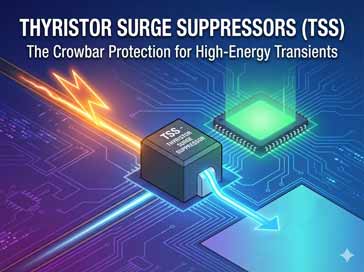
While many engineers are familiar with the standard TVS, Transient Voltage Suppression), diode, there is a more specialized, powerful, and often misunderstood component used when the stakes—and the energies—are higher: the Thyristor Surge Suppressor, TSS.
What is a Thyristor Surge Suppressor?
A Thyristor Surge Suppressor, often known by the brand name SIDACtor (a trademark of Littelfuse), is a solid-state, silicon-based protection device. Unlike standard diodes, it is a four-layer PNPN device.
At its core, a TSS is a crowbar device. While a standard TVS diode "clamps" a voltage (holding it at a specific level), a TSS "crowbars" the circuit—effectively creating a short circuit to ground once a certain threshold is exceeded. This allows it to shunt massive amounts of current away from sensitive components with very little heat buildup in the protector itself.
How it Works: The Physics of the Crowbar
To understand how a TSS works, we have to look at its V-I (Voltage-Current) characteristic curve. It is a tale of three distinct states:
The Off-State (High Impedance): During normal operation, the TSS acts as an open switch. It has a high "Off-state Voltage" (), where it draws only a tiny amount of leakage current (typically in the microamp range). From the perspective of your signal or power line, the device is essentially invisible.
The Breakover Point: As a voltage transient arrives, the voltage across the TSS begins to rise. Once it hits the **Breakover Voltage** (), the internal PNPN structure begins to avalanche. This is the "trigger" point. Unlike a TVS diode that enters a stable clamping state, the TSS's internal resistance collapses almost instantly.
The On-State (The Foldback): This is where the "thyristor" part of the name comes in. Once triggered, the voltage across the TSS "snaps back" or "folds back" to a very low value—usually between about 1V and 5V.
Because the voltage on which these devices are used is generally is now so low, the device can carry hundreds or even thousands of Amps of very short period surge current without dissipating much power.
If a TVS diode were to clamp a 200V surge at 50V, it would generate more heat as it clamps to just above the expected line voltage. By contrast a TSS drops that same surge to about 2V, keeping the component (and your PCB) much cooler.
However as the TSS is a latching device and it also reduces the voltage much more, it is only suitable for some situations.
Critical Parameters: The TSS Datasheet
When selecting a TSS, there are four variables that determine success or failure:
Peak Off-state Voltage: This must be higher than your maximum normal operating voltage. If your line runs at 48V, you want a of at least 58V to avoid accidental triggers.
Breakover Voltage: This is the maximum voltage your circuit will "see" before the TSS kicks in. It must be lower than the destruction threshold of the components you are protecting.
Holding Current: This is the most important parameter for safety. Once the surge is gone, the TSS will *stay* in its short-circuit state until the current flowing through it drops below the "Holding Current."
Off-state Capacitance: TSS devices are famous for having very low capacitance (often <50pF), which makes them ideal for high-speed data lines where a "fat" TVS diode would ruin the signal integrity.
In normal operation the TSS should be "invisible" in the circuit and until a voltage spike is present it's presence should not affect the circuit operation in any way.
Electrical parameters such as off-state leakage (IDRM), breakdown voltage (V(BR)) and capacitance should mean that the device has no effect on normal operation of the circuit.
The TSS breakdown voltage (V(BR)) is normally chosen to be 20% to 30% greater than the maximum repetitive off-state voltage (VDRM). In this way the device should not trigger until a real transient is seen. Note: VDRM is the normal operating voltage level.
The transition to on-state voltage mode is initiated at the device's maximum breakover voltage (V(BO)).
Once the TSS is in on-state conduction, the current through TSS device needs to be interrupted or drop below minimum holding current (IH) to restore it to its non-conductive state after the transient has subsided.
Where are TSS Devices Used?
TSS devices aren't used everywhere because they are specialized electronic components which are suitable for environments prone to high-energy, long-duration surges. Other devices like the transient suppressor diodes or varistors, MOVs are more suitable for other circuit designs.
Transient surge suppressors are widely used in a number of applications including:
Telecommunications (The Classic Use Case): Telecom lines (POTS, DSL, SLICs) are essentially miles of copper wire acting as giant antennas for lightning. Because these lines carry high-voltage AC ring signals (up to 90V or more), a standard TVS diode would be too bulky and have too much capacitance. TSS devices provide the high-energy "crowbar" needed to survive a nearby lightning strike while keeping data rates high.
Ethernet, & PoE (Power over Ethernet): PoE is particularly tricky because it combines high-speed data with 48V power. Engineers use low-capacitance TSS arrays to protect the sensitive Ethernet transformers and PHY chips from surges induced on the long CAT5 / Cat6 / Cat7 etc cables.
DSL: The low capacitance of te TSS device prevents signal degradation in high-speed data streams.
Industrial Control & RS-485: Industrial environments are another classic environment where TSSs are particularly useful. Here, long data cables often run alongside high-voltage power lines. Inductive switching from giant motors can create massive transients. TSS devices are used here because they can handle repeated hits without degrading, unlike some other technologies like Metal Oxide Varistors, MOVs.
Security Systems: Protecting long-run sensor wires that are prone to induced surges.
TSS vs. TVS: Which One Should You Choose?
Although it is often thought that transient voltage suppressor diodes, TVSs, and Thyristor surge suppressors, TSSs, are similar and either can be used in any circuit, this is not the case. They are very different devices wth different characteristics and should be used in different situations and circuits.
The summary below gives the highlight characteristics and applications for both.
| Comparison of Transient Voltage Suppressor Diodes & Thyristor Surge Suppressors |
||
|---|---|---|
| Feature | TVS Diode | Thyristor Surge Suppressor, TSS |
| Action | Clamping (holds voltage constant) | Crowbar (drops voltage to near-zero) |
| Heat Dissipation | High (must absorb energy) | Low (shunts current at low voltage) |
| Capacitance | Generally higher | Generally low |
| Reset Behaviour | 'Resets' automatically | Requires current to drop below holding current |
| Suitability | Low-energy ESD / Local power rails | High-energy surges / Long data lines |
The Danger of "Latch-Up"
The biggest risk when using a TSS is what is called latch-up. Because the TSS only resets when the current falls below the Holding Current, you cannot use a TSS on a high-current DC power rail.
If you put a TSS on a 12V, 10A power supply and a surge triggers it, the TSS will drop the voltage to about 2V and start pulling as much current as the power supply can give. Since 10A is almost certainly higher than the (usually 50mA to 150mA), the TSS will never turn off. It will stay shorted until the power supply shuts down or the TSS is destroyed.
Rule of thumb: Only use TSS devices on lines where the current is naturally limited or where the signal is AC (which crosses zero current twice per cycle, automatically resetting the TSS).
The Thyristor Surge Suppressor is the ultimate "safety valve" for high-reliability communication and industrial systems. By utilising the physics of the thyristor to fold back voltage, it provides a level of power handling and signal transparency that standard diodes simply cannot match.
While they require a bit more care in design—specifically regarding the holding current—they are the reason our phone lines, internet, and industrial sensors can survive the violent electrical environment of the real world.
 Written by Ian Poole .
Experienced electronics engineer and author.
More Electronic Components:
Batteries
Capacitors
Connectors
ADC
DAC
Diodes
FET
Inductors
Memory types
Phototransistor
Quartz crystals
Relays
Resistors
RF connectors
Switches
Surface mount technology
Thyristor
Transformers
Transistor
Unijunction
Valves / Tubes
Return to Components menu . . .