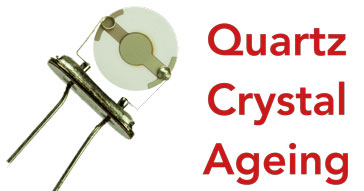
Quartz Crystal Ageing: long term stability & accuracy
The resonant frequency of quartz crystal resonators moves by a small amount over time in a process called ageing.
Home » Electronic components » this page
Quartz Crystals, Xtals Tutorial Includes:
Quartz crystals: xtals
What is quartz
How a crystal works
Crystal overtone operation
Quartz crystal frequency pulling
Quartz crystal cuts
Quartz ageing
Crystal resonator manufacture
How to specify a quartz crystal
Load capacitance calculations
VCXO
TCXO
OCXO
Crystal filter
Monolithic crystal filter
Ceramic resonator & filter
Ceramic filter specifications
Quartz crystals age with time and this is a fact that has to be considered when selecting a quartz crystal resonator and designing a circuit using one.
Understanding the mechanisms behind quartz crystal ageing is essential for any engineer involved in frequency control, precision timing, or RF design.
While quartz resonators are celebrated for their exceptionally high Q factor and stability, they are not static components.
Over time, their resonant frequency undergoes a permanent, cumulative change known as ageing. This guide explores the mechanisms, factors, and design strategies involved in managing this phenomenon, incorporating industry-standard whitepaper insights and established best practices.
What is Quartz Crystal Ageing?
At its most fundamental level, ageing refers to the long-term frequency change of a crystal over a period of years.
While these variations are typically small—often measured in parts per million (ppm)—they are permanent.
For applications like microprocessor clocks, a few ppm of drift might be negligible; however, in precision communications, GPS synchronization, or high-stability filters, ageing can lead to system-level failures if not properly accounted for.
It is important to distinguish between frequency changes as a result of ageing from from the frequency changes and errors caused by temperature stability or calibration tolerance.
While temperature stability describes a reversible change in frequency due to environmental thermal shifts, ageing is a one-way path of drift that occurs even if the environmental conditions remain constant.
Primary Mechanisms: Why do Crystals Age?
Research into crystal behaviour has identified two primary drivers for the frequency changes from ageing: Mass-Transfer and Mechanical Stress.
A. Mass-Transfer and Contamination
The resonant frequency of a quartz resonator is directly tied to the physical mass of the quartz blank.
This means that any unwanted addition or removal of material from the surface of the quartz blank will alter its resonant frequency.
Contamination Sources: Any microscopic debris or gas molecules inside the hermetically sealed package can affect the crystal. For example, conductive epoxy used to mount the quartz blank can "out-gas" over time. This process releases oxidizing material into the otherwise inert atmosphere of the package, which then deposits on the blank or electrodes, increasing mass and lowering the frequency.
Manufacturing Hygiene: To combat this, high-precision crystals are manufactured in ultra-clean environments. Stages like final dimensioning and chemical etching are used to remove traces of abrasive lapping pastes that might otherwise trap gas molecules.
During manufacture quartz crystal resonators are normally encapsulated in an inert gas environment. A very good seal on the encapsulation is needed so that other gases do not enter.
Also the final stages of the preparation of the crystal blank must be prepared as finely as possible. Rather than lapping the blank to bring it to the right dimensions, chemical etching is used. In this way the minimum disruption is caused to the crystal lattice, and this reduces the ingress of contaminants over time that will cause ageing.
B. Mechanical Stress and Relaxation
Quartz is a piezoelectric material, meaning mechanical stress and electrical signals are intimately linked.
Stress Points: Stress can originate from multiple components within the device, including the quartz blank itself, the epoxy adhesive, the mounting structure, and the metal electrodes.
Thermal Expansion Mismatch: During operation, heating and cooling cycles induce stress because these different materials have varying expansion coefficients.
Long-Term Relaxation: Over months and years, these internal stresses slowly "relax" or settle. As the system relaxes, the mechanical tension on the quartz changes, leading to a corresponding shift in frequency. The development of the SC-cut (Stress Compensated) crystal was specifically aimed at reducing frequency changes caused by this type of mechanical stress.
External Factors Affecting Ageing Rates
While internal physics drive ageing, the way a crystal is used in a circuit significantly influences how fast that ageing occurs.
Temperature Effects: Crystal ageing is highly sensitive to temperature; it occurs much more rapidly at higher operating temperatures. Reducing the required temperature range or maintaining a steady, lower temperature can effectively slow the rate of drift.
Drive Levels: The power applied to the crystal by the oscillator circuit, known as the "drive level," is a major factor. High drive levels cause more intense mechanical vibrations, which can accelerate wire fatigue, frictional wear at mounting points, and surface changes. Keeping drive levels low is a standard design recommendation to minimize ageing.
Drive Level Dependence (DLD): In some cases, if the drive level is too low, the crystal may fail to start or may exhibit "jumps" in frequency, a phenomenon known as Drive Level Dependence.
Ageing in Practice: The Decay Curve
One of the most critical insights for designers is that quartz crystal ageing is not a linear process.
As expected the rates of change of the crystal frequency vary with the time after manufacture. The maximum rate of change of frequency occurs immediately after manufacture and decays thereafter.
As a guide it is found that it is fastest within the first 45 days of operation. Even so there is always some degree of ageing throughout the life of the crystal. In view of the fact that the greatest rate of change is immediately after manufacture, high tolerance items are run for some time before being shipped. In very high tolerance items this may extend to a few months of operation.
Once the ageing rate has settled it is found that typical figures can be quoted for many types. It is found that one of the main variations is the type of encapsulation that is used.
The two most common methods of encapsulation for through-hole crystals are resistance weld and cold weld. These will typically give figures of around ±5 parts per million (ppm) for a resistance weld sealed encapsulation, and ±2 ppm for a cold weld sealed encapsulation using an HC43/U holder.
These both move in a downward direction. Glass encapsulated crystals may also be found on some occasions. These tend to move in an upward direction, and may have a tolerance or slightly less than ±5 ppm. Also there is a wide variety of surface mount crystals. A typical plastic package or a glass seam weld package may give around ±5 ppm while a metal seam weld package may give less than ±3 ppm.
Understanding Specifications: A crystal specified with an ageing rate of ±5ppm per year does not necessarily mean it will drift by ±25ppm after five years.
The Logarithmic Trend: It is common for a device to exhibit ±1ppm to ±2ppm of drift in the first year, with the rate significantly reducing in subsequent years. A useful "guide-rule" in the industry is to expect a maximum of ±10ppm over a 10-year period for standard crystals, though high-quality units often perform much better than this. Even then most of the ageing will occur in the first year, and it will be much less in subsequent years.
Accelerated Ageing and Testing
Because engineers cannot wait ten years to verify a design, the industry uses accelerated ageing tests to predict long-term performance.
The High-Temp Soak: By soaking a crystal at an elevated temperature—typically +85°C for 30 days—manufacturers can simulate approximately one year of ageing at normal room temperature.
Extrapolation: The data collected during these 30-day tests can be plotted and extrapolated to predict the frequency movement several years into the future. These tests are usually performed using passive methods (unpowered) to focus specifically on material and stress-related ageing.
Design Strategies for Frequency Management
When designing a circuit, the engineer must decide whether the ageing of a specific crystal is a threat to the system's performance.
A. Frequency Adjustment and Trimming
For high-precision applications using quartz oscillators like VCXOs (Voltage-Controlled), TCXOs (Temperature-Compensated), or OCXOs (Oven-Controlled), the ageing drift effectively changes the crystal's frequency tolerance.
Real-Time Correction: These specialized oscillators allow the output frequency to be adjusted or "trimmed" back to its nominally specified value using an external control voltage or digital interface.
B. Assessing Design Margins
The importance of ageing is relative to the total frequency allowance of the system.
High-Precision Scenarios: If a design uses a TCXO with ±1ppm stability, even a small amount of ageing becomes significant and must be kept at relatively small values.
Low-Precision Scenarios: If the total frequency movement allowance for a system is, for example, ±100ppm, and a device with a rating of ±50ppm is selected, the extra ±10ppm from a decade of ageing can effectively be ignored.
Summary of Best Practices for Minimizing Ageing
To ensure the longest possible life and maximum stability for a crystal resonator, designers and manufacturers should adhere to the following:
Manufacturing: Ensure ultra-clean environments to prevent mass-transfer contamination.
Circuit Design: Maintain low drive levels to reduce mechanical stress and fatigue.
Thermal Management: Keep the crystal at a steady temperature; avoid high-heat environments where possible.
Physical Care: Do not damage the hermetic seal or bend pins, as this can introduce moisture or contaminants.
Component Choice: Select stress-compensated (SC) cuts for applications where mechanical stress is a primary concern.
Quartz crystal ageing is an inevitable physical reality, but it is also a highly predictable one. By understanding that ageing is driven by mass-transfer and stress relaxation, and by leveraging accelerated testing data, engineers can build robust systems that remain accurate over years of service.
Whether through choosing the right crystal cut, implementing frequency trimming, or simply allowing for sufficient design margin, the effects of ageing can be effectively managed to ensure long-term stability and reliability.
 Written by Ian Poole .
Experienced electronics engineer and author.
More Electronic Components:
Batteries
Capacitors
Connectors
ADC
DAC
Diodes
FET
Inductors
Memory types
Phototransistor
Quartz crystals
Relays
Resistors
RF connectors
Switches
Surface mount technology
Thyristor
Transformers
Transistor
Unijunction
Valves / Tubes
Return to Components menu . . .