Resistor Colour Code
The resistor colour code has been in use for many years for leaded resistors and gives an easy method of marking their value and tolerance in the component body.
Home » Electronic components » this page
Resistor Tutorial Includes:
Resistors overview
Carbon composition
Carbon film
Metal oxide film
Metal film
Wirewound
SMD resistor
MELF resistor
Variable resistors
Light dependent resistor
Thermistor
Varistor
Resistor colour codes
SMD resistor markings & codes
Resistor specifications
Resistor maximum voltage
Where & how to buy resistors
Standard resistor values & E series
The common tubular leaded resistors with coloured bands around them have been a central part of electronics technology formany years, and they will continue to be so for very many years to come.
But what do the coloured bands mean, and how can the key information about the resistor that they carry be decoded?
Interesting story of the resistor colour codes
The resistor colour code was born out of necessity in the 1920s, developed by the Radio Manufacturers Association (RMA) in the United States.
Before this standardisation, individual manufacturers used their own proprietary marking systems, which made cross-referencing components nearly impossible for early radio engineers and hobbyists.
The decision to use colours rather than printed alphanumeric characters was a masterclass in practical engineering: resistors were becoming so small that printing legible text was technically difficult and costly.
Furthermore, printed numbers could easily be obscured or rubbed off during the soldering process, whereas a colour marking provided a robust, 360-degree identification method.
In its earliest form, the system did not use the familiar parallel bands we see today. Instead, it utilized a "Body-End-Dot" (also known as the Body-Tip-Dot) configuration.
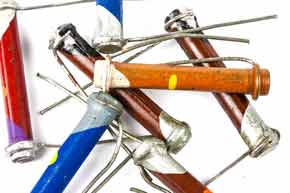
In this antique scheme, the entire body of the resistor was painted one colour to represent the first digit; one end was painted a different colour for the second digit, and a small dot in the center of the body acted as the multiplier.
While this was an improvement over text, it still had flaws—specifically, if the resistor was mounted with the dot facing the circuit board, the value was hidden.
As manufacturing processes improved, the industry transitioned to the modern "band" system, which ensured the value remained visible regardless of the component's orientation.
Formal international standardization followed in the post-war era to ensure global compatibility. The code was officially codified by the International Electrotechnical Commission (IEC) in 1952 as IEC 62 (now IEC 60062) and was later adopted as the EIA RS-279 standard in 1963.
Throughout the 20th century, the organization overseeing the standard changed names several times—from the RMA to the RTMA, then RETMA, and finally the Electronic Industries Alliance (EIA).
Despite these organizational shifts and the rise of surface-mount technology (SMT), the core "ROY G. BIV" inspired colour sequence has remained a foundational language of electronics for nearly a century.
Resistor colour code basics
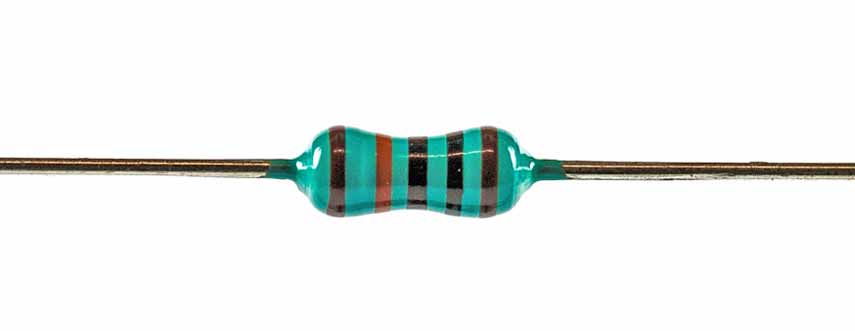
There may be three four or even five rings. These rings have values as shown in the table below. The first two indicate the significant figures in the value. The second is a multiplier and shows the power of ten to which the significant figures must be multiplied. As an example if a resistor had the rings yellow, purple, red these would correspond to the values 4, 7, 2, indicating a resistance of 47 x 10^2 or 4700 ohms. It can be seen from this that the third ring corresponds to the number of zeros after the significant figures.
The fourth ring if it is present shows the tolerance, i.e. how accurate the resistor is. This is indicated as a percentage. Many resistors today are either 2% or 5%. This means that their value will be within 2% or 5% of the stated value. Years ago most resistors were only 20%, although even today tolerances of this order are quite acceptable for many situations.
The fifth ring, again if it is present, indicates the temperature coefficient. As the value of a resistor will change with temperature this may be important in some situations. This information may be added in the fifth ring on the resistor. These figures are quoted in ppm/C i.e. parts per million per degree C. In other words a 1 kohm resistor with a 100 ppm temperature coefficient would change by 0.1 ohms for every degree Celsius it changes.
| Colour | Digit 1 | Digit 2 | Digit 3 | Multiplier | Tolerance |
|---|---|---|---|---|---|
| Black | 0 | 0 | 0 | x 1 | |
| Brown | 1 | 1 | 1 | x 10 | ± 1% |
| Red | 2 | 2 | 2 | x 100 | ± 2% |
| Orange | 3 | 3 | 3 | x 1k | |
| Yellow | 4 | 4 | 4 | x 10k | |
| Green | 5 | 5 | 5 | x 100k | ± 0.5% |
| Blue | 6 | 6 | 6 | x 1M | ± 0.25% |
| Violet | 7 | 7 | 7 | x 10M | ± 0.1% |
| Grey | 8 | 8 | 8 | ± 0.05% | |
| White | 9 | 9 | 9 | ||
| Gold | x 0.1 | ± 5% | |||
| Silver | x 0.01 | ± 10% |
Vintage body-end-dot system
The "Body-End-Dot" system is an essential piece of knowledge for anyone restoring vintage radios or working with pre-WWII electronics.
While it uses the same colour values as the modern band system, the physical application is quite different.
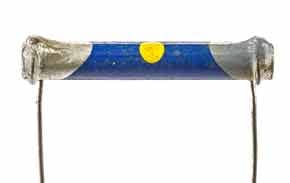
In this scheme, you read the component in the following order:
Body Colour: The main colour of the resistor represents the first digit.
End (Tip) Colour: The colour on one end of the resistor represents the second digit.
Dot Colour: A small dot or band in the centre represents the multiplier (number of zeros).
Using the colour table above: Blue (Body) = 6, Grey (End) = 8, Yellow (Dot) = x 10k (104).
This means that the value is calculated as 68 × 10,000 = 680,000 Ω i.e. 680 kΩ (680 kilohms).
It's worth mentioning that no resistors using this scheme are manufactured today, but they may be encountered with vintage wireless and electronic equipment.
The resistor colour coding system has been widely used for very many years and will be continued to be used for many years to come. As such it is worth understanding it and also memorising the values for the different colours or having a handy chart to hand.
 Written by Ian Poole .
Experienced electronics engineer and author.
More Electronic Components:
Batteries
Capacitors
Connectors
ADC
DAC
Diodes
FET
Inductors
Memory types
Phototransistor
Quartz crystals
Relays
Resistors
RF connectors
Switches
Surface mount technology
Thyristor
Transformers
Transistor
Unijunction
Valves / Tubes
Return to Components menu . . .