Calculating Load Capacitance for Quartz Crystal Resonators
The load capacitance of a parallel resonant quartz crystal resonator is an important, but often misunderstood value required in its specification and purchase.
Home » Electronic components » this page
Quartz Crystals, Xtals Tutorial Includes:
Quartz crystals: xtals
What is quartz
How a crystal works
Crystal overtone operation
Quartz crystal frequency pulling
Quartz crystal cuts
Quartz ageing
Crystal resonator manufacture
How to specify a quartz crystal
Load capacitance calculations
VCXO
TCXO
OCXO
Crystal filter
Monolithic crystal filter
Ceramic resonator & filter
Ceramic filter specifications
When designing circuits using quartz crystal resonators one of the common issues is how to determine the paralle capacitance value needed.
This capacitance is required to bring crystals operating in their "parallel resonant" mode to resonate on exactly the right frequency.
Get the wrong capacitance and the crystal will run off frequency and not give the expected output, so it's really important to understand how to determine the parallel capacitance required.
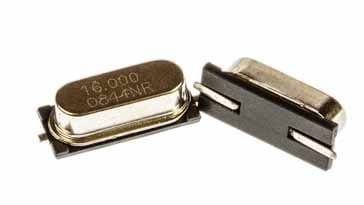
What is Load Capacitance (CL)
The reason that a crystal running in parallel mode needs the correct load capacitance is simple.
The overal resonant circuit for a crystal running in a parallel resonant mode includes the load or external capacitance seen by the crystal. Its frequency is determined by the combination of the quartz blank and the external Load Capacitance (CL).
When a manufacturer specifies a crystal as "25.000 MHz at 18pF," it means the crystal will vibrate at exactly 25 MHz only if the total capacitance in the oscillator circuit equals 18pF.
To understand why this occurs, it is worth looking at the equivalent circuit for a quartz crystal resonator.
In the series resonant mode, the components C and and L act in series with one another and the resistance R reflects the losses which are normally very low.
In the parallel mode
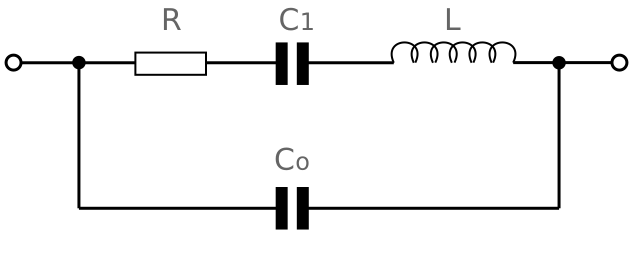
It is possible to equate these theoretical constituent components to real physical attributes of the crystal:
- L: The inductance arises from the mass of the material.
- C: This capacitance arises from the compliance of the crystal.
- R: This element arises from the losses in the system. The largest of these arises from the frictional losses of the mechanical vibration of the crystal.
- Co : This capacitance in the theoretical quartz crystal equivalent circuit arises from the capacitance between the electrodes of the crystal element. This is often refered to as the shunt capacitance.
When operating in this mode it will be seen that any capacitance introduced by the external circuit will also have an effect and be in parallel with C0.
As a result this 'load' capacitance forms part of the specification for the operation of the crystal and its value needs to be incorporated into the calculations.
The crystal must have the correct load capacitance for it to be able to operate as required.
Oscillator calculations
The actual calculations and the hints, tips and points to note vary according to the type of oscillator used.
The most common types of oscillator used with quartz crystals are the Pierce oscillator which is very popular for use in processor and logic circuits where a single inverter stage can be used as the active element, and the Colpitts oscillator which is found more often in RF applications.
These oscillator topologies will be viewed separately:
1. Load Capacitance in the Pierce Oscillator
The Pierce oscillator is the industry standard oscillator circuit for microprocessors and digital ICs due to its excellent stability and low power consumption.
In a Pierce oscillator, the crystal is connected across an inverter . C1 and C2 are connected from each terminal of the crystal to ground.
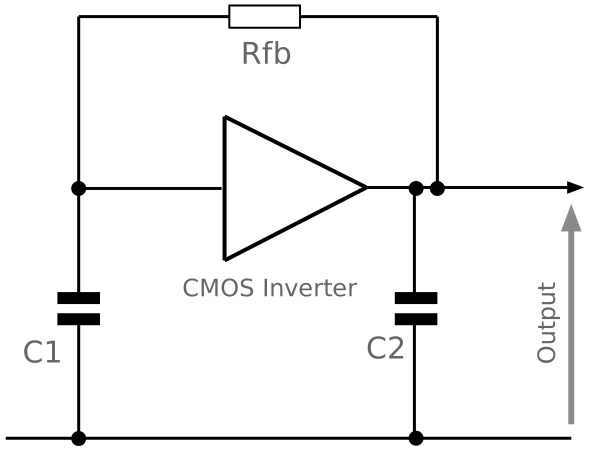
Where:
C1 = crystal capacitor - see note below
C2 = crystal capacitor - see note below
Cstray = the stray capacitance in the remainder of the circuit, PCB track, IC or transistor pin, etc and this might typically be 2 - 5pF.
C1 and C2 are the capacitors found in a Pierce Oscillator circuit. This is the type used by almost every microcontroller and digital IC. The crystal is connected between two pins (typically XTAL-IN and XTAL-OUT). C1 and C2 are connected from each of those pins directly to Ground.
When calculating and selecting the various values there are some useful points to note:
Balance: In almost all cases, you should use the same value for both (C1=C2). This keeps the oscillator symmetrical and stable.
Selecting the value: If you know your crystal requires a load capacitance (CL) of 10pF, and you estimate your stray PCB capacitance (Cstray) is 4pF, you would solve for C1 and C2. In this case, C1 and C2 would both need to be roughly 12pF.
Rounding: If your calculation results in a non-standard capacitor value (like 13.4pF), it is usually safest to round to the nearest standard value (like 12pF or 15pF).
2. Load Capacitance in the Colpitts Oscillator
The Colpitts oscillator is frequently used in RF applications and discrete transistor designs. It is identified by its characteristic capacitive voltage divider.
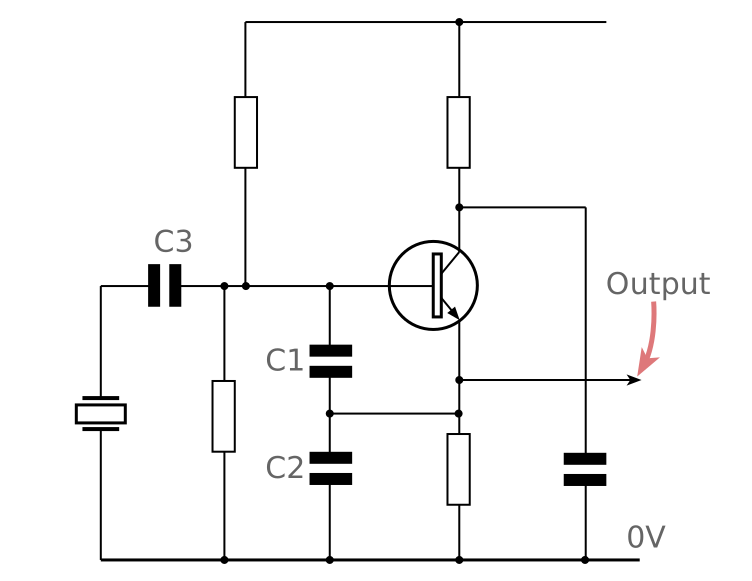
In a Colpitts design, the two capacitors C1 and C2 are in series with each other across the crystal.
One of these capacitors is often in parallel with the transistor’s internal junctions.
The formula for calculating the loadcapacitance remains broadly the same, but Cstray is often higher in Colpitts designs because the transistor's input capacitance (Cbe or Cgs) must be added to the value of one of the capacitors.
Where:
C1 and C2 are the capacitor values shown ont he circuit
Cin is the input capacitance of the transistor
Ctrace is the spurious capacitance of the PCB, component pins, etc.
Design Tip: Because the transistor's internal capacitance can change with temperature, Colpitts oscillators sometimes exhibit more "drift" than Pierce designs unless high-quality NP0/C0G capacitors are used.
Stray capacitance Cstray
No circuit is free from stray levels of capacitance. Every PCB trace, IC pin, and solder pad adds a tiny bit of capacitance. These need to be accommodated in any calculations.
PCB Traces: Typically add 0.5pF to 1pF per inch.
IC Pins: Typically add 2pF to 5pF.
Rule of Thumb: Most engineers use a value between 3pF and 5pF for Cstray when performing initial calculations.
If your frequency is consistently too low, it means your actual CL is too high (likely due to underestimated stray capacitance). For a Pierce oscillator configuration, try reducing reduce the values of C1 and C2 to compensate.
Summary Table
| |
|||
|---|---|---|---|
| Oscillator Type | Typical CL | Typical Usage | Sensitivity |
| Pierce | 8 - 20pF | Microcontrollers & digital circuits) | Low (very stable) |
| Colpitts | 12 - 30pF | Discrete high frequency RF circuits | Moderate, depends on transistor, etc |
 Written by Ian Poole .
Experienced electronics engineer and author.
More Electronic Components:
Batteries
Capacitors
Connectors
ADC
DAC
Diodes
FET
Inductors
Memory types
Phototransistor
Quartz crystals
Relays
Resistors
RF connectors
Switches
Surface mount technology
Thyristor
Transformers
Transistor
Unijunction
Valves / Tubes
Return to Components menu . . .